






Bengaluru Startup Voxelgrids Is Changing the Story of MRI Machines in India
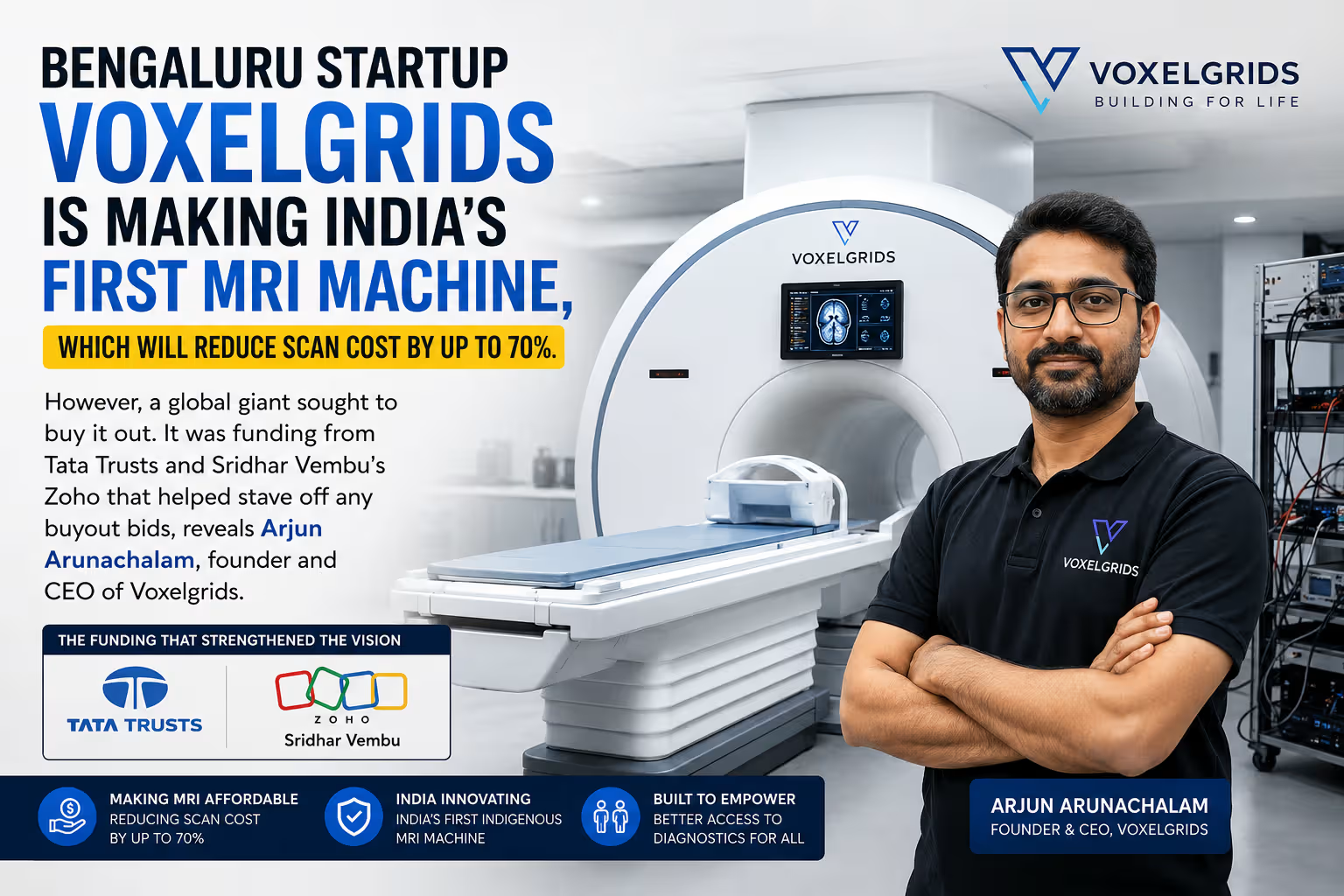
Voxelgrids MRI machine For millions of Indians, an MRI scan can be an essential step between a medical problem and a correct diagnosis. Yet access to MRI technology remains uneven. Large hospitals in major cities may have multiple scanners, while smaller towns and rural areas can struggle with availability, high equipment costs, maintenance requirements and limited specialist infrastructure.
That is the problem Bengaluru-based deep-tech company Voxelgrids Innovations has spent years trying to solve.
The company is developing a homegrown 1.5 Tesla MRI scanner designed around a very different philosophy: make advanced medical imaging more affordable, compact, energy-efficient and easier to deploy.
The story becomes even more interesting because Voxelgrids was not simply another startup looking for the highest possible valuation. According to founder and CEO Arjun Arunachalam, the company faced a buyout approach from a global MRI player during a difficult period. Instead of selling, the team continued with support from organisations including Tata Trusts and Zoho.
That decision matters because MRI technology is not just another consumer product. It sits at the intersection of healthcare, engineering, software, manufacturing and national technological capability.
Voxelgrids’ own history shows that the project began with support from Tata Trusts’ Foundation for Innovation and Social Entrepreneurship and later received grants from organisations including BIRAC. In 2021, Zoho invested $5 million in the company as part of its Series A funding.
The result is a remarkable Indian deep-tech journey: an engineering team attempting to build sophisticated MRI technology domestically instead of relying entirely on imported systems.
And the potential impact goes beyond one company.
If MRI equipment becomes substantially cheaper to purchase and operate, diagnostic centres could potentially expand into locations where expensive conventional systems are difficult to justify.
What Is Voxelgrids?
Voxelgrids Innovations is a Bengaluru-based medical technology company focused on MRI systems.
Its stated mission is straightforward: develop state-of-the-art MRI scanners that are more affordable and accessible.
The company works across several technically demanding areas, including:
- MRI magnet technology
- Electromagnetics
- Gradient coils
- RF antennas and body coils
- MRI spectrometers
- Pulse-sequence development
- Image reconstruction
- Embedded software
- Scanner engineering
- Patient-handling systems
Voxelgrids currently describes its technology as compact, lightweight and full-body capable, with a focus on affordability.
That combination is important.
Building an MRI scanner is considerably more complicated than assembling a conventional medical device. A complete system requires expertise in physics, electrical engineering, radio-frequency systems, cryogenics or magnet technology, mechanical engineering, software and image reconstruction.
The company’s development journey illustrates precisely how difficult this type of deep-tech project can be.
According to Voxelgrids, founder Arjun Arunachalam first worked on MRI-related intellectual property while in Singapore. In 2016, he approached Tata Trusts with a proposal to build cost-effective MRI scanners in India. The Trusts introduced him to the Foundation for Innovation and Social Entrepreneurship, where the early team began its work.
A prototype was subsequently deployed at Sri Sathya Sai Institute of Higher Medical Sciences in Bengaluru in 2017, with the first images produced in March 2018.
This was not an overnight startup success story.
It was years of research, prototyping, testing, fundraising and engineering.
Why Does India Need an Indigenous MRI Machine?
The importance of Voxelgrids becomes clearer when we look at the economics of MRI.
MRI—or magnetic resonance imaging—is one of the most powerful diagnostic imaging technologies used in modern medicine. Unlike X-rays and CT scans, MRI does not use ionising radiation.
It can provide detailed images of soft tissues and is widely used in areas such as:
- Neurology
- Orthopaedics
- Oncology
- Spine imaging
- Abdominal imaging
- Cardiac imaging
- Musculoskeletal diagnosis
- Soft-tissue evaluation
The problem is not the usefulness of MRI.
The problem is access.
A conventional MRI system can involve a large capital investment, specialised infrastructure, significant electricity consumption, installation requirements and maintenance costs.
Tata’s documentation on Voxelgrids has previously highlighted the company’s goal of reducing both the capital and operating burden associated with MRI. Its earlier 1.5 Tesla system was described as weighing about 2.3 tonnes, compared with roughly 4–6 tonnes for conventional systems, while consuming substantially less power.
The same Tata account reported an equipment cost of approximately ₹3.5 crore at that stage, compared with ₹5–8.5 crore for conventional MRI systems, along with a claimed 60% reduction in cost per scan.
These figures are from earlier stages of the technology’s development and should not be interpreted as today’s universal market prices.
But they demonstrate the fundamental idea behind Voxelgrids.
The company is trying to change the cost structure of MRI rather than simply sell another MRI machine.
How Much Could Voxelgrids Reduce MRI Scan Costs?
This is one of the most important questions surrounding the startup.
Recent reports and discussions around Voxelgrids have highlighted the possibility of reducing MRI scan costs by up to 70%.
However, it is important to distinguish between the potential reduction in the cost structure of the technology and the final price a patient pays.
The price of an MRI scan depends on much more than the machine itself.
It can include:
- Equipment financing
- Hospital infrastructure
- Electricity
- Maintenance
- Technician costs
- Radiologist fees
- Facility costs
- Consumables and associated services
- Financing and depreciation
- Hospital operating margins
Therefore, a cheaper MRI scanner does not automatically mean that every MRI scan in India will become 70% cheaper.
The more realistic way to understand the claim is that a substantial reduction in equipment and operating costs can create the conditions for significantly cheaper diagnostic imaging.
Earlier Tata material described a target of cutting MRI scan costs by a factor of three and reported a 60% reduction in cost per scan for the technology at that stage.
Tata Trusts has also described the machine as capable of consuming up to 70% less power, which is a different metric from a 70% reduction in the patient’s scan price.
That distinction is worth remembering.
70% lower energy consumption is not the same thing as a 70% cheaper MRI scan.
The final patient benefit will depend on how hospitals, diagnostic centres and service providers deploy the technology.
The Technology Behind Voxelgrids’ MRI
The most fascinating part of the Voxelgrids story is not simply that the machine is made in India.
It is how the company has approached the engineering problem.
1.5 Tesla Imaging
Voxelgrids has developed a 1.5 Tesla MRI platform.
The 1.5T category is important because it is widely established in clinical MRI. The goal is not to build a low-cost machine by compromising the fundamental usefulness of MRI.
Instead, the company has focused on redesigning the system around cost, size, energy consumption and deployment.
Voxelgrids says its technology combines 1.5T superconducting MRI magnets with gradient coils, RF systems and proprietary software.
Liquid-Helium-Free Approach
One of the notable aspects of the company’s technology is its focus on eliminating dependence on conventional liquid-helium cooling.
Traditional superconducting MRI systems have historically depended heavily on cryogenic infrastructure.
Voxelgrids developed a dry-magnet approach intended to eliminate the need for expensive liquid cryogens.
Tata Trusts has described the company’s system as lightweight and portable and highlighted its ability to operate without the conventional liquid-helium dependency.
That can have major implications for hospitals.
A system that does not depend on the same cryogenic infrastructure can potentially be:
- Easier to install
- Easier to maintain
- More suitable for smaller facilities
- Less vulnerable to cryogen supply issues
- More practical for mobile deployment
Lower Power Consumption Could Be a Major Advantage
Healthcare infrastructure in India is not uniform.
A major metropolitan hospital can provide stable electricity, sophisticated cooling systems and dedicated technical staff.
A smaller healthcare facility may not have the same infrastructure.
Voxelgrids has designed its system with these realities in mind.
Tata Trusts reported that the Voxelgrids scanner could consume substantially less power than conventional MRI systems. An earlier Tata Trusts annual report cited a reduction of up to 70% in power consumption.
The company has also highlighted its ability to withstand conditions such as voltage fluctuations, heat and dust.
This matters because technology designed for India needs to account for Indian operating environments.
A machine that works beautifully in a highly controlled metropolitan hospital but requires expensive infrastructure may not solve the accessibility problem.
A machine engineered for difficult environments has a different value proposition.
Faster MRI Scans Could Increase Hospital Capacity
MRI scanning can be time-consuming.
The longer a scan takes, the fewer patients a machine can accommodate during a working day.
Voxelgrids has worked on imaging technologies intended to increase scanning speed.
Tata Trusts reported that the company’s whole-body MRI scanner could perform scans three to four times faster than conventional scanners under certain protocols.
Faster scanning can potentially create another economic advantage.
Suppose a diagnostic centre has a machine that can safely complete more scans within the same operating window.
The centre can spread fixed equipment costs across a larger number of examinations.
That could improve economics for both providers and patients.
Of course, actual scan time varies according to the body part, protocol, patient condition, image requirements and clinical indication. A headline claim about faster scanning should therefore not be interpreted as every MRI examination taking one-quarter of the usual time.
Portability Could Take MRI Beyond Major Cities
Perhaps the most socially important part of Voxelgrids’ original concept is portability.
Conventional MRI installations are difficult to move.
They require specialised rooms and infrastructure.
Voxelgrids has worked toward a smaller and lighter system that can be installed in locations where conventional MRI deployment would be difficult.
Tata Trusts previously described the scanner as potentially suitable for mobile deployment and even envisioned systems mounted on vehicles to serve remote areas.
Imagine what that could mean.
Instead of asking every patient from a rural district to travel to a major city for an MRI scan, diagnostic services could potentially move closer to underserved communities.
A mobile MRI model could serve:
- Rural hospitals
- District hospitals
- Cancer centres
- Medical colleges
- Community healthcare networks
- Remote diagnostic facilities
- Temporary medical camps
That is where the technology could become more than an engineering achievement.
It could become a healthcare-access solution.
The Arjun Arunachalam Story: From Global Research to Indian Deep Tech
At the centre of Voxelgrids is founder and CEO Arjun Arunachalam.
His background is particularly relevant to the company’s mission.
Voxelgrids says Arunachalam has an MS and PhD background in electrical engineering from the University of Wisconsin–Madison and previously worked at GE Global Research before moving into academia and entrepreneurship. Social Alpha describes him as having spent more than a decade working on MRI technologies.
This combination of academic research and industry experience gave him an unusual perspective.
He had seen advanced MRI technology internationally.
But he also saw India’s access problem.
The result was a question that would eventually become the foundation of Voxelgrids:
Could India build sophisticated MRI technology itself—and make it economically viable for Indian healthcare?
That question sounds simple.
The engineering challenge was anything but simple.
Tata Trusts Played a Crucial Early Role
Deep-tech medical hardware rarely fits the conventional startup funding model.
A software startup can sometimes launch a product within months.
A medical-device company may need years of research, prototyping, testing, validation, certification and regulatory work before meaningful commercial revenue arrives.
That creates a financing problem.
Investors must provide capital long before the final market opportunity becomes visible.
Voxelgrids received early support through Tata Trusts’ Foundation for Innovation and Social Entrepreneurship.
According to the company’s own history, Arjun Arunachalam approached Tata Trusts in 2016 with his proposal. The Trusts subsequently introduced the team to FISE.
Social Alpha then supported the early development.
Tata Trusts’ account of the project shows why this support mattered: the organisation saw the project as a social-impact technology capable of expanding access to advanced diagnostics.
This was patient capital in the truest sense.
The technology needed time.
And someone had to be willing to fund that time.
Zoho and Sridhar Vembu Entered at a Critical Stage
The next major chapter came in 2021.
Zoho Corporation, led by co-founder Sridhar Vembu, invested $5 million in Voxelgrids for a reported 25% stake.
Contemporary reporting said the investment was intended to support deep-tech capabilities and intellectual property development in India.
This was significant for several reasons.
First, Zoho is primarily known as a software company.
Voxelgrids was building highly specialised medical hardware.
Second, the investment represented a willingness to support a long-term technology project rather than chase a quick software-style return.
Third, it demonstrated the role that profitable Indian technology companies can potentially play in funding domestic deep-tech innovation.
Zoho itself highlighted the need for patient, long-term investment in deep technology when announcing its Voxelgrids investment.
For Voxelgrids, the investment provided more than money.
It provided additional time.
And for a deep-tech company, time can be as valuable as capital.
Why the Buyout Story Matters
The most intriguing part of the Voxelgrids story is the reported attempt by a global MRI company to acquire the startup.
The significance is not simply that somebody wanted to buy the company.
Buyout offers are normal in the technology industry.
The bigger question is:
What happens to an important technology when the company developing it is acquired?
If a large incumbent acquires a startup, the technology could be scaled faster.
But an acquisition could also change:
- Product priorities
- Pricing strategy
- Manufacturing decisions
- Market focus
- Research direction
- Geographic availability
For Voxelgrids, the stated mission was to make MRI more affordable and accessible.
Arunachalam’s reported decision to resist the buyout therefore becomes part of the company’s larger philosophy.
Instead of maximising the immediate exit opportunity, the company continued to seek funding that would allow it to remain independent.
Recent discussions around the story have highlighted the role of Tata Trusts and Zoho in helping Voxelgrids continue on that path.
The exact commercial terms and identity of the global company behind the reported approach should not be assumed unless officially disclosed.
But the broader lesson is clear.
Long-term deep-tech innovation often needs investors who are willing to wait.
This Is More Than a “Make in India” Story
It would be easy to describe Voxelgrids simply as another Make in India success.
That would undersell the achievement.
India has become very good at software.
But advanced medical hardware requires a different industrial ecosystem.
An MRI machine combines:
- Physics
- Electrical engineering
- Mechanical engineering
- RF engineering
- Software
- Signal processing
- Image reconstruction
- Manufacturing
- Medical validation
- Regulatory compliance
Voxelgrids’ own description of its engineering capabilities reflects this multidisciplinary nature.
That makes the company strategically important.
The real achievement is not merely producing one machine.
It is building the knowledge and engineering capabilities required to develop future generations of medical-imaging systems.
Why Affordable MRI Could Transform Healthcare in Smaller Cities
Healthcare accessibility is often discussed in terms of doctors and hospitals.
Diagnostic technology is equally important.
A patient may reach a hospital, meet a specialist and still have to travel hundreds of kilometres for an MRI.
That delay can affect diagnosis and treatment.
More affordable MRI equipment could make it economically feasible for smaller hospitals and diagnostic centres to install scanners.
This could strengthen healthcare infrastructure in:
- Tier-2 cities
- Tier-3 cities
- Rural districts
- Industrial towns
- Government hospitals
- Medical colleges
The impact could be particularly important in oncology and neurological care, where advanced imaging often plays a central role in diagnosis and treatment planning.
Could Voxelgrids Make MRI Affordable for Rural India?
Potentially—but deployment will determine the real impact.
A cheaper machine alone cannot solve every healthcare-access problem.
Rural deployment also requires:
- Trained MRI technicians
- Radiologists
- Maintenance support
- Reliable connectivity
- Patient referral systems
- Appropriate clinical protocols
- Regulatory compliance
- Financing models
- Service infrastructure
Voxelgrids’ compact and portable approach could reduce some infrastructure barriers, but the broader healthcare ecosystem still needs to function.
One promising model is remote reporting.
A scanner can be installed closer to patients while images are transmitted to radiologists elsewhere.
Tata previously described this kind of mobile and distributed model for Voxelgrids technology.
That combination—local scanning plus remote expertise—could be particularly powerful for underserved areas.
The Economics of an Indigenous MRI Machine
The financial argument for Voxelgrids can be divided into three levels.
Level 1: Lower Equipment Cost
If a scanner costs substantially less than imported alternatives, hospitals need less upfront capital.
Level 2: Lower Operating Cost
Lower power consumption and reduced dependence on specialised cryogenic infrastructure can potentially lower ongoing expenses.
Level 3: Higher Utilisation
Faster imaging and easier deployment can potentially increase the number of patients served.
Together, these factors can change the economics of diagnostic imaging.
That is why Voxelgrids should not be viewed simply as a company selling a cheaper machine.
Its larger proposition is:
A different economic model for MRI.
What Does “Indigenous MRI” Actually Mean?
The phrase “indigenous MRI” deserves some clarification.
It does not necessarily mean that every individual component—from raw materials to every electronic component—is manufactured in India.
In advanced engineering, indigenous development generally refers to domestic design, engineering, intellectual property and system development, with manufacturing and component sourcing occurring through a broader supply chain.
Voxelgrids’ stated capabilities span the core MRI system architecture, including magnet technology, RF, gradients, software and image reconstruction.
That distinction matters because technological sovereignty is built through knowledge and engineering capability, not simply through final assembly.
Voxelgrids and India’s Medical-Device Opportunity
India imports a substantial amount of sophisticated medical equipment.
That creates vulnerability.
When critical equipment is imported, healthcare providers can be exposed to:
- Currency fluctuations
- Import costs
- Overseas supply chains
- Spare-parts availability
- Foreign service contracts
- Technology licensing
- Geopolitical disruptions
Domestic medical-device development can reduce some of these dependencies.
MRI is only one category.
The same philosophy can potentially apply to:
- CT scanners
- Ultrasound systems
- Radiation therapy equipment
- Patient monitoring systems
- Surgical robotics
- Laboratory diagnostics
- Medical AI
- Digital pathology
Voxelgrids therefore represents a larger question:
Can India become a serious developer of advanced medical technology rather than primarily a market for imported equipment?
What Challenges Does Voxelgrids Still Face?
Despite the promise, the company has significant challenges ahead.
Regulatory Approval
Medical devices must meet regulatory requirements before widespread commercial deployment.
Voxelgrids has made progress on this front. Social Alpha reported in 2025 that the company had received CDSCO clearance for manufacturing and commercial sale of its indigenous liquid-helium-free MRI system.
Clinical Validation
Performance must be demonstrated across different clinical applications and patient populations.
Manufacturing Scale
Building a few sophisticated machines is different from manufacturing hundreds consistently.
Service Network
Hospitals need dependable maintenance and technical support.
Radiologist Availability
More MRI machines do not automatically create more radiologists.
Patient Pricing
Hospitals must actually pass equipment savings on to patients for the affordability promise to become visible.
Competition
Global MRI companies have decades of experience, established supply chains and extensive service networks.
Voxelgrids therefore has to compete not only on machine price but also on reliability, image quality, service, software and clinical confidence.
Why the Next Few Years Could Be Crucial
The development phase is one thing.
Commercial scale is another.
A successful medical-device company needs to move through several stages:
Research → Prototype → Clinical Testing → Regulatory Approval → First Installation → Commercial Manufacturing → Service Network → Scale
Voxelgrids has spent years progressing through those stages.
Social Alpha described the journey from its early entrepreneur-in-residence stage in 2016 to commercial installation as a roughly nine-year journey, illustrating how long deep-tech development can take.
This is precisely why patient capital matters.
A company trying to build advanced hardware cannot always be evaluated using the same timeline as a consumer internet startup.
What Voxelgrids Means for Indian Startups
There is a broader lesson for India’s startup ecosystem.
The country has no shortage of software entrepreneurs.
But deep-tech requires a different kind of entrepreneurial culture.
Founders may need to spend years working on:
- Fundamental research
- Prototypes
- Manufacturing
- Patents
- Regulatory approvals
- Clinical validation
- Hardware iteration
Revenue may arrive much later than the first investment.
Voxelgrids demonstrates that such companies can emerge when researchers, institutions, social-impact organisations and patient investors work together.
The funding journey itself is instructive.
Early incubation came through Social Alpha and Tata Trusts-linked support.
Government and international grants helped advance the technology.
Zoho later provided institutional equity.
The result was not dependent on one giant funding round.
It was a sequence of support mechanisms.
That may be a useful model for India’s future deep-tech ecosystem.
What Patients Should Expect If the Technology Scales
If Voxelgrids succeeds at scale, patients may eventually see several potential benefits.
Lower MRI Prices
Diagnostic centres could have lower capital and operating expenses.
More MRI Centres
Lower equipment costs could improve the business case for opening facilities in smaller cities.
Faster Access
More scanners could reduce waiting periods.
Rural Availability
Portable systems could bring imaging closer to underserved communities.
Better Healthcare Economics
Hospitals could provide advanced imaging without making the same level of capital investment.
But these outcomes are not automatic.
The technology must be manufactured at scale, installed reliably and used efficiently.
Most importantly, the economic savings need to reach healthcare providers and patients.
Is Voxelgrids Really Building India’s First MRI Machine?
This claim requires careful wording.
India has had MRI scanners for decades, and MRI systems have certainly been installed and used extensively in Indian hospitals.
So “India’s first MRI machine” should not be understood as meaning India has never had an MRI scanner before.
The meaningful claim is that Voxelgrids has developed an indigenous MRI platform, rather than simply importing a complete conventional system.
Tata Trusts described its earlier Voxelgrids development as a first-of-its-kind portable MRI scanner in India.
More recent industry commentary describes the company as having developed India’s first indigenous liquid-helium-free 1.5T MRI system.
That is the technological milestone.
Why the Tata Trusts–Zoho Combination Is So Interesting
The two organisations represent very different parts of India’s innovation ecosystem.
Tata Trusts brought a social-impact and incubation perspective.
Zoho brought private-sector technology investment and a long-term approach to deep engineering.
Their involvement demonstrates something important:
Deep-tech companies may need a different capital ecosystem from conventional startups.
A venture investor seeking rapid growth may find a decade-long hardware project difficult.
A mission-oriented institution may be more comfortable supporting early research.
A profitable technology company may have the patience and technical understanding to provide later-stage capital.
Together, these different forms of support can keep a promising technology alive long enough to reach the market.
The Bigger Question: Can India Build Its Own Critical Healthcare Technology?
Voxelgrids raises a question far larger than MRI.
What if India can develop advanced medical equipment domestically and make it significantly cheaper?
The implications could extend far beyond one product.
India could potentially become:
- A major medical-device manufacturing hub
- An exporter of affordable diagnostic technology
- A developer of healthcare hardware for emerging markets
- A centre for medical-imaging software
- A producer of specialised clinical technologies
Countries across Asia, Africa and other developing markets face healthcare-access challenges similar to India’s.
A successful Indian MRI platform could therefore have a global market opportunity.
The opportunity is especially compelling if the technology can combine:
Clinical performance + affordability + reliability + portability.
That is a powerful combination for emerging markets.
What Makes the Voxelgrids Story Different From a Typical Startup Story?
Most startup stories focus on valuation.
Voxelgrids’ story is different.
It is about technology.
It is about patience.
It is about engineering.
It is about whether a founder is willing to reject a potentially attractive exit because the original mission has not yet been achieved.
And it is about investors who are prepared to fund that mission.
The company did not emerge from a conventional consumer internet playbook.
It came from years of MRI research.
That distinction matters.
The Road Ahead for Voxelgrids
Voxelgrids now has an opportunity to prove that India’s deep-tech ambitions can translate into commercial healthcare impact.
The next stage will be about scale.
Can the company manufacture consistently?
Can it build a nationwide service network?
Can hospitals trust the equipment?
Can radiologists obtain high-quality images?
Can the technology maintain reliability outside major metropolitan hospitals?
Can the company keep costs low as it expands?
And, most importantly, can the savings reach patients?
Those questions will determine whether Voxelgrids becomes merely an interesting Indian engineering achievement or a major healthcare company.
Voxelgrids MRI Machine: Key Facts at a Glance
| Feature | Voxelgrids |
|---|---|
| Company | Voxelgrids Innovations |
| Location | Bengaluru, India |
| Founder & CEO | Arjun Arunachalam |
| Technology | MRI |
| Magnetic strength | 1.5 Tesla |
| Design focus | Compact, lightweight, affordable |
| Cryogenic approach | Liquid-helium-free technology |
| Intended use | Full-body MRI |
| Key advantage | Lower capital and operating requirements |
| Power consumption | Earlier Tata material reported up to 70% lower power consumption |
| Scan speed | Earlier reports cited up to 3–4× faster scanning under relevant protocols |
| Early support | Tata Trusts/FISE, Social Alpha and grants |
| Series A investor | Zoho Corporation |
| Zoho investment | $5 million reported in 2021 |
| Founder | Arjun Arunachalam |
| Potential impact | More affordable and accessible MRI diagnostics |
The specifications and performance figures above come from company, Tata Trusts and contemporary reporting; exact commercial performance can vary by scanner configuration and clinical protocol.
Frequently Asked Questions About Voxelgrids MRI
1. What is Voxelgrids?
Voxelgrids Innovations is a Bengaluru-based deep-tech medical-device company developing indigenous MRI technology. Its focus is on creating compact, affordable and accessible MRI systems.
2. Who founded Voxelgrids?
Voxelgrids was founded by Arjun Arunachalam, who is also the company’s CEO. His background includes electrical-engineering research, GE Global Research and academic work.
3. What type of MRI machine has Voxelgrids developed?
The company has developed a 1.5 Tesla MRI scanner designed for whole-body imaging.
4. Is Voxelgrids MRI made in India?
Voxelgrids has developed an indigenous MRI platform in India, including core technologies spanning magnets, RF systems, gradients, software and image reconstruction.
5. Can Voxelgrids reduce MRI scan costs by 70%?
The widely discussed 70% figure needs context. Earlier Tata material reported up to 70% lower power consumption, while other material reported a 60% reduction in scan cost. The final patient price depends on hospital and diagnostic-centre economics.
6. Who invested in Voxelgrids?
Voxelgrids received early support through Tata Trusts/FISE and Social Alpha, along with government and other grants. In 2021, Zoho invested $5 million for a reported 25% stake.
7. Why is Sridhar Vembu associated with Voxelgrids?
Sridhar Vembu, co-founder of Zoho, supported the company through Zoho’s investment in Voxelgrids. Zoho said the investment was intended to encourage deep-tech capabilities and intellectual property development in India.
8. Did a global MRI company try to acquire Voxelgrids?
Recent accounts of the founder’s story report that a multinational MRI company made a buyout approach during a difficult funding period. The company’s decision to remain independent has become an important part of the Voxelgrids story. The identity and detailed terms of the reported offer have not been independently established in the sources reviewed for this article.
9. Can Voxelgrids MRI be used in rural areas?
Its compact and lower-infrastructure design is intended to make deployment in smaller and remote healthcare facilities more practical. Tata Trusts has previously discussed mobile and rural deployment as part of the technology’s potential.
10. Does Voxelgrids MRI use liquid helium?
The company’s technology is designed around a liquid-helium-free MRI approach, which can reduce dependence on conventional cryogenic infrastructure.
11. Is Voxelgrids MRI already commercially available?
The company has progressed from prototypes to regulatory clearance and commercial development. Social Alpha reported in 2025 that its indigenous liquid-helium-free MRI system had received CDSCO clearance for manufacturing and commercial sale. Availability and deployment depend on the specific product and location.
12. Why is an Indian MRI machine important?
MRI technology is expensive and infrastructure – intensive. A successful indigenous platform could reduce equipment costs, improve access and strengthen India’s medical-device manufacturing capabilities.
Voxelgrids Is Betting on Patient Capital and Indian Engineering
The Voxelgrids story is ultimately about much more than an MRI scanner.
It is about what happens when scientific research, entrepreneurship and patient capital come together around a difficult problem.
Arjun Arunachalam and his team spent years working on technology that few startups would consider easy to commercialise. Tata Trusts and Social Alpha provided crucial early support. Government and research grants helped the project advance. Later, Zoho’s $5 million investment provided institutional backing at a critical stage.
Then came the reported buyout approach.
The company chose not to sell.
That decision carries a bigger message.
India’s next generation of technology companies cannot be built entirely around quick exits. Some technologies require years of persistence before their economic and social value becomes obvious.
MRI is a perfect example.
If Voxelgrids can successfully scale its technology, build a dependable service network and translate lower equipment and operating costs into lower patient prices, its impact could extend well beyond Bengaluru.
It could help bring advanced imaging closer to smaller cities.
It could make mobile MRI more practical.
It could reduce dependence on imported technology.
And it could encourage more Indian entrepreneurs to tackle difficult engineering problems that require a decade rather than a few months.
The real test now is not whether India can build one MRI machine.
The real test is whether India can build, scale, service and export world-class medical technology at an affordable price.
Voxelgrids has already taken a significant step toward answering that question.
What do you think about India’s indigenous MRI technology? Could a homegrown 1.5 Tesla scanner significantly reduce MRI costs and improve healthcare access in smaller cities and rural India? Share your views in the comments and follow this blog for more updates on Indian startups, deep-tech innovation, healthcare technology and Make in India breakthroughs.
Frequently Asked Questions (FAQ): Voxelgrids MRI Machine
1. What is Voxelgrids?
Voxelgrids is a Bengaluru-based deep-tech medical technology startup developing indigenous MRI systems designed to make advanced medical imaging more affordable and accessible in India.
2. Who is the founder of Voxelgrids?
Arjun Arunachalam is the founder and CEO of Voxelgrids. He has a background in electrical engineering, MRI research and advanced imaging technology.
3. What is special about the Voxelgrids MRI machine?
Voxelgrids is developing a 1.5 Tesla indigenous MRI system with a focus on lower cost, lower power consumption, compact design and reduced infrastructure requirements.
4. Is Voxelgrids building India’s first MRI machine?
India has used MRI machines for many years. The significance of Voxelgrids is that it has developed an indigenous MRI platform in India, rather than simply importing a complete conventional MRI system.
5. Can the Voxelgrids MRI reduce scan costs by 70%?
The reported 70% figure needs to be understood carefully. Voxelgrids’ technology has been associated with substantial reductions in equipment and operating costs, including lower power consumption. The actual price paid by patients depends on hospitals, diagnostic centres, operating expenses and other factors.
6. How much does an MRI scan cost in India?
MRI scan prices vary considerably depending on the city, hospital, body part being scanned, contrast requirements and type of MRI examination. A lower-cost MRI system could potentially help diagnostic centres reduce their operating costs and offer more affordable scans.
7. Does the Voxelgrids MRI use liquid helium?
Voxelgrids has developed a liquid-helium-free MRI approach. This can reduce dependence on conventional cryogenic infrastructure and potentially make MRI systems easier and less expensive to operate.
8. What is the magnetic strength of the Voxelgrids MRI?
The company’s platform is based on 1.5 Tesla MRI technology, a widely used strength for clinical MRI imaging.
9. Why is a 1.5 Tesla MRI important?
A 1.5T MRI system can provide detailed diagnostic images for a wide range of clinical applications. It is an established category of MRI technology used for areas such as brain, spine, joints, abdomen and other body regions.
10. Who funded Voxelgrids?
Voxelgrids received early support associated with Tata Trusts and Social Alpha, along with other grants and funding. In 2021, Zoho Corporation invested $5 million in the company.
11. Why did Sridhar Vembu and Zoho invest in Voxelgrids?
Zoho’s investment reflected an interest in supporting Indian deep-tech innovation and the development of intellectual property and advanced technology within India. Sridhar Vembu has also been associated with supporting long-term technology development rather than focusing only on short-term startup returns.
12. Did a global MRI company try to buy Voxelgrids?
Reports about the company’s journey say that a global MRI company made a buyout approach. Founder Arjun Arunachalam has described how continued support from investors helped Voxelgrids remain independent. The identity and detailed commercial terms of the reported offer have not been publicly established in the sources used for this article.
13. Why did Tata Trusts support Voxelgrids?
Tata Trusts saw potential in the company’s objective of developing affordable MRI technology and expanding access to advanced diagnostic imaging, particularly in underserved areas.
14. Can Voxelgrids MRI be used in rural India?
The company’s compact and lower-infrastructure design is intended to make MRI deployment more practical in smaller healthcare facilities. Portable or mobile deployment could potentially help extend MRI services to underserved regions.
15. Could Voxelgrids make MRI available in smaller cities?
Potentially, yes. A less expensive and easier-to-install MRI system could improve the economic feasibility of diagnostic centres in Tier-2 and Tier-3 cities. However, availability will also depend on trained technicians, radiologists, maintenance and regulatory requirements.
16. How can a cheaper MRI machine benefit patients?
A lower-cost MRI system could potentially lead to:
- Lower diagnostic costs
- More MRI centres
- Shorter waiting periods
- Greater availability in smaller cities
- Better access to advanced imaging
- Reduced travel requirements for patients
The actual benefit will depend on whether healthcare providers pass equipment and operating savings on to patients.
17. Is Voxelgrids MRI faster than conventional MRI machines?
Earlier reports about the company’s technology have highlighted faster imaging under certain protocols. However, MRI scan times vary according to the body part, imaging protocol, patient condition and clinical requirements. Therefore, faster scanning should not be interpreted as every examination taking the same amount of time.
18. What makes indigenous MRI technology important for India?
Developing MRI technology domestically can strengthen India’s medical-device ecosystem, reduce dependence on imported equipment and build expertise in areas such as magnet technology, RF engineering, signal processing, software and medical imaging.
19. Can India’s indigenous MRI technology compete with global companies?
Voxelgrids will have to compete on several factors, including image quality, reliability, clinical performance, price, after-sales service, regulatory compliance and manufacturing scale. Its lower-cost and India-focused design could provide an important competitive advantage if the company successfully scales production.
20. When will Voxelgrids MRI become widely available?
The company has progressed from research and prototype development toward regulatory clearance and commercialisation. Widespread availability will depend on manufacturing capacity, hospital adoption, distribution and service infrastructure.
21. Is the Voxelgrids MRI suitable for every medical condition?
MRI technology has many clinical applications, but the appropriate imaging method depends on the patient’s condition and the doctor’s recommendation. Patients should not choose an MRI system or diagnostic test solely based on price.
22. What is the biggest challenge for Voxelgrids?
The biggest challenge is likely to be scaling deep-tech hardware from successful development to reliable commercial deployment. Manufacturing, clinical validation, regulatory compliance, service support and hospital adoption will all be important.
23. What could Voxelgrids mean for India’s healthcare sector?
If successfully scaled, Voxelgrids could demonstrate that advanced medical equipment can be designed and developed in India at a lower cost. Its technology could contribute to greater access to MRI diagnostics and encourage further investment in Indian medical-device innovation.
24. Is Voxelgrids only important because of its MRI machine?
No. Its importance also lies in the engineering capabilities being developed in India. MRI requires expertise across physics, electronics, magnet technology, RF systems, software, signal processing, mechanical engineering and medical imaging.
25. What is the main takeaway from the Voxelgrids story?
The Voxelgrids story demonstrates the potential of patient capital, Indian engineering and long-term deep-tech development. With support from organisations such as Tata Trusts and Zoho, the company has continued developing indigenous MRI technology with the broader goal of making advanced diagnostics more accessible.
Disclaimer: MRI availability, pricing, technical specifications and regulatory status can change as the technology develops. Patients should consult qualified healthcare professionals regarding the appropriate diagnostic test for their medical needs.
Sources: Voxelgrids, Tata Trusts, Tata Group, Zoho and contemporary reporting were used to verify the company’s history, technology and funding details.
Share this content:




Post Comment