






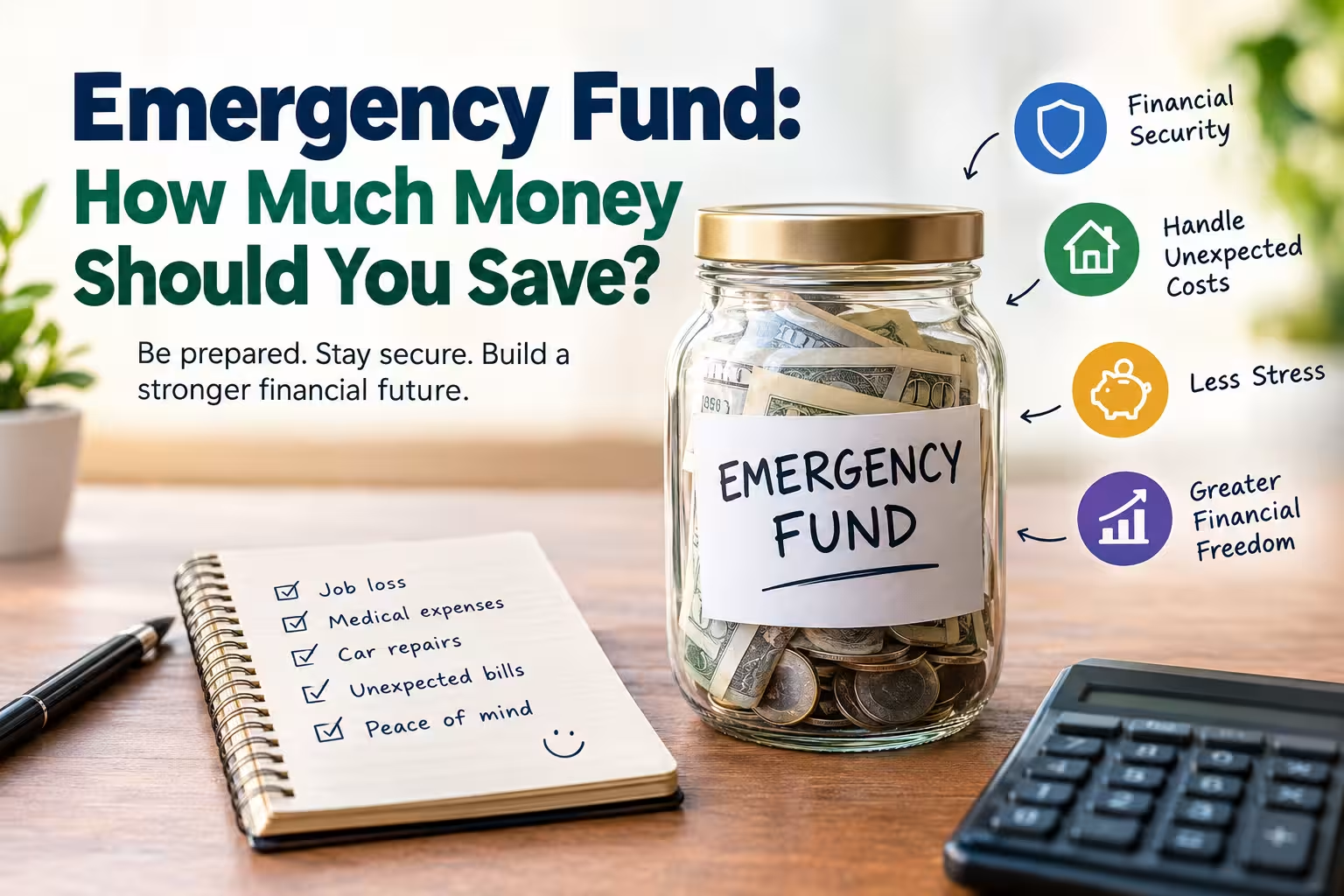
Emergency Fund: How Much Money Should You Save? A Complete Guide to Building Financial Security
An unexpected medical bill, a sudden job loss, an urgent car repair, or a major household expense can disrupt even a carefully planned budget. When these situations arise, having money set aside can make the difference between managing the problem comfortably and relying on expensive loans or credit cards.
That is why an emergency fund is one of the most useful foundations of personal finance. It provides a financial cushion for unexpected expenses, protects your regular savings, and gives you more flexibility when life does not go according to plan.
But how much money should you actually save? Is ₹50,000 enough? Should you aim for three months of expenses, six months of income, or an entire year’s salary? And how can you build an emergency fund when your monthly income is limited?
The answer depends on your essential expenses, job security, family responsibilities, existing insurance coverage, and access to other financial resources. There is no single amount that works for everyone.
This guide explains how to calculate your ideal emergency fund, choose an appropriate savings target, build your fund step by step, and keep the money accessible without taking unnecessary risks. Whether you are a salaried employee, a freelancer, a business owner, or someone just beginning to manage money, you will find practical examples and actionable strategies to help you get started.
What Is an Emergency Fund?
An emergency fund is money you save specifically to cover unexpected, necessary expenses or a temporary loss of income.
Unlike money saved for a vacation, a new smartphone, a wedding, or a house deposit, an emergency fund is reserved for situations that require immediate financial attention and were not part of your normal budget.
For example, suppose you lose your job unexpectedly. Your rent, groceries, electricity bills, insurance premiums, and other essential expenses continue even though your salary stops. An emergency fund can help you meet these obligations while you look for another job.
Similarly, if your family faces an urgent medical expense that is not fully covered by insurance, your emergency savings can help cover the shortfall.
The purpose is straightforward: to give you access to money when you need it most, without forcing you to borrow, sell long-term investments at an unfavorable time, or abandon important financial goals.
What an Emergency Fund Can Cover
Depending on your circumstances, appropriate uses may include:
- Essential living expenses during unemployment.
- Unexpected medical costs and emergency medicines.
- Urgent home repairs, such as a leaking roof or damaged plumbing.
- Necessary vehicle repairs when transportation is essential for work.
- Emergency travel to assist a family member.
- Essential expenses during a temporary interruption in freelance or business income.
- Unexpected insurance deductibles or costs not covered by your policy.
- Urgent replacement of essential equipment needed to earn an income.
The key is necessity and unpredictability. An expense does not automatically qualify as an emergency simply because it is expensive.
What an Emergency Fund Should Not Cover
Avoid using emergency savings for predictable or optional spending, such as:
- Annual insurance premiums you can budget for in advance.
- Planned holidays and celebrations.
- Regular shopping or dining out.
- Routine vehicle servicing.
- Festival purchases and gifts.
- Planned home renovations.
- Investments in stocks, mutual funds, or speculative assets.
- A purchase you want to make before payday.
These expenses should generally have their own budget categories or savings funds.
For example, if you know your vehicle insurance renewal is due in six months, you can set aside a portion of the premium each month. That is planned saving, not emergency saving.
Keeping these categories separate helps protect your emergency fund for situations where it is genuinely needed.
Why Is an Emergency Fund Important?
An emergency fund is more than a bank balance. It is a practical tool for managing uncertainty and protecting your financial plans.
1. It Protects You During Job Loss
Losing a job can create immediate financial pressure. Even if you expect to find another position quickly, recruitment processes, interviews, and salary negotiations can take time.
Without savings, you may have to accept the first available job, borrow money from family, or rely on credit cards.
A well-funded emergency reserve gives you time to search for suitable employment while continuing to pay essential bills.
2. It Reduces Dependence on High-Cost Borrowing
Unexpected expenses often arrive at inconvenient times. Without available cash, people may turn to credit cards, personal loans, or other borrowing options.
Borrowing can make an already difficult situation more expensive because interest and fees may increase the amount that must eventually be repaid.
An emergency fund reduces the likelihood of needing new debt for an unexpected bill. It cannot eliminate every borrowing need, but it gives you another option before you borrow.
3. It Helps Protect Long-Term Investments
Imagine that you have invested money for retirement or a future home purchase. A sudden medical bill forces you to sell part of your investment portfolio.
If markets have fallen, you might have to sell at a loss or interrupt a long-term investment strategy.
Emergency savings help separate short-term financial needs from long-term investments. This allows investments to remain focused on their intended goals rather than serving as the first source of emergency cash.
4. It Supports Better Financial Decisions
Financial pressure can make decisions harder. When you are worried about rent, groceries, or medical bills, you may feel compelled to accept unfavorable terms or make rushed choices.
A cash reserve can provide breathing room.
For instance, someone with several months of essential expenses saved may be better positioned to negotiate a job offer, arrange necessary repairs, or compare treatment costs without immediately resorting to expensive borrowing.
5. It Provides Financial Flexibility for Families
Families often have more than one person depending on the same income. Children, elderly parents, school expenses, housing payments, and medical needs can make an unexpected disruption particularly difficult.
An emergency fund helps households continue meeting essential obligations when income falls or an urgent expense arises.
It is especially valuable when one person earns most or all of the household income.
6. It Makes Other Financial Goals More Sustainable
You may be saving for a home, investing for retirement, paying off debt, or building a business.
Without emergency savings, an unexpected expense can force you to pause these goals or withdraw money intended for them.
Building an emergency reserve creates a more stable foundation for the rest of your financial plan.
How Much Money Should You Save in an Emergency Fund?
A common guideline is to save enough to cover three to six months of essential living expenses. If your income is irregular, your job is unstable, or several people depend on you financially, you may want a larger reserve.
India’s National Institute of Securities Markets (NISM) also highlights the importance of keeping emergency money safe and readily accessible, rather than prioritizing high investment returns.
The right target depends on how long you might need to manage without your regular income and how much you would need to spend during that period.
The Three-to-Six-Month Rule Explained
Three months of essential expenses
Starting target
Suitable for some people with stable employment, relatively low financial obligations, and dependable alternative support.
Six months of essential expenses
Common goal
A reasonable target for many households, particularly those with rent or loan payments, dependants, or limited access to backup income.
Nine to twelve months of essential expenses
A larger safety cushion
Worth considering for freelancers, self-employed people, single-income families, people in uncertain industries, or those who may need more time to replace their income.
These are planning guidelines, not fixed financial rules. Your circumstances may justify a smaller or larger target.
Should You Calculate Your Emergency Fund Using Income or Expenses?
Calculate it primarily using essential monthly expenses, not your full salary.
Suppose you earn ₹60,000 per month but spend ₹35,000 on necessary household costs. A six-month emergency fund based on essential expenses would be ₹2,10,000.
If you calculated six months using your entire salary, you would arrive at ₹3,60,000. That may be a useful larger savings goal, but it is not necessarily the amount you need to maintain your basic lifestyle during an income interruption.
The distinction matters because your discretionary spending may fall during an emergency. You might pause holidays, restaurant visits, entertainment subscriptions, and nonessential shopping.
However, do not underestimate essential costs just to make the savings target look easier. Include obligations that will continue even when income stops.
How to Calculate Your Emergency Fund Step by Step
The most reliable way to determine how much money to save is to build your target from your actual monthly budget.
Step 1: Calculate Your Essential Monthly Expenses
Review your bank statements, bills, loan repayments, and household spending for the past two or three months.
List expenses you would need to continue paying during an emergency.
| Expense category | Example monthly amount |
|---|---|
| Rent or essential housing costs | ₹10,000 |
| Groceries and household supplies | ₹6,000 |
| Electricity, gas, water, and phone | ₹2,000 |
| Transportation | ₹3,000 |
| Insurance premiums averaged monthly | ₹2,000 |
| Essential medical expenses | ₹1,500 |
| Loan minimum payments | ₹4,000 |
| Essential family or childcare costs | ₹3,500 |
| Total essential expenses | ₹32,000 |
Illustrative figures only. Replace these amounts with your own household expenses.
Include necessary expenses that may be easy to overlook, such as medicines, school-related essentials, internet access needed for work, and support for dependent family members.
Step 2: Choose Your Target Number of Months
Decide whether three, six, nine, or twelve months is appropriate for your situation.
For the example above, essential monthly expenses are ₹32,000.
- Three months: ₹32,000 × 3 = ₹96,000.
- Six months: ₹32,000 × 6 = ₹1,92,000.
- Nine months: ₹32,000 × 9 = ₹2,88,000.
- Twelve months: ₹32,000 × 12 = ₹3,84,000.
A six-month target would therefore be ₹1.92 lakh.
Step 3: Consider Expenses That May Increase During an Emergency
Your normal budget may not reflect every cost that arises during a crisis.
For example:
- Losing a job could increase travel expenses related to interviews.
- A family medical emergency could create costs beyond normal healthcare spending.
- A home repair might require an immediate payment.
- A period of unemployment could require temporary relocation.
Consider whether these risks justify a separate contingency amount in addition to your basic monthly-expense calculation.
Avoid adding every imaginable expense to the target. Focus on plausible risks that could materially affect your household.
Step 4: Subtract Existing Emergency Savings
If you already have money specifically reserved for emergencies, subtract it from your target.
For example:
- Six-month target: ₹1,92,000.
- Existing emergency savings: ₹45,000.
- Remaining amount to save: ₹1,47,000.
Money reserved for a planned holiday, an upcoming tuition payment, or a house deposit should not automatically be counted as emergency savings.
Likewise, avoid counting the same money twice across multiple financial goals.
Step 5: Set a Monthly Savings Amount
Choose a contribution you can sustain without missing essential bills or creating new expensive debt.
If you need to save ₹1,47,000 and can put aside ₹7,000 every month, the basic calculation is:
\[ \text{Months to target} = \frac{₹1,47,000}{₹7,000} = 21 \]
You would need 21 months to reach the goal, ignoring interest and any withdrawals.
If ₹7,000 is too difficult, start with ₹2,000 or ₹3,000 and increase the amount when your financial situation improves.
A smaller contribution made consistently is more useful than an ambitious savings plan that repeatedly fails.
Calculate Your Own Emergency Fund
Use this calculator to estimate a savings target based on your household’s essential expenses and the money you have already saved.Essential monthly expenses (₹)Emergency fund target3 months6 months9 months12 monthsCurrent emergency savings (₹)Planned monthly contribution (₹)
Your emergency fund target
₹1,80,000
Still needed
₹1,70,000
Estimated time
34 months
Goal progress
6%
This estimate excludes interest, inflation, changes in expenses, and future withdrawals. It is an educational planning tool, not personalized financial advice.
Emergency Fund Examples for Different Monthly Budgets
Seeing how the numbers change across different budgets can make the savings goal easier to understand.
| Essential monthly expenses | 3-month fund | 6-month fund | 12-month fund |
|---|---|---|---|
| ₹15,000 | ₹45,000 | ₹90,000 | ₹1,80,000 |
| ₹25,000 | ₹75,000 | ₹1,50,000 | ₹3,00,000 |
| ₹35,000 | ₹1,05,000 | ₹2,10,000 | ₹4,20,000 |
| ₹50,000 | ₹1,50,000 | ₹3,00,000 | ₹6,00,000 |
| ₹75,000 | ₹2,25,000 | ₹4,50,000 | ₹9,00,000 |
| ₹1,00,000 | ₹3,00,000 | ₹6,00,000 | ₹12,00,000 |
These examples assume that the monthly essential-expense figure stays constant. In practice, inflation, changes in rent, healthcare needs, and family circumstances may require you to update your target.
Example 1: A Young Salaried Professional
Suppose you earn ₹40,000 per month and spend ₹24,000 on essential expenses.
You live with family, have no dependants, and work in a field where you believe you could find another job relatively quickly.
A three-month target would be ₹72,000. You might begin with that amount while gradually working toward six months of expenses, depending on your actual job security and family obligations.
Example 2: A Married Couple With Children
Suppose a household spends ₹55,000 per month on rent, food, transport, insurance, education-related essentials, loan payments, and other necessary costs.
A six-month emergency fund would be ₹3.3 lakh.
If one partner earns most of the household income, the family may need a larger reserve because losing that income could affect almost every household obligation.
Example 3: A Freelancer With Variable Income
Suppose a freelancer’s essential monthly expenses are ₹40,000, but payments from clients are unpredictable.
A six-month fund would be ₹2.4 lakh. A nine-month fund would be ₹3.6 lakh.
The larger amount may be appropriate if finding new clients takes time or if several clients could delay payments simultaneously.
The freelancer should also keep business operating funds separate from personal emergency savings whenever possible.
Factors That Determine Your Ideal Emergency Fund Size
The three-to-six-month guideline is a useful starting point, but your actual target should reflect the risks you face.
Employment Stability
Someone with a permanent role, strong demand for their skills, and reliable employment prospects may need a different buffer from someone working on short-term contracts.
Consider not just whether you have a job today, but how long replacing your income might take.
A specialized position, a narrow job market, or a difficult hiring environment may justify a larger fund.
Number of Dependants
If children, elderly parents, or other family members rely on your income, you have more financial obligations to protect.
You may also need to account for expenses that cannot easily be reduced, such as school fees, essential care, and regular medical needs.
Number of Income Earners
A household with two stable, independent incomes may be better able to withstand the loss of one income than a household that depends entirely on one salary.
However, two incomes do not automatically mean low risk. If both people work in the same industry or for employers affected by the same economic conditions, their incomes could be disrupted together.
Debt and Fixed Obligations
Rent, home-loan EMIs, vehicle-loan payments, and other debt commitments can continue even when your earnings fall.
A household with substantial fixed obligations should pay particular attention to the amount it must spend each month to remain financially stable.
Insurance Coverage
Health insurance, appropriate life insurance for dependants, and other relevant policies can reduce some financial risks.
However, insurance does not replace an emergency fund. Policies may have exclusions, waiting periods, deductibles, claim limits, or expenses that are not reimbursed.
Review your coverage and keep enough savings to manage realistic out-of-pocket costs.
Health and Family Responsibilities
Regular medical needs, an elderly family member who requires assistance, or a household member whose work capacity may change can make a larger cash reserve sensible.
The goal is to reflect your real obligations without assuming that every possible event will occur.
Access to Alternative Support
You may have access to a second household income, a dependable family support network, or other reliable resources.
These can influence your target, but avoid treating uncertain help as guaranteed money. A relative may be unable to lend money precisely when you need it.
How to Build an Emergency Fund on a Low Salary
You do not need a high income to begin building an emergency fund. You need a realistic savings target, a manageable contribution, and a plan you can maintain.
If money is tight, your first goal should be to establish a small reserve rather than attempting to save several months of expenses immediately.
Start With a Small Emergency Cushion
Your initial target could be ₹5,000, ₹10,000, or another amount that would help you handle a common unexpected bill.
Choose a figure that makes sense for your circumstances. Someone who relies on a vehicle for work may want to prioritize a basic repair reserve, while someone with recurring healthcare costs may prioritize money for unexpected medical expenses.
Once you reach the first milestone, work toward one month of essential expenses and then gradually expand the fund.
Save a Fixed Amount Every Month
Consistency matters more than the size of your first contribution.
For example, if you save ₹1,000 every month, you will contribute ₹12,000 over a year, before interest and withdrawals.
If you can save ₹2,500 per month, your annual contributions would total ₹30,000.
Choose a contribution that fits your actual budget. Increase it when you receive a raise, reduce unnecessary spending, or finish paying off a debt.
Automate Your Savings
If your bank allows scheduled transfers, arrange for a fixed amount to move into a separate savings account after payday.
This reduces the temptation to spend the money first and save whatever remains.
If your income varies, you can transfer a percentage of each payment instead of a fixed amount. Choose a percentage that still leaves enough for essential bills and required debt payments.
Find Small, Sustainable Spending Reductions
Review your spending for recurring costs that provide limited value.
Potential areas to examine include:
- Unused digital subscriptions.
- Frequent food delivery.
- Impulse purchases.
- Unnecessary bank charges.
- Expensive convenience spending that can be reduced.
- Duplicate services or memberships.
You do not need to eliminate every enjoyable expense. The aim is to free up money without making the budget so restrictive that it becomes difficult to maintain.
Direct Windfalls Toward Your Goal
If you receive a performance bonus, a tax refund, a gift, or extra freelance income, consider directing part of it toward emergency savings.
You could save half and use the rest for another priority. The exact split depends on your obligations and how urgently you need to build the fund.
Windfalls can accelerate progress without requiring you to cut your regular budget further.
Avoid Saving by Creating New Financial Problems
Do not skip essential medicines, miss loan payments, or neglect necessary insurance just to reach your emergency fund target faster.
Likewise, if you are carrying expensive debt, consider balancing a small starter emergency reserve with a repayment plan. Otherwise, a minor unexpected expense could force you to borrow again.
The right balance depends on interest costs, minimum payments, the urgency of your savings goal, and your access to other resources.
Where Should You Keep Your Emergency Fund?
An emergency fund has a different purpose from a long-term investment portfolio. You do not need to maximize returns at the expense of being able to access your money quickly.
The most important qualities are safety, liquidity, and easy access. NISM specifically emphasizes these priorities for emergency savings.
For readers in India, the following options are worth considering.
1. A Separate Savings Account
A dedicated savings account is a straightforward option for emergency money.
Benefits include:
- Easy access through banking channels.
- A clear separation between emergency savings and everyday spending.
- The ability to earn interest, depending on the account.
- Convenient transfers to pay urgent bills.
Choose an account with suitable withdrawal access, reasonable fees, and reliable banking services.
A separate account can also reduce the temptation to spend the money on routine purchases.
Best for: The portion of your emergency fund you may need immediately.
2. A Sweep-In or Flexi Fixed Deposit
Some banks offer arrangements that connect a savings account with a fixed deposit, subject to the bank’s product rules.
These products may provide a way to earn a different rate of interest on eligible balances while retaining access to funds.
Before using one, check:
- Whether money can be withdrawn at any time.
- Whether a withdrawal breaks the deposit fully or partially.
- Applicable premature withdrawal penalties.
- Minimum balance and deposit requirements.
- How quickly the funds become available.
Do not assume that every fixed deposit can be liquidated instantly without a cost.
Best for: A portion of your reserve that is not required for immediate cash access, provided the withdrawal terms suit your needs.
3. Liquid Mutual Funds
Liquid mutual funds invest in short-term debt and money-market instruments. They may be considered for a portion of emergency savings by investors who understand their risks and withdrawal procedures.
However, they are mutual funds, not bank deposits. Their value is not guaranteed, and access is subject to scheme rules, applicable cut-off times, settlement arrangements, and other conditions.
You should not treat them as equivalent to money in an instantly accessible bank account.
Best for: People who understand mutual fund risks and have already established an adequate immediately accessible cash reserve.
4. Cash at Home
Keeping a small amount of cash at home can be useful during a temporary banking outage, power failure, or situation in which digital payments are unavailable.
However, holding your entire emergency fund in physical cash introduces risks of theft, loss, and damage.
Keep only an amount that makes sense for your household’s immediate needs, store it securely, and avoid unnecessary exposure.
Should You Keep Your Emergency Fund in Stocks or Cryptocurrency?
Generally, no. These assets can experience substantial price fluctuations, and their value may fall at the same time you need cash.
Selling investments during a market decline could lock in losses. Cryptocurrency also introduces significant price volatility and other risks.
An emergency fund should not depend on market conditions being favorable when a crisis occurs.
Money intended for long-term growth belongs in a different part of your financial plan.
Is Your Bank Deposit Insured in India?
India’s Deposit Insurance and Credit Guarantee Corporation (DICGC) provides deposit insurance of up to ₹5 lakh per depositor per bank, including principal and interest, subject to its applicable rules and conditions. Eligible savings accounts and fixed deposits are among the covered deposit types.
The limit applies to eligible deposits aggregated across branches of the same bank for the same depositor in the same right and capacity. It is not a separate ₹5 lakh allowance for every account or branch.
If your emergency fund is larger than this amount, understand how the insurance limit applies to your deposits and consider your overall banking risk. Check the official DICGC guidance and confirm that your bank is covered before relying on deposit insurance.
Should You Build an Emergency Fund Before Investing?
For most people who do not have adequate cash reserves, building at least a starter emergency fund is a sensible early financial priority.
That does not mean you must stop all investing until you have accumulated six months of expenses.
Your approach should reflect your cash flow, existing debt, employer benefits, family support, and immediate financial risks.
A Practical Order of Priorities
Consider the following sequence:
- Cover essential expenses. Pay for food, housing, utilities, necessary medicines, and other basic needs.
- Meet required debt payments. Avoid preventable penalties and additional financial problems.
- Build a starter emergency reserve. Save an amount that can cover a modest unexpected bill.
- Address expensive debt. If you carry high-interest debt, balance repayment against the need to maintain some emergency savings.
- Expand your emergency fund. Work toward three to six months of essential expenses, or a larger amount if your circumstances require it.
- Continue long-term investing. Build investments for retirement and other goals without relying on them as your first line of emergency funding.
This is a flexible framework rather than a universal order. For example, an employer retirement contribution with valuable matching benefits, an urgent debt obligation, or a household with no insurance may require a different balance.
The main principle is to avoid a financial plan in which every available rupee is invested and no readily accessible money remains for an unexpected expense.
Emergency Fund vs. Other Types of Savings
It is easy to confuse emergency savings with money set aside for planned purchases. Keeping these purposes separate can make your financial plan easier to manage.
| Financial goal | Purpose | Typical time horizon |
|---|---|---|
| Emergency fund | Unexpected costs or income loss | Available when needed |
| Monthly bills account | Rent, groceries, utilities, regular payments | Immediate and recurring |
| Sinking fund | Known future expenses, such as insurance renewals | Weeks or months |
| Vacation fund | Planned travel and holidays | Based on travel date |
| Home deposit fund | Purchase of a house or property | Medium to long term |
| Retirement portfolio | Long-term financial independence | Many years |
Why Separate Savings Goals?
Suppose you have ₹2 lakh in savings, including ₹80,000 intended for a planned home renovation.
If your emergency fund target is ₹1.5 lakh, you should not assume that the entire ₹2 lakh is available for emergencies. The renovation money already has a purpose.
A separate account or clearly defined ledger for each goal makes it easier to understand how much money is genuinely available.
You can maintain separate bank accounts where practical or use a budgeting spreadsheet to track the amounts. The important thing is to avoid double-counting money.
How to Manage Your Emergency Fund After Reaching the Target
Reaching your target is an achievement, but emergency savings require occasional maintenance.
Your expenses, income, family responsibilities, and financial risks will change over time. The amount that was sufficient two years ago may not be enough today.
Review Your Target Every Six to Twelve Months
Check your budget periodically and ask:
- Have rent or essential living costs increased?
- Have you taken on a new loan?
- Are more people depending on your income?
- Has your job become less stable?
- Have you moved to a more expensive city?
- Has your insurance coverage changed?
- Has your household’s income structure changed?
If essential monthly expenses rise from ₹30,000 to ₹35,000, a six-month target increases from ₹1.8 lakh to ₹2.1 lakh.
Update your target whenever a meaningful change occurs rather than relying on an old number indefinitely.
Replenish the Fund After Using It
If you spend ₹25,000 on an emergency repair, subtract that amount from your emergency fund balance.
Once the immediate problem is resolved, begin rebuilding the reserve. You may temporarily reduce discretionary spending or redirect some savings contributions toward replenishment.
You do not need to feel guilty about using emergency money for a genuine emergency. That is exactly why the fund exists.
What If Your Emergency Fund Becomes Larger Than Necessary?
If your circumstances improve and your emergency fund exceeds a reasonable target, you may decide to redirect some surplus money toward other financial goals.
Before doing so, make sure you have accounted for upcoming expenses, insurance gaps, job stability, and other risks.
Do not move money into long-term investments simply because your bank balance looks large. First confirm that the remaining emergency reserve is still appropriate.
Common Emergency Fund Mistakes to Avoid
Even people who save regularly can make mistakes that reduce the usefulness of their emergency reserves.
Mistake 1: Setting an Unrealistic Target
Trying to save ₹5 lakh immediately when your budget allows only ₹2,000 per month can feel discouraging.
Better approach: Set an initial milestone, then work toward progressively larger goals. Reaching ₹10,000 is meaningful even if your eventual target is ₹2 lakh.
Mistake 2: Counting Your Full Salary Instead of Essential Expenses
Using total income as the calculation base may create a target that is larger than necessary for some households.
Better approach: Calculate what you would genuinely need to spend during an emergency, while retaining a sensible allowance for irregular costs.
Mistake 3: Investing the Entire Fund in Risky Assets
Stocks, cryptocurrency, and other volatile assets can lose value when markets are under pressure.
Better approach: Keep emergency money in suitable low-risk, accessible places. Invest separately for long-term growth.
Mistake 4: Keeping All Your Money in an Inaccessible Deposit
A deposit that offers attractive interest but imposes withdrawal delays or penalties may be unsuitable for money you need urgently.
Better approach: Understand the withdrawal terms before depositing emergency savings. Keep an accessible portion available for immediate needs.
Mistake 5: Using the Fund for Planned Purchases
Taking money from your emergency reserve for a holiday or an expensive gadget can leave you exposed when an actual emergency arises.
Better approach: Create separate sinking funds for foreseeable costs.
Mistake 6: Ignoring Insurance
A cash reserve alone may not be enough to manage a major medical event or another substantial financial risk.
Better approach: Review relevant insurance coverage and understand exclusions, deductibles, limits, and claim requirements.
Mistake 7: Forgetting to Rebuild Savings
After using the fund, it is easy to focus on normal expenses and postpone replenishment indefinitely.
Better approach: Set a new savings goal as soon as the immediate emergency has passed.
Mistake 8: Waiting Until You Earn More
You may feel that saving is pointless until you receive a raise or find a higher-paying job.
Better approach: Start with an affordable contribution today. Increase it when your circumstances improve.
Expert Tips for Building a Strong Emergency Fund
The following practices can make your savings plan easier to maintain.
Make Savings a Budgeted Expense
Treat your planned emergency fund contribution like a regular bill.
If you wait until the end of the month to see what remains, other spending may consume the available money.
Use a Separate Account
A separate account can make your progress visible and discourage casual withdrawals.
Give the account a clear label, such as “Emergency Savings,” so its purpose is obvious.
Match the Account to Your Withdrawal Needs
Consider when you might need the money, how quickly it would become available, and whether you would face a fee or penalty.
The most suitable option is not necessarily the one with the highest advertised return.
Plan for Uneven Income
If you are self-employed or receive commissions, save a portion of each payment instead of relying entirely on a fixed monthly contribution.
You may also want a larger reserve because income gaps can last longer than expected.
Use Financial Windfalls Strategically
Bonuses, gifts, and extra earnings can help you reach milestones faster. Decide in advance what portion will go toward emergency savings.
Keep Records of Your Progress
A simple spreadsheet can show:
- Your target amount.
- Your current balance.
- Your monthly contribution.
- Any withdrawals.
- Your remaining savings gap.
Review it periodically and adjust the plan when your expenses change.
Avoid Treating Credit as Your Emergency Fund
A credit card limit is not the same as cash savings. Borrowing creates an obligation to repay, potentially with interest and fees.
Credit may sometimes be necessary, but it should not be your primary emergency strategy when you can build a cash reserve.
Practical 90-Day Plan to Start Your Emergency Fund
If you have not started saving yet, the easiest way forward is to turn the idea into a short, manageable action plan.
Your first three months
0 of 9 tasks completedReset checklist
Days 1–30
Understand your finances
Calculate essential monthly expensesChoose an initial emergency savings targetOpen or designate a separate savings account
Days 31–60
Establish your savings habit
Set a realistic monthly contributionAutomate a transfer or set a payday reminderReview spending for sustainable savings opportunities
Days 61–90
Review and improve
Check your progress against the targetIncrease contributions if your budget allowsCreate a plan to reach one month of essential expenses
By the end of 90 days, you may not have reached your final target, and that is perfectly fine. The purpose of this plan is to establish a repeatable system that helps you save consistently.
If your income is limited, focus on maintaining the habit. If your income increases, use part of the additional money to accelerate your progress.
Frequently Asked Questions About Emergency Funds
1. How much money should I have in an emergency fund?
A common starting guideline is three to six months of essential living expenses. You may need more if your income is unpredictable, you support dependants, or replacing your job could take considerable time.
Calculate your target using actual household expenses rather than choosing an amount solely because it is popular.
2. Is ₹50,000 enough for an emergency fund?
It depends on your essential monthly expenses and financial responsibilities.
If you spend ₹15,000 per month on essentials, ₹50,000 covers a little over three months. If your essential expenses are ₹40,000 per month, the same amount covers only about five weeks.
Use ₹50,000 as an initial milestone if appropriate, then calculate your longer-term target.
3. Should I save three months or six months of expenses?
Three months can be a reasonable initial goal for someone with stable employment, limited obligations, and reliable backup resources. Six months provides a larger cushion for many households.
Consider your job security, debt payments, dependants, insurance coverage, and access to alternative income before deciding.
4. Where should I keep my emergency fund in India?
A separate savings account is a practical starting point because it can provide convenient access to money. Depending on your needs, you may consider suitable fixed-deposit arrangements for part of the balance, provided withdrawal terms are appropriate.
Prioritize safety and liquidity over high returns. Remember that mutual funds are not bank deposits and do not receive DICGC deposit insurance.
5. Should I invest my emergency fund in mutual funds?
Your immediately accessible emergency money should generally not depend on investment-market performance.
Some investors consider liquid mutual funds for a portion of their reserve, but these funds carry investment risks and have redemption and settlement conditions. They are not equivalent to guaranteed cash or insured bank deposits.
Understand the risks and access arrangements before considering them.
6. Can I build an emergency fund on a ₹20,000 salary?
Yes. Begin with a contribution that fits your budget, even if it is only ₹500 or ₹1,000 per month.
For example, saving ₹1,000 each month produces ₹12,000 in contributions over a year, before interest and withdrawals. You can increase the amount if your income rises or your expenses decrease.
The goal is steady progress, not a savings target that forces you to miss essential payments.
7. Should I pay off debt or build an emergency fund first?
The answer depends on the type of debt, its interest rate, your cash flow, and how vulnerable you are to unexpected expenses.
A small starter emergency reserve can help prevent a minor shock from creating more debt. At the same time, expensive debt may deserve urgent repayment because interest can accumulate quickly.
Maintain required payments, consider a starter reserve, and balance further savings against repayment of costly debt.
8. When should I use my emergency fund?
Use it for unexpected, necessary expenses or a loss of income that you cannot reasonably cover from your normal budget.
Examples include an urgent medical bill, an essential home repair, or living costs during unemployment.
Avoid using it for planned holidays, routine shopping, or foreseeable expenses that should have a separate savings plan. If you use the fund for a genuine emergency, focus on rebuilding it afterward.
Conclusion: Start Building Your Emergency Fund Today
An emergency fund is one of the simplest ways to prepare for financial uncertainty. It helps you manage unexpected bills, cope with income interruptions, reduce dependence on borrowing, and protect money intended for your long-term goals.
For many households, saving three to six months of essential expenses is a useful starting guideline. If you have an irregular income, substantial family responsibilities, or uncertain employment, a larger reserve may be appropriate.
The most effective approach is to calculate your essential monthly costs, choose a realistic target, keep the money accessible, and save consistently. Start with a small milestone if necessary, then expand the fund as your financial situation improves.
You do not need to build the entire reserve in one month. What matters is having a clear target and making regular progress toward it.
Your next step: Calculate your essential monthly expenses today, multiply that amount by your chosen number of months, and decide how much you can save from your next paycheck. Even a modest first contribution can begin building a stronger financial safety net.
https://sarkariyojana24.co.in/
How to Create a Monthly Budget: A Beginner’s Guide to Managing Money and Saving More
Share this content:




Post Comment