






Financial Goals: Short-Term vs Long-Term Planning – How to Build a Secure Financial Future

Managing money is not just about earning a good salary, paying monthly bills, or saving whatever remains at the end of the month. It is about making thoughtful financial decisions that help you achieve the things you want in life. Whether you are planning an international vacation, purchasing a new vehicle, buying your first home, funding your children’s education, or preparing for retirement, having clearly defined financial goals can make a significant difference.
However, one common challenge people face is understanding the difference between short-term and long-term financial planning. Some financial goals require money within a few months, while others may take 10, 20, or even 30 years to achieve. Saving for these goals requires different strategies, investment choices, and levels of risk.
For example, the money you need for an emergency fund should generally be kept in accessible and relatively low-risk savings options. On the other hand, money intended for retirement several decades away may have more room for long-term investments that experience market fluctuations.
Understanding financial goals: short-term vs long-term planning helps you organize your income, control unnecessary expenses, build savings, and make informed investment decisions. Instead of managing money without a clear direction, you can create a practical roadmap that connects your current financial decisions with your future lifestyle.
This guide explains what short-term and long-term financial goals mean, how they differ, how to set realistic targets, which savings and investment approaches to consider, and how to build a financial plan that supports different stages of life.
Financial Goals: Short-Term vs Long-Term Planning – What Are Financial Goals?
Financial goals are specific money-related objectives that you want to accomplish within a particular period.
They give your income and savings a purpose. Rather than spending money without a plan, you decide how much you need, when you need it, and what actions will help you reach your target.
Financial goals can be related to almost every stage of life, including:
- Building an emergency fund.
- Paying off credit card debt.
- Saving for a family vacation.
- Purchasing a two-wheeler or car.
- Buying a house or apartment.
- Funding higher education.
- Starting a business.
- Supporting your children’s future.
- Building retirement savings.
- Creating long-term financial independence.
The right financial goals depend on your income, expenses, responsibilities, age, financial situation, and personal priorities.
For example, a person who has recently started working may prioritize building an emergency fund and paying off education loans. Someone with a family may focus on buying a home, children’s education, and retirement planning.
There is no single financial plan that works for everyone. What matters is creating goals that are realistic and suitable for your circumstances.
Why Are Financial Goals Important?
Financial goals provide direction and help you make better decisions about money.
Here are some important reasons to establish them.
1. They give your money a purpose
When you know what you are saving for, it becomes easier to control unnecessary spending. You can prioritize important expenses instead of making impulsive purchases.
2. They improve saving habits
Having a specific savings target encourages consistency. Even small monthly contributions can gradually help you build meaningful savings.
3. They prepare you for unexpected expenses
An emergency fund can protect your regular savings when unexpected expenses arise, such as medical bills, urgent home repairs, or temporary income loss.
4. They reduce financial stress
A clear financial plan helps you understand your current position and what you need to do next.
5. They support better investment decisions
Your investment choices should depend on when you need the money. Financial goals help you select suitable savings and investment options based on your time horizon and risk tolerance.
6. They help you prepare for major life events
Purchasing a home, getting married, starting a family, or retiring requires financial preparation. Planning ahead makes these milestones easier to manage.
Understanding Short-Term Financial Goals
Short-term financial goals are money-related objectives that you want to achieve within a relatively short period.
A practical planning range is generally a few months to three years, although some financial planners may define the period differently depending on the objective.
These goals usually involve expenses that are approaching and require relatively predictable access to money.
Examples include:
- Saving ₹30,000 for a family vacation.
- Building an initial emergency savings fund.
- Purchasing a smartphone or laptop.
- Paying off a small credit card balance.
- Saving for a professional certification.
- Paying an upcoming insurance premium.
- Building savings for a vehicle down payment.
- Preparing money for a planned medical expense.
The main purpose of short-term financial planning is to accumulate the required amount without exposing essential savings to unnecessary risks.
Characteristics of Short-Term Financial Goals
Short-term goals have several important characteristics.
1. Limited time horizon
You generally expect to achieve these goals within months or a few years.
2. Higher need for liquidity
You may need to withdraw the money at a specific time. Therefore, accessibility is important.
3. Lower tolerance for investment risk
If you need money next year, a significant market decline could affect your ability to achieve the goal.
4. Clearly defined savings targets
Short-term goals are often easier to calculate because the required amount and deadline are relatively close.
5. Regular contributions
Monthly savings or automatic transfers can help you reach the target without depending on occasional large deposits.
Examples of Short-Term Financial Goals
Let’s understand some common short-term goals.
1. Building an Emergency Fund
An emergency fund is one of the most useful short-term financial priorities.
It is money reserved for unexpected situations, including:
- Job loss.
- Medical emergencies.
- Urgent home repairs.
- Unexpected travel.
- Temporary income disruption.
- Essential vehicle repairs.
A commonly used starting target is three to six months of essential living expenses. People with irregular income, dependants, or less predictable employment may need a larger reserve.
For example, if your essential monthly expenses are ₹25,000, a three-to-six-month emergency fund would be:
- Three months: ₹75,000.
- Six months: ₹1,50,000.
You do not need to accumulate the entire amount immediately. Start with a smaller achievable target and increase it gradually.
Keep emergency savings in accessible, relatively low-risk financial options rather than investments that may fluctuate significantly in value.
2. Saving for a Vacation
Travel is an enjoyable financial goal, but paying for a holiday through expensive credit card debt can create unnecessary pressure.
Suppose you want to save ₹60,000 for a family vacation within 12 months.
Your monthly savings requirement would be:
₹60,000 ÷ 12 = ₹5,000.
By setting aside ₹5,000 every month, you can gradually prepare for the trip.
This approach allows you to enjoy your holiday without disturbing your emergency fund or long-term investments.
3. Paying Off Credit Card Debt
High-interest debt can make it difficult to achieve other financial goals.
If you have outstanding credit card balances, consider making repayment a major short-term priority.
Two common repayment approaches are:
- Debt avalanche method: Pay extra toward the debt with the highest interest rate first while maintaining minimum payments on other debts.
- Debt snowball method: Pay extra toward the smallest balance first to build motivation through smaller victories.
The avalanche method can reduce total interest costs, while the snowball method may help people stay motivated.
Avoid adding new unnecessary debt while following your repayment plan.
4. Purchasing Electronic Devices
Suppose you want to purchase a laptop worth ₹50,000 within ten months.
Instead of using a high-interest loan or credit card EMI, you could save ₹5,000 every month.
This approach gives you greater control over your spending and helps you avoid unnecessary borrowing costs.
5. Saving for Professional Development
Learning new skills can support career development and improve employment opportunities.
You may want to save for:
- Professional certification courses.
- Technical training.
- Online education.
- Competitive examination preparation.
- Career-related workshops.
For example, if a certification costs ₹24,000 and you plan to enrol after eight months, saving ₹3,000 monthly will help you prepare.
Best Savings and Investment Options for Short-Term Financial Goals
The right financial product depends on the time remaining before you need the money, liquidity requirements, risk tolerance, and applicable taxes.
For short-term goals, protecting the amount you have accumulated is generally more important than seeking high returns.
Here are some commonly considered options in India.
1. Savings Accounts
A savings account provides convenient access to money and is useful for emergency savings and upcoming expenses.
Benefits include:
- Easy deposits and withdrawals.
- Convenient digital banking.
- Accessibility through ATMs and online banking.
- Suitable for maintaining a readily available cash reserve.
However, savings account interest may be relatively low compared with other financial products.
2. Fixed Deposits (FDs)
Bank fixed deposits allow you to deposit money for a predetermined period at an agreed interest rate.
They can be considered for goals with a known deadline.
Advantages include:
- Predictable interest terms.
- Multiple tenure options.
- Relatively straightforward management.
- Potentially suitable for planned expenses.
Consider premature withdrawal conditions, applicable penalties, taxation, and deposit insurance limits.
In India, eligible deposits are insured by DICGC up to ₹5 lakh per depositor per insured bank, including principal and interest, subject to the applicable rules.
3. Recurring Deposits (RDs)
Recurring deposits are useful for people who prefer saving a fixed amount every month.
For example, you may deposit ₹2,000 every month for a year.
This creates a disciplined savings habit and makes it easier to accumulate money for planned purchases.
Check the interest rate, tenure, premature closure conditions, and taxation before opening an RD.
4. Liquid Mutual Funds
Liquid mutual funds invest primarily in short-maturity money market and debt instruments.
They may be considered for certain short-term savings needs, but they are not guaranteed-return products.
Their value can fluctuate, and liquidity or redemption settlement arrangements may vary.
They should not automatically replace bank deposits or an immediately accessible emergency reserve.
5. Short-Duration Debt Funds
Short-duration debt funds invest in debt securities with relatively short portfolio durations.
They may be suitable for investors who understand interest-rate and credit risks.
However, they can experience losses due to changes in interest rates or deterioration in the credit quality of securities.
For a goal with a fixed deadline, consider whether the potential risk is appropriate.
Important Consideration
Do not choose an investment simply because it offers a higher advertised return.
For short-term financial goals, ask three questions:
- Will the money be available when I need it?
- Can I tolerate a temporary or permanent loss?
- Are the returns sufficient for my savings target after considering taxes and charges?
Understanding Long-Term Financial Goals
Long-term financial goals are financial objectives that generally require more than five years to achieve.
They often involve major life milestones and wealth-building activities.
Unlike short-term goals, long-term goals provide more time to save, invest, and potentially benefit from compounding.
Examples include:
- Purchasing a house.
- Funding children’s higher education.
- Building a retirement corpus.
- Achieving financial independence.
- Starting or expanding a business.
- Creating wealth for future generations.
- Paying off a long-term mortgage.
- Planning for major family responsibilities.
Long-term financial planning requires patience, consistency, and periodic reviews.
You may need to adjust your investment strategy as your income, responsibilities, and goals change.
Characteristics of Long-Term Financial Goals
1. Extended investment horizon
These goals may take 10, 15, 20, or more years to achieve.
2. Potential for compounding
Long-term investing allows returns to potentially generate additional returns over time.
3. Greater capacity to manage volatility
A longer time horizon may provide more opportunity to recover from market downturns, although recovery is never guaranteed.
4. Higher importance of inflation
The cost of education, housing, healthcare, and daily living may increase over time.
Therefore, long-term goals should account for inflation.
5. Need for periodic adjustments
Your investment plan should evolve as your financial circumstances and target dates change.
Examples of Long-Term Financial Goals
1. Retirement Planning
Retirement planning is one of the most important long-term financial goals.
You may want to retire at 60, 55, or another age depending on your preferences and circumstances.
The challenge is that retirement may last for several decades, and your income requirements can change over time.
You should consider:
- Expected retirement age.
- Current monthly household expenses.
- Future inflation.
- Healthcare costs.
- Existing retirement savings.
- Expected pension or other income.
- Lifestyle preferences.
- Family responsibilities.
For example, suppose your current monthly household expenses are ₹40,000.
If inflation averages an assumed 6% annually, the equivalent monthly expense after 25 years would be approximately ₹1,72,000.
This is an illustration of how inflation can affect purchasing power, not a prediction of future inflation.
It shows why simply saving the amount you spend today may not be enough for retirement.
2. Buying a House
Purchasing a home is a major financial commitment.
Even if you plan to use a home loan, you need to prepare for:
- Down payment.
- Stamp duty and registration charges.
- Legal and documentation expenses.
- Moving expenses.
- Interior work.
- Maintenance costs.
- Monthly loan repayments.
Suppose you plan to purchase a property in eight years and want to accumulate ₹12 lakh for the down payment and related initial costs.
Your savings strategy should consider the time remaining, expected property prices, inflation, and the risks associated with your investments.
Avoid relying entirely on uncertain investment returns to meet a fixed property purchase deadline.
3. Children’s Higher Education
Education costs can become a significant financial responsibility.
If your child is currently five years old and you expect to fund higher education at age 18, you have approximately 13 years to prepare.
Consider:
- Expected course fees.
- Potential education abroad.
- Accommodation.
- Travel expenses.
- Books and equipment.
- Inflation in education costs.
A separate education fund can help you track progress without mixing it with retirement savings or emergency money.
4. Building Long-Term Wealth
Wealth creation involves gradually increasing your financial assets through savings, investments, and responsible financial decisions.
It may include:
- Equity mutual funds.
- Direct equity investments.
- Public Provident Fund (PPF).
- Employee Provident Fund (EPF).
- National Pension System (NPS).
- Fixed-income investments.
- Real estate.
- Other suitable financial assets.
Every option has different risks, liquidity conditions, tax treatment, and investment requirements.
A diversified approach can help reduce dependence on a single asset or investment category.
5. Achieving Financial Independence
Financial independence means having sufficient financial resources to support your desired lifestyle without depending entirely on active employment income.
It does not necessarily mean retiring early.
For some people, it means having enough savings to change careers, start a business, reduce working hours, or manage family responsibilities without constant financial pressure.
Achieving this objective generally requires:
- Consistent savings.
- Responsible spending.
- Debt management.
- Long-term investments.
- Emergency preparation.
- Regular financial reviews.
Best Investment Options for Long-Term Financial Goals
Long-term investments should be selected according to your goals, risk tolerance, investment horizon, and financial circumstances.
Here are some commonly used options in India.
1. Equity Mutual Funds
Equity mutual funds invest primarily in shares of companies.
They may be appropriate for investors seeking long-term capital growth who can tolerate market volatility.
Common categories include:
- Large-cap funds.
- Mid-cap funds.
- Small-cap funds.
- Flexi-cap funds.
- Index funds.
- Sectoral and thematic funds.
Equity investments can experience substantial short-term fluctuations.
They are not suitable for every investor or every financial goal.
2. Systematic Investment Plans (SIPs)
A Systematic Investment Plan allows you to invest a fixed amount in a mutual fund at regular intervals.
For example, you may invest ₹3,000 every month in an appropriate mutual fund.
Benefits include:
- Investment discipline.
- Regular contributions.
- Convenience.
- Potential participation in market growth.
- Rupee-cost averaging when markets fluctuate.
However, an SIP is only an investment method. It does not guarantee profits or protect investors from market losses.
3. Public Provident Fund (PPF)
PPF is a government-backed small savings scheme with a long investment horizon.
It may be useful for investors seeking a long-term fixed-income-oriented savings option.
Its important characteristics include:
- A 15-year initial maturity period.
- Government-declared interest rates that can change periodically.
- Prescribed annual contribution limits.
- Specific rules for partial withdrawals and extensions.
- Tax benefits subject to applicable tax provisions.
PPF may be useful for certain long-term objectives, but its lock-in conditions make it unsuitable for money that may be required soon.
4. Employee Provident Fund (EPF)
EPF is an important retirement savings mechanism for eligible salaried employees.
Both employee and employer contributions help build retirement savings under applicable rules.
It can support long-term financial security, especially when combined with other retirement investments.
Employees should understand their contribution details, withdrawal conditions, and applicable tax provisions.
5. National Pension System (NPS)
NPS is a regulated retirement-oriented investment system.
It provides different investment choices and allows eligible subscribers to build retirement savings.
Its features include:
- Long-term retirement focus.
- Multiple asset allocation options.
- Market-linked investment exposure.
- Rules governing withdrawals and maturity.
- Tax benefits subject to applicable provisions.
NPS has specific withdrawal and annuity requirements. Understand these before investing.
6. Direct Equity Investments
Investing directly in individual company shares may offer growth opportunities but involves significant research and risk.
You need to understand:
- Business fundamentals.
- Financial statements.
- Valuation.
- Industry conditions.
- Management quality.
- Market risks.
Investors without sufficient knowledge may prefer diversified investment products instead of concentrating their savings in a few individual stocks.
7. Real Estate
Real estate can be part of a long-term financial strategy.
Residential or commercial property may provide potential rental income and capital appreciation.
However, property investment also involves:
- High initial capital requirements.
- Maintenance expenses.
- Transaction costs.
- Limited liquidity.
- Legal and documentation risks.
- Market uncertainty.
A property should be evaluated as a financial asset rather than assuming that its price will always increase.
Short-Term vs Long-Term Financial Planning: Key Differences
Both types of financial planning are necessary, but their priorities and investment strategies differ.
The following table explains the main differences.
| Comparison | Short-Term Planning | Long-Term Planning |
|---|---|---|
| Time horizon | Generally up to 3 years | Usually 5 years or more |
| Main objective | Upcoming expenses and immediate needs | Major life goals and wealth creation |
| Risk tolerance | Usually low | Depends on the investor and goal |
| Liquidity | High priority | Depends on the investment period |
| Investment focus | Capital preservation and accessibility | Growth and long-term financial security |
| Common options | Savings accounts, FDs, RDs | Equity funds, PPF, EPF, NPS |
| Inflation impact | Relevant but over a shorter period | Particularly important |
| Review frequency | Regular, especially near the target date | Periodic, with adjustments as needed |
| Examples | Vacation, emergency savings | Retirement, home purchase, education |
Which Is More Important: Short-Term or Long-Term Financial Planning?
Neither should be ignored.
Short-term planning protects your immediate financial stability, while long-term planning helps you prepare for major life milestones.
Imagine someone who invests aggressively for retirement but has no emergency fund.
If they lose their job, they may be forced to withdraw long-term investments at an unfavourable time.
Similarly, someone who keeps all their savings in a bank account may find it difficult to build sufficient wealth for retirement because their money may not grow enough to keep pace with inflation.
A balanced financial strategy should address both needs.
How to Set Financial Goals Using the SMART Method
One practical approach to setting financial goals is the SMART framework.
SMART stands for:
- Specific.
- Measurable.
- Achievable.
- Relevant.
- Time-bound.
This framework helps convert general intentions into clear financial targets.
1. Specific: Define Exactly What You Want
Avoid vague goals such as:
“I want to save more money.”
Instead, define a specific objective:
“I want to save ₹1 lakh for an emergency fund.”
A clear target helps you identify the amount required and the actions needed.
2. Measurable: Assign a Financial Target
Every financial goal should have a measurable amount.
For example:
- Emergency fund: ₹1,50,000.
- Vacation savings: ₹60,000.
- Laptop purchase: ₹50,000.
- House down payment: ₹12,00,000.
You can measure your progress by tracking your savings balance.
3. Achievable: Match the Goal With Your Income
A goal should be challenging but realistic.
Suppose your monthly income is ₹30,000 and you want to save ₹20,000 every month.
If your essential expenses are ₹22,000, that target may not be achievable without changing your circumstances.
Instead, start with an amount that fits your budget.
You can increase your savings as your income grows.
4. Relevant: Connect the Goal With Your Priorities
Not every financial objective deserves equal attention.
Ask yourself:
- Is this goal necessary?
- Does it support my future plans?
- Is it more important than my other financial commitments?
- Does it fit my current financial situation?
Prioritize goals according to their importance.
5. Time-Bound: Set a Deadline
A deadline creates accountability.
For example:
“I want to accumulate ₹1 lakh within 20 months.”
This means saving approximately ₹5,000 every month, excluding any interest or investment returns.
A specific deadline makes it easier to monitor your progress.
Step-by-Step Guide to Creating a Financial Plan
You do not need a complicated investment strategy to begin financial planning.
Start with a simple process and improve it over time.
Step 1: Calculate Your Monthly Income
Identify all sources of income.
These may include:
- Salary.
- Business income.
- Freelance earnings.
- Rental income.
- Interest income.
- Other regular sources.
Use your actual take-home income when preparing your monthly budget.
If your income changes from month to month, calculate a conservative average and avoid depending on your highest-earning month.
Step 2: Understand Your Expenses
Divide your expenses into categories.
Essential expenses:
- Rent or home loan EMI.
- Groceries.
- Electricity.
- Transportation.
- Education.
- Insurance.
- Medical expenses.
Lifestyle expenses:
- Dining out.
- Entertainment.
- Shopping.
- Subscriptions.
- Holidays.
- Non-essential purchases.
Financial commitments:
- Loan repayments.
- Savings.
- Investments.
- Retirement contributions.
Understanding where your money goes is the foundation of effective financial planning.
Step 3: Calculate Your Current Savings
Check how much money you already have in:
- Savings accounts.
- Fixed deposits.
- Recurring deposits.
- Mutual funds.
- Provident fund accounts.
- Other investments.
Also calculate your outstanding liabilities.
Your net worth is:
Net Worth = Total Assets − Total Liabilities
This calculation gives you a starting point for measuring financial progress.
Step 4: List All Your Financial Goals
Write down everything you want to achieve.
For example:
| Financial Goal | Target Amount | Time Horizon |
|---|---|---|
| Emergency fund | ₹1,50,000 | 2 years |
| Family vacation | ₹60,000 | 1 year |
| Vehicle purchase | ₹1,50,000 | 3 years |
| Home down payment | ₹12,00,000 | 8 years |
| Retirement savings | Depends on retirement needs | 25 years |
These are illustrative targets. Your actual requirements will depend on your income, expenses, and responsibilities.
Step 5: Prioritize Your Financial Goals
When you have several goals, trying to fund all of them equally may not be practical.
Consider prioritizing them as follows:
- Cover essential living expenses.
- Make required debt repayments.
- Build an emergency fund.
- Address high-interest debt.
- Maintain appropriate insurance protection.
- Save for important short-term goals.
- Invest for long-term goals.
- Increase savings as your income improves.
This is a flexible framework rather than a universal rule. For example, an employer retirement contribution or a critical insurance premium may require attention alongside emergency savings.
Step 6: Decide How Much to Save Every Month
Calculate how much you need to contribute toward each goal.
For a simple target without investment returns:
Monthly Savings = (Target Amount − Existing Savings) ÷ Remaining Months
Example:
You want to save ₹1,20,000 within 24 months and already have ₹20,000.
Remaining amount:
₹1,20,000 − ₹20,000 = ₹1,00,000.
Monthly savings requirement:
₹1,00,000 ÷ 24 = approximately ₹4,167.
This calculation gives you a basic savings target.
Actual investment returns, taxes, and charges may change the amount required.
Step 7: Choose Appropriate Savings and Investment Options
Match your investment selection with the financial goal.
For a goal approaching in one year, capital stability and liquidity may be more important than growth.
For a retirement goal several decades away, diversified growth-oriented investments may be appropriate depending on your risk tolerance.
Avoid investing short-term money in volatile assets simply because their potential returns appear attractive.
Step 8: Automate Your Savings
Automatic transfers can make financial discipline easier.
For example:
- Transfer ₹3,000 to an emergency fund.
- Invest ₹2,000 in a suitable mutual fund SIP.
- Deposit ₹2,000 into an RD.
- Allocate another amount toward a specific purchase.
The amounts should depend on your budget.
Automating contributions reduces the temptation to spend money before saving it.
Step 9: Monitor Your Progress
Review your financial goals regularly.
Ask:
- Am I saving the required amount?
- Have my monthly expenses increased?
- Has my income changed?
- Are my investments performing as expected?
- Is my target amount still realistic?
- Do I need to change my deadline?
Small adjustments can prevent larger financial problems later.
Practical Examples of Short-Term and Long-Term Financial Planning
Understanding financial planning becomes easier when you see how it works in real situations.
Example 1: A First-Time Salaried Employee
Suppose Rahul earns ₹35,000 per month.
His essential and lifestyle expenses total ₹25,000.
He has ₹10,000 available for savings and investments.
He could allocate the amount as follows:
| Purpose | Monthly Amount |
|---|---|
| Emergency savings | ₹4,000 |
| Short-term savings | ₹2,000 |
| Long-term investment | ₹3,000 |
| Additional debt repayment or buffer | ₹1,000 |
| Total | ₹10,000 |
This approach gives him an opportunity to build immediate financial stability while beginning long-term wealth creation.
The allocation should be adjusted if he has outstanding high-interest debt or other essential commitments.
Example 2: A Married Couple Planning to Buy a House
Suppose a couple earns a combined monthly income of ₹90,000.
They want to purchase a house in seven years.
Their priorities include:
- Maintaining an emergency fund.
- Saving for a down payment.
- Managing existing EMIs.
- Continuing retirement investments.
- Paying regular household expenses.
They can create separate savings targets for each objective.
For the house down payment, they should gradually move away from excessive market exposure as the purchase date approaches.
This reduces the risk of a market downturn affecting money needed for the purchase.
Example 3: Parents Planning for Children’s Education
Suppose parents want to save for their child’s higher education, which is expected to begin in 12 years.
They estimate that the future education expense could be ₹20 lakh.
Instead of waiting until the child reaches secondary school, they can begin investing regularly.
They should also review the target annually because education costs may increase.
As the admission date approaches, they can gradually shift the required amount toward more stable and accessible options.
Example 4: A Person Preparing for Retirement
Suppose Meera is 30 years old and wants to retire at 60.
She has approximately 30 years to build her retirement savings.
Her financial strategy may include:
- Maintaining an emergency fund.
- Contributing to EPF if eligible.
- Investing in diversified equity mutual funds.
- Considering NPS.
- Maintaining appropriate insurance.
- Reviewing retirement expenses.
- Increasing contributions when her income rises.
The advantage of starting early is that she has more time to benefit from potential compounding.
However, she must also manage market risk and inflation.
Understanding the Power of Compounding in Long-Term Financial Planning
Compounding is one of the most important concepts in long-term investing.
It occurs when investment returns generate additional returns over time.
For example, if you invest ₹1,00,000 and earn a hypothetical 8% annual return, your investment becomes ₹1,08,000 after one year.
If the same return is earned in the next year, the second year’s return is calculated on ₹1,08,000 rather than the original ₹1,00,000.
Over longer periods, this effect can become significant.
Example of Compounding
Consider a hypothetical investment of ₹5,000 every month for 20 years.
Assuming a 10% annualized return with monthly compounding:
- Monthly investment: ₹5,000.
- Investment period: 20 years.
- Total amount invested: ₹12,00,000.
- Illustrative future value: approximately ₹38 lakh.
This is only a mathematical illustration.
Actual mutual fund returns are not fixed or guaranteed. Market performance, investment expenses, and taxes can affect the final value.
Why Starting Early Matters
Starting early gives your investments more time to grow.
Consider two people:
- Person A starts investing ₹5,000 monthly at age 25.
- Person B starts investing ₹5,000 monthly at age 35.
Both invest the same monthly amount, but Person A has an additional ten years of investment time.
If both earn the same hypothetical return, Person A may accumulate a significantly larger amount.
This demonstrates why delaying retirement planning can make achieving the same target more difficult.
How Inflation Affects Your Financial Goals
Inflation refers to the general increase in prices over time.
It reduces the purchasing power of money.
For example, ₹10,000 may cover several household expenses today, but the same amount may not cover those expenses after 15 years.
Inflation is particularly important for long-term financial planning because goals such as education, healthcare, housing, and retirement may become more expensive.
How to Calculate Future Financial Requirements
You can estimate the future cost of a goal using:
Future Cost = Present Cost × (1 + Inflation Rate)^Number of Years
For example:
Suppose a course currently costs ₹5 lakh.
Assuming education costs increase by 6% annually, the estimated cost after 15 years would be approximately ₹11.98 lakh.
This is an illustrative calculation using an assumed inflation rate. Actual education costs may increase at a different rate.
Ways to Prepare for Inflation
- Increase your savings contributions periodically.
- Include inflation in your financial targets.
- Consider suitable long-term growth investments.
- Avoid keeping all long-term savings in low-return instruments.
- Review major financial goals every year.
- Maintain a diversified investment portfolio.
The goal is not to predict inflation perfectly. It is to ensure your financial plan does not ignore the possibility of rising expenses.
How to Balance Short-Term and Long-Term Financial Goals
One of the biggest financial planning challenges is deciding how much money to allocate to immediate needs and future objectives.
You may want to purchase a car, plan a vacation, build retirement savings, and save for a home simultaneously.
The solution is to divide your money into separate goal-based categories.
1. Create Separate Savings Buckets
Maintain separate accounts or clearly identified investment categories for different goals.
For example:
- Emergency fund.
- Vacation fund.
- Vehicle purchase fund.
- House down payment fund.
- Retirement fund.
This makes it easier to track progress.
2. Give Priority to Financial Protection
Before making aggressive investments, address basic financial protection.
Consider:
- Emergency savings.
- Health insurance.
- Suitable life insurance when dependants rely on your income.
- Management of high-interest debt.
These measures can reduce the financial impact of unexpected events.
3. Use Different Strategies for Different Goals
Do not invest every rupee in the same financial product.
A retirement investment and an emergency fund have different purposes.
Your investment choices should reflect the required withdrawal date, liquidity needs, and risk tolerance.
4. Increase Contributions When Income Grows
Whenever you receive a salary increase, bonus, or additional income, consider increasing your savings and investments.
For example, if your salary increases by ₹5,000 per month, you could direct a portion of that increase toward your existing financial goals rather than increasing lifestyle expenses immediately.
5. Review Your Goals Every Year
Life changes.
You may change jobs, get married, have children, purchase a property, or take on new financial responsibilities.
Your financial plan should reflect these developments.
Common Financial Planning Mistakes to Avoid
Even people who earn well can struggle financially when they make avoidable money-management mistakes.
Here are some common problems and how to address them.
1. Setting Unrealistic Savings Targets
Trying to save too much can make your financial plan difficult to maintain.
Start with a realistic amount and increase it gradually.
Consistency is more useful than an ambitious target that you abandon after two months.
2. Ignoring Emergency Savings
Investing every available rupee without maintaining accessible emergency money can create difficulties.
Unexpected expenses may force you to sell investments at an unfavourable time or borrow money.
Build an emergency reserve according to your circumstances.
3. Mixing Short-Term and Long-Term Investments
Using a retirement investment for a vacation or keeping emergency savings in volatile stocks can create unnecessary problems.
Maintain separate financial goals and choose appropriate products for each.
4. Ignoring Inflation
A target of ₹10 lakh may seem sufficient today, but its purchasing power could be much lower after 15 or 20 years.
Estimate future costs instead of relying entirely on present-day prices.
5. Depending on Guaranteed High Returns
Be cautious of investment schemes promising unusually high or guaranteed returns.
Understand how an investment generates returns, what risks are involved, and whether the provider is properly regulated.
Avoid making investment decisions based only on promotional claims.
6. Taking Unnecessary Loans
Frequent borrowing for lifestyle purchases can reduce your ability to save.
Before taking a loan, consider the total repayment amount, interest rate, tenure, and impact on your monthly budget.
7. Delaying Retirement Planning
Many people prioritize immediate purchases while postponing retirement savings.
Starting early, even with a small amount, can provide more time for potential investment growth.
8. Not Reviewing Financial Goals
A financial plan created five years ago may no longer match your current income or responsibilities.
Review it periodically and update your targets.
9. Investing Without Understanding Risk
Do not select a mutual fund, stock, or insurance product simply because someone recommends it.
Understand its objective, costs, risks, liquidity, and suitability.
10. Treating Insurance as an Investment Without Evaluating It
Insurance and investments serve different purposes.
Term life insurance primarily provides financial protection, while investment products aim to accumulate wealth.
Evaluate each product according to its purpose rather than assuming that every insurance policy is an effective investment.
Best Practices for Successful Financial Goal Planning
Developing good financial habits can make your plan easier to follow.
Consider these practices.
Follow a Monthly Budget
A budget helps you understand how much money is available for saving and investing.
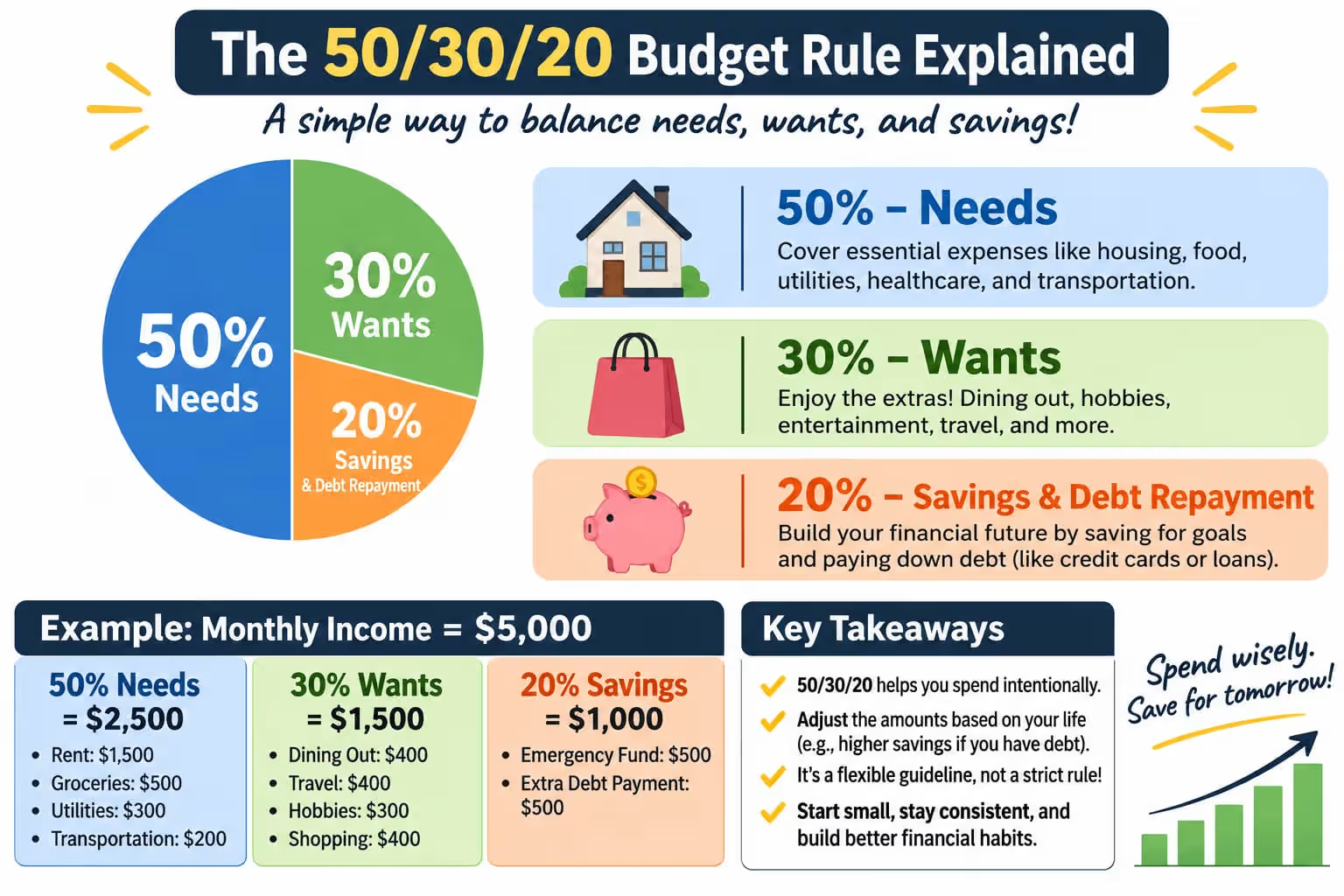
One commonly discussed budgeting framework is the 50/30/20 rule:
- 50% for needs.
- 30% for wants.
- 20% for savings and debt repayment.
This is a starting guideline, not a strict requirement.
If your income is limited or your housing costs are high, you may need a different allocation.
Pay Yourself First
Set aside your savings soon after receiving your income.
Do not wait until the end of the month to save whatever remains.
Avoid Lifestyle Inflation
When your income increases, avoid automatically increasing every expense.
Directing part of your salary increase toward investments can improve your long-term financial position.
Maintain a Good Credit Profile
Pay loan EMIs and credit card bills on time.
Monitor your credit report and avoid taking unnecessary loans.
Diversify Your Investments
Depending on your circumstances, diversification across asset classes may help reduce concentration risk.
However, diversification does not eliminate the possibility of losses.
Keep Important Financial Documents Organized
Maintain records of:
- Bank accounts.
- Investment statements.
- Insurance policies.
- Loan agreements.
- Tax documents.
- Nominee details.
- Retirement account information.
Review nominee details and keep your family informed about where essential financial records are maintained.
Review Investment Costs and Taxes
Returns should be evaluated after considering applicable expenses and taxes.
An investment with an attractive headline return may not deliver the same result after charges and taxation.
Financial Planning at Different Stages of Life
Financial priorities change as people move through different stages of life.
A strategy suitable for a 25-year-old may not be appropriate for someone approaching retirement.
Financial Planning in Your 20s
Your twenties are a useful time to develop financial discipline.
Important priorities include:
- Building an emergency fund.
- Avoiding unnecessary debt.
- Starting retirement investments.
- Learning basic investment concepts.
- Purchasing appropriate insurance.
- Developing career-related skills.
Even modest investments can provide a valuable starting point.
Financial Planning in Your 30s
Your thirties may involve increasing family and financial responsibilities.
Priorities may include:
- Buying a home.
- Planning children’s education.
- Increasing retirement contributions.
- Reviewing health and life insurance.
- Managing home or vehicle loans.
- Building a larger emergency reserve.
Try to balance major purchases with retirement savings.
Financial Planning in Your 40s
Your forties may be an important period for strengthening your financial position.
Consider:
- Increasing retirement savings.
- Reviewing children’s education targets.
- Reducing expensive debt.
- Evaluating existing investments.
- Planning healthcare expenses.
- Reviewing insurance coverage.
You may also need to reassess your retirement age and expected lifestyle.
Financial Planning in Your 50s
As retirement approaches, protecting accumulated wealth becomes increasingly important.
Consider:
- Reviewing retirement income requirements.
- Reducing excessive portfolio risk where appropriate.
- Evaluating outstanding liabilities.
- Planning healthcare expenses.
- Understanding retirement withdrawal rules.
- Reviewing pension and annuity options.
Your strategy should reflect how soon you will need the money.
Financial Planning After Retirement
After retirement, your financial priorities generally shift toward income management and capital preservation.
Important considerations include:
- Monthly living expenses.
- Medical expenses.
- Regular income sources.
- Inflation.
- Withdrawal rates.
- Emergency liquidity.
- Estate planning.
Avoid making investment decisions without considering how they could affect your long-term retirement income.
The Role of Technology in Financial Planning
Digital financial tools have made it easier to track income, expenses, investments, and savings goals.
You do not need expensive software to manage your finances.
Several simple tools can help.
1. Budgeting Applications
Budgeting applications can help categorize expenses and identify spending patterns.
Choose tools that provide suitable security and privacy protections.
2. SIP Calculators
SIP calculators estimate the potential future value of regular investments.
They are useful for understanding how monthly contributions and investment periods may affect outcomes.
Remember that calculator results are based on assumed returns, not guaranteed performance.
3. Retirement Calculators
Retirement calculators help estimate the amount you may need after retirement.
You can enter:
- Current age.
- Expected retirement age.
- Monthly expenses.
- Expected inflation.
- Existing retirement savings.
- Assumed investment returns.
The results should be treated as planning estimates.
4. Expense Tracking Spreadsheets
A simple spreadsheet can record:
- Monthly income.
- Essential expenses.
- Lifestyle expenses.
- Savings.
- Investments.
- Loan repayments.
- Financial goal progress.
Reviewing this information every month can help you identify areas for improvement.
5. Online Banking and Automatic Transfers
Standing instructions and automated transfers make it easier to maintain consistent savings habits.
Always protect your banking credentials and use secure financial applications.
Expert Tips for Improving Your Financial Goals
If you want to make your financial plan more effective, consider these practical recommendations.
1. Start with one important goal.
If you are new to financial planning, begin with an emergency fund or another high-priority objective.
2. Use realistic numbers.
Base your savings targets on actual income, expenses, and future requirements.
3. Avoid comparing your financial journey with others.
People have different salaries, responsibilities, family support, and financial obligations.
4. Increase investments gradually.
You can begin with a manageable monthly amount and increase it when your income improves.
5. Keep your emergency savings separate.
Avoid using emergency money for shopping, entertainment, or planned vacations.
6. Reassess investment risk as goals approach.
An investment strategy suitable 15 years before a goal may be inappropriate when the money is needed in six months.
7. Avoid emotional investing.
Do not make sudden investment decisions because of short-term market movements or social media recommendations.
8. Understand every financial product.
Read the terms, charges, risks, and withdrawal conditions before investing.
9. Protect your financial information.
Use strong passwords, two-factor authentication, and official financial platforms.
10. Seek professional guidance when needed.
A qualified financial adviser can help with complex decisions involving retirement, taxes, insurance, and investment allocation.
Financial Planning Challenges and Future Considerations
Financial planning is not a one-time activity. Economic conditions, personal responsibilities, technology, and financial products continue to evolve.
Several factors deserve attention.
Rising Living Costs
Housing, education, healthcare, and other essential expenses may increase over time.
Financial plans should account for changing costs rather than assuming today’s expenses will remain constant.
Changing Employment Patterns
Freelancing, contract work, entrepreneurship, and career changes can create irregular income.
People with variable earnings may benefit from maintaining larger cash reserves and using flexible savings targets.
Increasing Healthcare Requirements
Healthcare expenses can be difficult to predict.
Maintaining suitable health insurance and accessible emergency savings can help reduce financial uncertainty.
Market Volatility
Equity and debt markets can experience fluctuations.
Investors should avoid assuming that recent performance will continue indefinitely.
Digital Financial Scams
Online investment fraud, fake trading platforms, phishing messages, and fraudulent loan offers can threaten financial security.
Verify financial institutions and investment intermediaries before transferring money.
Never share OTPs, passwords, or banking PINs.
Changing Tax Rules
Tax rules and investment regulations can change.
Review current official guidance before making decisions involving tax-saving investments, retirement withdrawals, or other tax-sensitive financial products.
Frequently Asked Questions (FAQs)
1. What Is the Difference Between Short-Term and Long-Term Financial Goals?
Short-term financial goals are objectives you generally want to achieve within a few months to three years. Examples include building an emergency fund, paying off credit card debt, and saving for a vacation.
Long-term financial goals generally require five years or more. Examples include retirement planning, buying a house, and funding children’s higher education.
The main difference is the time horizon, which influences your savings strategy, investment choices, and risk tolerance.
2. What Are Five Examples of Short-Term Financial Goals?
Five common short-term financial goals are:
- Building an emergency fund.
- Saving for a family vacation.
- Paying off high-interest credit card debt.
- Purchasing a laptop or smartphone.
- Saving for a vehicle down payment.
These goals generally require accessible savings and careful budgeting.
3. What Are Five Examples of Long-Term Financial Goals?
Five examples include:
- Building a retirement fund.
- Purchasing a home.
- Funding children’s higher education.
- Achieving financial independence.
- Building long-term wealth.
These objectives usually require consistent savings, investment discipline, and periodic financial reviews.
4. How Much of My Salary Should I Save Every Month?
There is no single savings percentage suitable for everyone.
The 50/30/20 budgeting rule suggests allocating 20% of income toward savings and debt repayment. However, you can adjust this percentage based on your income, essential expenses, outstanding loans, and financial responsibilities.
The most important thing is to establish a sustainable savings habit and gradually improve it.
5. Which Is Better for Long-Term Financial Goals: SIP or FD?
SIPs and fixed deposits serve different purposes.
An SIP is a method of investing regularly in a mutual fund. Its returns depend on the underlying investment and are not guaranteed.
A fixed deposit offers predetermined interest terms for a specified period, subject to the bank’s conditions.
For long-term growth, diversified equity mutual funds may suit investors who can tolerate market risk. Fixed deposits may be more appropriate for investors prioritizing predictable returns and capital stability.
Your choice should depend on your financial goal, risk tolerance, and investment horizon.
6. How Much Money Should I Keep in an Emergency Fund?
A common starting point is three to six months of essential living expenses.
For example, if your essential monthly expenses are ₹30,000, you may target an emergency fund of ₹90,000 to ₹1,80,000.
If you are self-employed, have irregular income, or support several dependants, you may need a larger reserve.
7. Can I Work on Short-Term and Long-Term Financial Goals at the Same Time?
Yes. In fact, managing both together is generally a practical approach.
You can maintain separate savings for upcoming expenses while continuing suitable long-term investments.
For example, you might save monthly for a vacation, build an emergency fund, and invest toward retirement simultaneously.
The allocation should depend on your financial priorities and available income.
8. How Often Should I Review My Financial Goals?
Review your budget and savings progress every month.
A more comprehensive financial review can be conducted every six to twelve months or whenever a major life event occurs.
Check whether your income, expenses, investment allocation, and financial targets still match your circumstances.
Conclusion: Build a Strong Financial Future With Clear Goals
Financial success is not determined only by how much money you earn. It also depends on how effectively you manage, save, invest, and use that money.
Understanding financial goals: short-term vs long-term planning allows you to make informed decisions about both your immediate financial needs and future ambitions.
Short-term financial goals help you prepare for upcoming expenses, build emergency savings, manage debt, and maintain financial stability. Long-term financial goals help you prepare for major milestones such as purchasing a house, funding education, building wealth, and enjoying a financially secure retirement.
The best approach is to combine both strategies.
Start by calculating your income and expenses. Identify your most important financial goals, assign realistic amounts and deadlines, and select savings or investment options according to your time horizon and risk tolerance.
You do not need a large salary or substantial savings to begin. Even a small, consistent contribution can help you develop better financial habits.
Remember that financial planning is a continuous process. Your goals may change as your income, family responsibilities, and priorities evolve. Review your progress regularly and make adjustments whenever necessary.
Your next step: Write down three financial goals today—one short-term, one medium-term, and one long-term. Decide how much money each requires, set a deadline, and calculate your monthly savings target.
Start with what you can afford, remain consistent, and gradually increase your contributions.
A financially secure future begins with the decisions you make today.

Related Posts




Post Comment