







How to Create a Monthly Budget: A Beginner’s Guide to Managing Money and Saving More
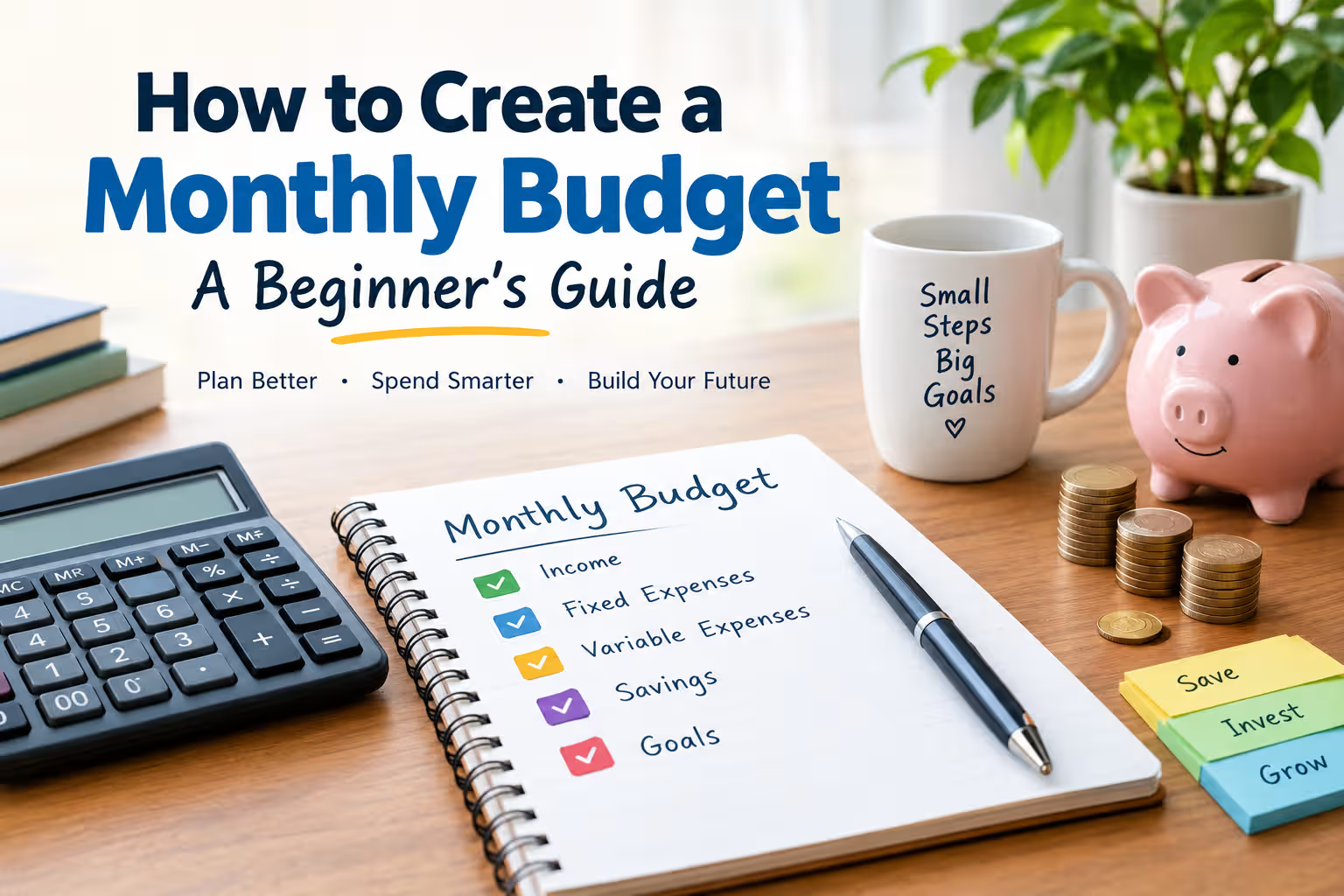
Creating a monthly budget is one of the most practical ways to take control of your finances. Whether you earn a fixed salary, work as a freelancer, run a small business, or manage a household, a clear budget helps you understand where your money goes, plan for upcoming expenses, and make progress toward your financial goals.
Many people assume budgeting means cutting out everything they enjoy or following a strict set of rules. In reality, a good monthly budget does the opposite: it gives you more control over your money. Instead of wondering why your salary disappears before the end of the month, you can decide in advance how much to spend, how much to save, and how much to set aside for unexpected expenses.
You do not need an advanced spreadsheet, expensive financial software, or a high income to get started. A notebook, a basic calculator, or a free budgeting app can be enough. What matters most is having an accurate picture of your income and expenses and reviewing your plan regularly.
This beginner’s guide explains how to create a monthly budget step by step, choose a budgeting method that fits your lifestyle, manage everyday expenses, build savings, and avoid common financial mistakes. It also includes practical examples and a sample monthly budget you can adapt to your own circumstances.
By the end, you will have a straightforward system for managing your money with greater confidence, even if you have never created a budget before.
What Is a Monthly Budget?
A monthly budget is a plan for how you will use the money you expect to receive and spend during a particular month. It organizes your income into categories such as housing, food, transportation, savings, debt repayments, insurance, and personal expenses.
The purpose is to make sure your money supports your needs and priorities rather than disappearing through unplanned spending.
For example, suppose your monthly take-home income is ₹35,000. You might allocate part of it to rent, groceries, utility bills, transportation, savings, and entertainment. Before the month begins, you decide how much you can reasonably spend in each category.
As the month progresses, you compare your actual expenses with your planned amounts. If your grocery spending is higher than expected, you can adjust another flexible category or revise the following month’s budget.
A budget is not a prediction that every expense will go exactly as planned. It is a financial guide that helps you make informed decisions when circumstances change.
Why Is Monthly Budgeting Important?
A monthly budget can help you:
- Understand your spending: Identify where your money goes and recognize patterns that may be costing you more than expected.
- Avoid running out of money: Plan for bills and essential purchases before spending on less important things.
- Build savings consistently: Treat savings as a planned financial priority instead of relying on whatever remains at the end of the month.
- Prepare for emergencies: Gradually build a reserve for unexpected medical costs, repairs, or temporary income loss.
- Manage debt: Set aside money for loan payments and credit card balances while avoiding unnecessary borrowing.
- Work toward long-term goals: Save for education, a home, a vehicle, travel, retirement, or other meaningful objectives.
- Reduce financial uncertainty: Replace guesswork with a clearer understanding of what you can afford.
A monthly budget is useful whether you earn ₹15,000 or ₹1,50,000. The appropriate amounts will differ, but the underlying principle remains the same: give every part of your income a clear purpose.
How to Create a Monthly Budget: A Step-by-Step Guide
The easiest way to start budgeting is to build a simple system and improve it as you learn more about your spending habits.
You do not need to get every category right immediately. Start with realistic estimates, track your actual expenses, and make adjustments based on what happens during the month.
Step 1: Calculate Your Total Monthly Income
Before deciding how much to spend, determine how much money you actually have available.
Your budget should be based on the money you can reasonably expect to receive, not your ideal income or the amount shown on a salary offer.
What Should You Include in Your Monthly Income?
Depending on your circumstances, your income may include:
- Monthly salary after taxes and payroll deductions
- Freelance or consulting payments
- Business income available for personal use
- Rental income after relevant property expenses
- Pension payments
- Regular financial support from family
- Reliable side-hustle earnings
- Interest or other recurring income
If you receive a salary, use your take-home pay rather than your gross salary. Your gross salary may include amounts that are deducted for taxes, retirement contributions, insurance, or other payroll items.
For example, if your monthly gross salary is ₹40,000 but you receive ₹36,500 in your bank account, use ₹36,500 as your starting figure for a personal spending budget.
How to Budget With an Irregular Income
Freelancers, business owners, commission-based workers, and seasonal employees may not receive the same amount every month.
In that situation, estimate a conservative monthly income using your recent earnings history. If income varies considerably, use a cautious figure that you can reasonably expect to receive rather than your best month.
For example:
| Month | Take-home income |
|---|---|
| January | ₹32,000 |
| February | ₹27,000 |
| March | ₹36,000 |
| April | ₹30,000 |
The average across these four months is ₹31,250. However, if your income is unpredictable, it may be safer to build your essential budget around a lower, dependable amount and use additional earnings to replenish savings, cover irregular bills, or meet financial goals.
For business owners, distinguish between business revenue and personal income. Money received by a business is not automatically available for household spending because operating expenses, taxes, and other obligations may still need to be paid.
Beginner tip: Start with your most reliable monthly income figure. A conservative budget is easier to manage than one that depends on money you might not receive.
Step 2: Track Your Expenses for One Month
Once you know your income, identify where your money goes.
This step is often more revealing than people expect. Small purchases, delivery fees, subscriptions, impulse buys, and frequent online orders can collectively make a noticeable difference to a monthly budget.
The objective is not to criticize your spending. It is to understand your habits so that you can decide what to change.
How to Track Your Expenses
Choose one simple method:
- Notebook: Write down each purchase and bill payment.
- Spreadsheet: Record expenses in Excel or Google Sheets.
- Budgeting app: Use an app that lets you categorize transactions.
- Bank statements: Review your account statements and transaction history.
- Expense tracker: Maintain a simple list on your phone.
Record the date, amount, category, and a short description of each transaction.
For example:
| Date | Expense | Category | Amount |
|---|---|---|---|
| October 1 | Grocery shopping | Groceries | ₹1,200 |
| October 2 | Bus pass | Transport | ₹600 |
| October 3 | Mobile recharge | Communication | ₹299 |
| October 4 | Coffee and snacks | Eating out | ₹180 |
| October 5 | Electricity bill | Utilities | ₹1,100 |
Review your records at the end of each week.
If you do not have a month of expense records yet, review the previous one or two months of bank statements and receipts. Use those figures as an initial estimate, then track your actual spending going forward.
Separate Needs, Wants, and Financial Goals
A useful way to organize your expenses is to divide them into three broad groups.
1. Needs
Essential expenses such as rent, basic groceries, electricity, necessary transport, medicines, insurance, and minimum debt payments.
2. Wants
Discretionary spending such as restaurant meals, entertainment, nonessential shopping, premium subscriptions, and hobbies.
3. Financial goals
Money allocated to emergency savings, future purchases, investments, retirement, and additional debt repayment.
Some expenses can fall into different categories depending on your situation. For example, a mobile phone may be necessary for work, while an expensive phone upgrade may be discretionary.
The purpose of these categories is to help you prioritize, not to create rigid rules about what you are allowed to buy.
Step 3: List Your Fixed and Variable Expenses
After tracking your spending, organize expenses according to how predictable they are.
Fixed Expenses
Fixed expenses are payments that remain relatively consistent from month to month.
Examples include:
- Rent
- Home loan or other loan installments
- School or college fees paid monthly
- Insurance premiums paid monthly
- Internet plans
- Regular subscriptions
- Certain maintenance charges
These costs are often easier to plan for because their amounts are known in advance.
Variable Expenses
Variable expenses fluctuate depending on your needs and usage.
Examples include:
- Groceries
- Electricity and water bills
- Fuel and public transport
- Medical expenses
- Household supplies
- Dining out
- Clothing
- Entertainment
Variable costs require more monitoring because the final amount can differ from your estimate.
Remember Irregular Expenses
One common budgeting mistake is planning only for bills that arrive every month.
Annual insurance premiums, vehicle servicing, school admissions, festivals, family celebrations, home repairs, and yearly subscriptions can disrupt an otherwise sensible budget.
Create a separate category for these irregular expenses.
Suppose you expect to pay ₹12,000 for annual vehicle insurance. Setting aside ₹1,000 each month gives you ₹12,000 over twelve months, assuming you start at the beginning of the saving period and do not withdraw the money.
Similarly, if you expect to spend ₹6,000 on a festival, you could save ₹1,000 monthly for six months.
This approach spreads predictable large expenses across several months instead of forcing you to find the entire amount at once.
Step 4: Choose a Monthly Budgeting Method
There is no single budgeting method that works for everyone. Your best option depends on your income, living expenses, financial goals, and how much detail you want to track.
Here are four useful methods for beginners.
Method 1: The 50/30/20 Budget Rule
The 50/30/20 rule divides your after-tax income into three broad categories:
- 50% for needs
- 30% for wants
- 20% for savings and debt repayment beyond required minimums
For someone earning ₹30,000 per month, the suggested allocation would look like this:
| Category | Percentage | Amount |
|---|---|---|
| Needs | 50% | ₹15,000 |
| Wants | 30% | ₹9,000 |
| Savings and additional debt repayment | 20% | ₹6,000 |
| Total | 100% | ₹30,000 |
This method is easy to remember and offers a useful starting point for organizing your money.
However, the percentages are guidelines, not mandatory limits. A person living in a high-rent city or supporting family members may need to spend substantially more than 50% on essentials. Someone with significant high-interest debt may need to allocate more toward repayment.
If the 50/30/20 split does not fit your circumstances, adjust it to match your actual financial responsibilities.
Method 2: Zero-Based Budgeting
Zero-based budgeting means assigning a purpose to every unit of your planned income.
The calculation is:
\[ \text{Income} – \text{Planned allocations} = 0 \]
This does not mean spending all your money. Savings, emergency funds, investments, and debt repayments are also allocations.
For example, a monthly income of ₹35,000 could be allocated as follows:
| Category | Planned amount |
|---|---|
| Rent | ₹9,000 |
| Groceries | ₹5,000 |
| Utilities and phone | ₹1,800 |
| Transport | ₹2,200 |
| Insurance and medical costs | ₹1,500 |
| Debt repayment | ₹3,000 |
| Emergency savings | ₹3,000 |
| Long-term savings | ₹2,500 |
| Personal and household spending | ₹2,500 |
| Irregular expense fund | ₹2,000 |
| Miscellaneous buffer | ₹2,500 |
| Total allocated | ₹35,000 |
Every rupee has a job, even if that job is remaining in savings.
Zero-based budgeting is particularly useful when money feels tight, your expenses are complicated, or you want to understand exactly where your income is going.
Method 3: The Envelope Budgeting Method
Envelope budgeting assigns a specific amount to each spending category.
Traditionally, people placed cash in separate envelopes marked groceries, transport, entertainment, and household expenses. When an envelope was empty, spending in that category stopped until the next budget period, except where an essential need required a deliberate adjustment.
Today, you can use the same idea with separate bank accounts, digital wallets, or spreadsheet categories.
For example, you might allocate:
- ₹5,000 for groceries
- ₹2,000 for transportation
- ₹1,500 for eating out
- ₹1,000 for personal shopping
Track the remaining balance in each category as you spend.
This method is helpful if you frequently exceed your limits in a few specific categories. It creates a visible boundary without requiring you to monitor every financial detail.
Avoid keeping unnecessary amounts of physical cash if doing so would create a security risk. Digital category tracking can provide similar benefits.
Method 4: Pay Yourself First
With this method, you set aside money for savings as soon as your income arrives, then use the remainder for planned expenses.
For example, if your take-home salary is ₹32,000 and your initial savings target is ₹2,000, transfer that amount into a suitable savings account after payday. Build the rest of your budget around the remaining ₹30,000.
The amount should be realistic. If you cannot consistently save ₹2,000, start with ₹500 or another manageable amount and increase it when your circumstances permit.
Paying yourself first works well for people who tend to spend whatever money remains in their account. It also makes saving a deliberate habit rather than an occasional activity.
Which Budgeting Method Should You Choose?
| Budgeting method | Best suited for |
|---|---|
| 50/30/20 rule | Beginners who want a simple starting framework |
| Zero-based budgeting | People who want detailed control over every allocation |
| Envelope budgeting | People who struggle to control specific spending categories |
| Pay yourself first | People who want to prioritize savings consistently |
You can also combine methods. For example, use the 50/30/20 rule to set broad targets and envelope budgeting to manage groceries, transport, and entertainment.
The best monthly budgeting method is the one you can maintain consistently.
Step 5: Set Realistic Spending Limits
Once you have chosen a budgeting method, assign a reasonable amount to each category.
Start with your actual expenses rather than copying someone else’s budget.
If your groceries typically cost ₹5,500 a month, setting a target of ₹3,000 without changing your shopping habits may lead to frustration. A better approach is to set a realistic target, identify opportunities to save, and revise the amount after observing your results.
Prioritize Essential Expenses First
Allocate money for the following before deciding how much you can spend on nonessential purchases:
- Housing and basic household costs
- Food and essential supplies
- Utilities and necessary communication
- Transport required for work, education, or caregiving
- Medical needs and appropriate insurance
- Required debt payments
- Savings for emergencies and upcoming obligations
The precise order may change depending on your situation. For example, an overdue essential bill or an urgent medical need may require immediate attention.
After covering essential obligations, decide how much to allocate to entertainment, dining out, shopping, and other flexible expenses.
Create a Small Miscellaneous Category
Unexpected small expenses occur even when you plan carefully.
You may need replacement household items, pay a small repair bill, or travel unexpectedly. If every rupee has already been assigned to another expense, these costs can throw off your budget.
Include a modest miscellaneous allowance if your income permits. You can increase or decrease it after reviewing your spending history.
If you do not use the full amount, move the remainder to savings or another financial priority at the end of the month.
Step 6: Create a Monthly Savings Plan
Saving money is easier when you decide what you are saving for and how much you can reasonably set aside.
Instead of treating savings as one large, undefined goal, divide them into purposes.
Build an Emergency Fund
An emergency fund is money reserved for unexpected expenses or financial disruptions, such as urgent medical treatment, necessary home repairs, or a temporary loss of income.
Without an emergency reserve, an unexpected expense may force you to borrow money or use funds intended for other goals.
A practical approach is to build your emergency savings gradually:
- Start with a small initial target that feels achievable.
- Set aside a consistent amount after payday.
- Keep emergency money separate from everyday spending money.
- Increase the reserve as your income and financial situation improve.
A commonly used longer-term target is three to six months of essential living expenses, although the appropriate amount depends on your circumstances. Someone with irregular income, dependants, or limited job security may need a larger reserve, while someone starting from zero can work toward a smaller first milestone.
For example, if your essential monthly expenses are ₹20,000, a three-month reserve would be ₹60,000. A six-month reserve would be ₹1,20,000.
You do not need to accumulate the full amount immediately. Start with a target such as ₹5,000 or ₹10,000 and build from there.
Keep emergency money accessible and prioritize safety and liquidity over trying to earn the highest possible return.
Save for Short-Term Goals
Short-term savings cover expenses you expect to face in the relatively near future.
Examples include:
- Buying a laptop
- Paying an education fee
- Planning a holiday
- Purchasing household appliances
- Paying an insurance premium
- Funding a wedding or family event
Suppose you want to buy a laptop worth ₹30,000 in ten months. If you start from zero and save evenly, you need to set aside ₹3,000 per month.
This is a simple calculation:
\[ \text{Monthly savings target} = \frac{\text{Goal amount}}{\text{Months remaining}} \]
If the required amount is too high, you can extend the timeline, choose a less expensive option, or adjust other discretionary spending.
Plan for Long-Term Financial Goals
Long-term goals may include retirement, buying a home, funding higher education, or building wealth.
The monthly budget should make room for these goals when your essential expenses and near-term obligations allow it.
The appropriate savings or investment vehicle depends on the time horizon, risk tolerance, liquidity needs, and personal circumstances. Money needed soon generally should not be exposed to large short-term market fluctuations merely in pursuit of higher returns.
Do not confuse saving with investing. Savings provide money for planned expenses and emergencies, while investments may help pursue longer-term objectives but can involve market risk.
Step 7: Manage Debt and Loan Payments
Debt repayment deserves a clear place in your monthly budget because missed payments can create additional charges, damage your credit history, and increase financial pressure.
List each debt with its current balance, interest rate, required minimum payment, and due date.
Include obligations such as:
- Personal loans
- Education loans
- Vehicle loans
- Home loans
- Credit card balances
- Buy-now-pay-later installments
- Other outstanding borrowings
Choose a Debt Repayment Strategy
Two commonly used methods are the debt avalanche and debt snowball approaches.
Debt avalanche: Pay the required minimum on each debt and direct additional repayment money toward the debt with the highest interest rate. This generally reduces interest costs compared with prioritizing a lower-rate debt, assuming other terms are comparable.
Debt snowball: Pay the required minimum on each debt and direct extra money toward the smallest balance first. Clearing a smaller debt may provide a sense of progress and make it easier to maintain the habit.
For either approach, continue meeting the minimum obligations on other debts. Check for prepayment fees, special loan terms, and other conditions before making additional payments.
Be Careful With Credit Card Spending
Credit cards can be useful payment tools, but they should not be treated as extra income.
Include card purchases in the relevant expense categories when you make them. When you pay the credit card bill, record the payment as settling the outstanding balance rather than counting the same purchases as new expenses a second time.
For example, if you spend ₹4,000 on groceries using a credit card, record ₹4,000 under groceries. When you pay that ₹4,000 bill, record the payment against your credit card liability rather than adding another ₹4,000 to your grocery total.
This prevents double-counting and gives you a more accurate picture of your spending.
If you carry a balance and incur high interest charges, review your repayment priorities and avoid adding new discretionary debt wherever possible.
Step 8: Build a Budget Around Your Pay Schedule
The timing of your income and bills matters just as much as the total amounts.
You might earn enough to cover your monthly expenses but still run short if several bills are due before your next salary arrives.
Create a Bill Calendar
List the dates on which you expect to receive income and the dates on which payments are due.
For example:
| Date | Financial activity |
|---|---|
| 1st | Salary received |
| 3rd | Rent payment |
| 5th | Insurance premium |
| 10th | Loan installment |
| 15th | Utility bills |
| 20th | Savings transfer |
| 25th | Review remaining spending money |
These dates are only an example. Use the actual schedule that applies to you.
If your salary arrives late in the month, you may need to keep enough money from the previous paycheck to cover bills due before the next one.
Use Weekly Spending Limits
Monthly budgets can feel difficult to manage because the remaining balance is not always obvious.
Breaking flexible spending into weekly amounts can make it easier to stay on track.
Suppose your monthly grocery allowance is ₹6,000. Dividing it into four weekly limits gives you ₹1,500 per week as a simple starting point.
However, calendar months are longer than four weeks, so a more accurate average is approximately ₹1,385 per week when spread across 52 weeks of the year:
\[ \frac{₹6,000 \times 12}{52} \approx ₹1,385 \]
You can also divide a monthly allowance into weekly amounts and keep a small portion for months with five shopping weeks.
Weekly limits work particularly well for groceries, transport, eating out, and other expenses that occur frequently.
Step 9: Choose a Budgeting Tool You Will Actually Use
A budget does not need to be complicated. Select a tool that fits your comfort level and makes expense tracking convenient.
Option 1: Notebook and Pen
A notebook is suitable if you prefer writing things down or do not want to use digital tools.
Create four columns:
- Date
- Expense description
- Category
- Amount
At the end of the week, total each category and compare it with your budget.
The main advantage is simplicity. The drawback is that calculations and summaries may take more time.
Option 2: Excel or Google Sheets
A spreadsheet is useful if you want automatic totals and a clear monthly overview.
You can create columns for the category, planned amount, actual amount, and difference.
For example:
| Category | Planned | Actual | Remaining |
|---|---|---|---|
| Groceries | ₹5,000 | ₹4,600 | ₹400 |
| Transport | ₹2,000 | ₹2,200 | -₹200 |
| Entertainment | ₹1,500 | ₹1,100 | ₹400 |
The remaining amount is calculated as planned spending minus actual spending. A negative amount indicates that you exceeded your target.
A spreadsheet can also display monthly savings, category totals, and trends over time.
Option 3: Budgeting Apps
Budgeting apps can make it easier to categorize expenses, review transactions, and monitor spending patterns.
Before selecting an app, consider:
- Whether it supports the accounts and payment methods you use
- Whether automatic transaction imports are available and reliable
- Whether manual expense entry is possible
- What personal and financial data it collects
- Whether it charges a subscription fee
- Whether you can export your records
- Whether its features are genuinely useful for your needs
Read the privacy policy and review permissions before connecting financial accounts. Never share your banking password, one-time password, card PIN, or other authentication credentials with an untrusted service.
You do not need a paid app to create an effective monthly budget.
Practical Example: A Monthly Budget for a ₹30,000 Salary
Let’s put the steps together using a hypothetical employee who receives ₹30,000 in monthly take-home pay.
The employee lives in a rented home, pays regular household bills, uses public transport, and wants to build savings without eliminating all discretionary spending.
EXAMPLE MONTHLY BUDGET
₹30,000
Monthly take-home income
Rent
₹8,000
Groceries
₹4,500
Utilities and phone
₹1,500
Transportation
₹1,800
Insurance and medical
₹1,200
Debt repayment
₹2,000
Emergency savings
₹2,500
Long-term savings
₹1,500
Personal and entertainment
₹2,000
Irregular expenses
₹1,500
Miscellaneous
₹3,500
Total allocated
₹30,000
This is an illustrative budget, not a recommended allocation for every person. The relatively large miscellaneous allowance is included to demonstrate how an entire income can be assigned a purpose, but it should be refined using actual expenses. If the person needs more money for essentials, the discretionary and savings allocations may need to change.
How to Evaluate This Budget
The first thing to check is whether essential expenses are realistic. If rent is actually ₹12,000 rather than ₹8,000, the budget must be revised before the month begins.
Next, identify whether the savings targets are affordable. This example sets aside ₹4,000 across emergency and long-term savings, in addition to money for irregular expenses. If that amount is too difficult to maintain, a smaller initial savings target is better than repeatedly abandoning the budget.
Finally, compare actual spending against the planned figures throughout the month.
Suppose transportation costs ₹2,300 instead of ₹1,800. You are ₹500 over budget in that category. You can investigate whether the increase was temporary, revise next month’s transport allowance, or reduce a flexible expense by ₹500 if appropriate.
Do not automatically reduce food, necessary medicines, or other essential spending simply to preserve an arbitrary target.
What If Your Salary Is Only ₹15,000?
A smaller income requires a different approach.
Start by listing housing, food, essential travel, utilities, medical needs, and minimum debt payments. These may account for most of your income, particularly if you support dependants or live in an expensive area.
Instead of forcing a 50/30/20 split, calculate the amount remaining after essential costs. Use whatever is genuinely affordable for a small emergency reserve, upcoming obligations, and discretionary spending.
For example, if your essential expenses total ₹12,500, only ₹2,500 remains for all other purposes. Your budget needs to reflect that reality.
If essential expenses consistently exceed income, cutting small luxuries may not be enough. You may need to explore lower-cost housing or transport options where practical, negotiate payment arrangements, check eligibility for relevant benefits, or pursue additional income opportunities.
Budgeting helps you identify the problem, but it cannot always solve a structural gap between income and necessary living costs.
How to Create a Monthly Budget When Your Financial Situation Is Different
A budgeting method should adapt to your circumstances. The same spending plan will not work equally well for a student, a family with children, a freelancer, and a person managing debt.
Monthly Budget for Students
Students may have limited income from family support, scholarships, part-time work, or internships.
A student budget should account for:
- Accommodation and hostel fees
- Food and groceries
- Books, course materials, and internet access
- Transportation
- Mobile recharge
- Education-related fees
- Personal expenses
- Emergency money
Separate education costs from general spending so that you know how much money is available for everyday needs.
If you receive a semester allowance, divide it across the months it must cover. Remember to reserve money for examination fees, books, travel home, and other expenses that do not occur every month.
Monthly Budget for Families
A household budget should reflect shared responsibilities and the needs of everyone who depends on the household income.
Include childcare, school fees, medical expenses, groceries, housing, transportation, insurance, and family-related savings goals.
If two adults contribute income, calculate the total dependable household take-home income and list the expenses the household is responsible for paying.
Discuss priorities together. One person may prioritize saving for a home, while another may be concerned about education costs or emergency savings. Agreeing on shared goals makes it easier to make spending decisions.
Keep some room for individual discretionary spending where the household budget allows. This can reduce disagreements over small personal purchases.
Monthly Budget for Freelancers and Business Owners
Irregular income makes planning more complicated because payments may arrive late or vary significantly.
A useful approach is to separate business finances from personal finances. Track business income, operating costs, taxes, and other obligations before deciding how much money is available for personal use.
Consider these practices:
- Use a conservative personal income estimate.
- Keep a reserve for months when payments are delayed.
- Set aside money for taxes according to the rules that apply to your circumstances.
- Build personal emergency savings separately from business working capital.
- Avoid increasing regular spending after one unusually profitable month.
- Review your budget when major client contracts or business costs change.
For freelancers, a strong budget needs to account for cash flow as well as profitability. An invoice that has not been paid cannot necessarily cover a bill due today.
Monthly Budget for People Paying Off Loans
If loan installments take up a large share of your income, start by listing all required payments and due dates.
Protect the money needed for essential living expenses and contractual minimum payments. Then assess whether additional repayment is affordable.
Review your loan interest rates and terms, and consider whether a repayment strategy that targets high-interest debt would help. Avoid taking out additional expensive loans simply to make a budget appear balanced.
If you are already struggling to make payments, contact your lender promptly to ask about available options. Do not assume that ignoring the problem will make it easier to resolve.
Best Practices for Maintaining a Monthly Budget
Creating a budget is only the beginning. The real benefit comes from using it consistently and changing it when your circumstances change.
1. Review Your Budget Every Week
Set aside 10–15 minutes each week to check your spending.
Ask yourself:
- How much have I spent so far?
- Which categories are close to their limits?
- Are any important bills due soon?
- Did I make an unplanned purchase?
- Do I need to adjust the remaining budget?
A short weekly review can reveal problems while there is still time to respond.
2. Automate Savings When Possible
If your income arrives predictably, you can schedule a transfer to a separate savings account shortly after payday.
Choose an amount that will not interfere with essential bills. Confirm that the transfer date and account balance are suitable to avoid failed payments or overdraft charges.
Automation can reduce the need to remember every month, but it does not replace reviewing your budget.
3. Use Separate Accounts or Categories for Different Purposes
Keeping emergency savings separate from everyday spending can make it less tempting to use that money for routine purchases.
You might use one account for bills, another for general spending, and an appropriate savings account for emergency reserves.
You do not necessarily need several bank accounts. Separate categories in a spreadsheet or budgeting app may provide sufficient organization.
4. Plan for Major Expenses in Advance
Check your calendar for upcoming insurance renewals, school fees, festivals, travel, and annual subscriptions.
Estimate the amount and the number of months remaining before payment is due. Then calculate the monthly amount needed.
If the payment is due soon and you have not saved enough, you may need to adjust other expenses, use available savings, or reconsider the purchase. Do not assume that dividing a bill by twelve will work if there are only two months left.
5. Adjust Your Budget After Income Changes
If your salary increases, avoid immediately committing the entire increase to new recurring expenses.
Consider directing some of the additional income toward emergency savings, debt repayment, or long-term goals.
If income falls, review discretionary spending promptly and reassess your essential costs. A budget should reflect your current financial reality rather than an outdated salary or lifestyle.
6. Make Room for Enjoyment
A sustainable budget should include some spending that you genuinely value, as long as essential needs and financial obligations are covered.
If you enjoy meeting friends, watching films, or buying books, include a reasonable allowance for those activities. A plan that eliminates every enjoyable purchase may be difficult to maintain.
The goal is not to spend as little as possible. It is to spend intentionally while making progress toward your priorities.
Common Monthly Budgeting Mistakes to Avoid
Even a well-designed budget can fail if it relies on unrealistic assumptions or is never updated.
Mistake 1: Underestimating Small Expenses
A coffee, snack, delivery fee, or small online purchase may seem insignificant on its own. Repeated spending can add up over a month.
How to avoid it: Record purchases as they happen. Review transaction histories and include small recurring costs in your budget.
Mistake 2: Forgetting Annual and Irregular Bills
A budget that includes only monthly payments may look affordable until an insurance renewal or school fee arrives.
How to avoid it: Maintain a list of predictable irregular expenses and set aside money in advance.
Mistake 3: Setting Unrealistically Low Spending Limits
If your planned grocery budget is far below what you normally need, you may exceed it repeatedly.
How to avoid it: Start with actual spending figures, identify realistic savings opportunities, and make gradual changes.
Mistake 4: Treating Savings as Whatever Is Left Over
When savings have no specific allocation, other purchases can easily consume the available money.
How to avoid it: Set a manageable savings target and include it in your plan from the beginning.
Mistake 5: Ignoring Cash Spending
It is easy to track digital payments while forgetting cash withdrawals and purchases.
How to avoid it: Record cash withdrawals as transfers to a cash-spending balance, then track the purchases made with that cash. Avoid counting both the withdrawal and each purchase as separate expenses.
Mistake 6: Giving Up After One Bad Month
An unexpected repair or a higher-than-usual utility bill does not mean your budget has failed.
How to avoid it: Identify the cause, make an appropriate adjustment, and continue. A useful budget is flexible enough to accommodate reasonable changes.
Mistake 7: Comparing Your Budget With Someone Else’s
Your housing costs, family responsibilities, location, income, and financial goals may be completely different from those of a friend or relative.
How to avoid it: Use budgeting rules as reference points, not as measures of personal success. Focus on whether your plan is realistic and improving your financial position.
Mistake 8: Forgetting to Check the Budget Against Your Bank Balance
A spreadsheet can show a positive budget balance even when an automatic payment is about to leave your account.
How to avoid it: Reconcile your records with actual bank balances and pending transactions. Distinguish money that is already committed to bills from money that is genuinely available to spend.
Expert Tips to Make Budgeting Easier
Once you have established a basic monthly budget, a few refinements can make it more useful.
Use a payday routine. When income arrives, review upcoming bills, set aside savings, and confirm how much remains for flexible spending.
Create a waiting period for nonessential purchases. For larger purchases, consider waiting 24–48 hours before buying. This can help you distinguish a genuine need from an impulse.
Review recurring subscriptions. Check whether you still use each service and whether a less expensive plan would meet your needs. Canceling something you do not use is usually easier than repeatedly trying to compensate for it in other categories.
Use sinking funds. A sinking fund is money gradually accumulated for a known future expense. You might maintain separate savings targets for vehicle maintenance, annual insurance, education, or holiday spending.
Measure progress in more than one way. Track whether bills are paid on time, whether debt balances are declining, whether emergency savings are growing, and whether unplanned spending is becoming easier to manage.
Keep the system simple at first. Start with perhaps eight to twelve useful categories. Add detail only when it helps you make better decisions.
Revisit financial priorities after major life events. Moving homes, having a child, changing jobs, starting a business, or taking on a new loan can substantially change your budget.
A budget is most useful when it reflects the life you actually live.
Your First-Month Monthly Budget Checklist
Use this checklist to turn the advice in this guide into a practical routine.
Your budgeting checklist
0 of 8
Understand my finances
Calculate take-home income and review recent transactions.
List all expenses
Include fixed, variable, annual, and irregular costs.
Choose a method
Select a percentage-based, zero-based, envelope, or pay-yourself-first approach.
Set spending limits
Prioritize essential bills and choose realistic category amounts.
Plan my savings
Choose an initial emergency fund target and one other financial goal.
Organize payment dates
Record salary dates, bill deadlines, and scheduled transfers.
Track spending weekly
Compare actual expenses with the plan and adjust when necessary.
Review the month
Calculate total spending, savings, and changes needed for next month.
Reset checklist
You can complete these steps over a few days rather than trying to organize everything at once. The aim is to establish a routine that you can repeat every month.
Frequently Asked Questions About Creating a Monthly Budget
1. How do I create a monthly budget for the first time?
Start by calculating your monthly take-home income. List your essential bills, variable expenses, debt payments, and upcoming irregular costs. Choose a budgeting method, assign amounts to each category, and decide how much you can save. Track your spending weekly and review the results at the end of the month. Your first budget is a starting point, not a final version.
2. What is the 50/30/20 rule in budgeting?
The 50/30/20 rule suggests allocating 50% of after-tax income to needs, 30% to wants, and 20% to savings and additional debt repayment. For example, on a monthly income of ₹40,000, the suggested allocations are ₹20,000, ₹12,000, and ₹8,000. These percentages are flexible guidelines and may need to change based on housing costs, family responsibilities, and existing debt.
3. How much money should I save every month?
There is no single savings amount that suits everyone. It depends on your income, necessary expenses, debt obligations, and goals. If possible, choose a consistent monthly target and increase it as your financial circumstances improve. Even a small, regular contribution can help establish a savings habit. Prioritize building an emergency reserve and account for high-interest debt when deciding how to allocate your money.
4. How can I manage a monthly budget on a low salary?
Begin with essential expenses such as housing, food, utilities, transportation, and necessary medical costs. Review your spending to identify avoidable fees, unused subscriptions, and discretionary purchases that can be reduced. Plan for irregular bills and save whatever amount is realistically affordable. If essential expenses exceed your income, consider practical ways to lower major costs, increase income, or access relevant assistance rather than relying entirely on small spending cuts.
5. Which is the best budgeting method for beginners?
The 50/30/20 rule is a straightforward starting point for people who want a simple structure. Zero-based budgeting offers more detailed control, while envelope budgeting can help people manage categories where they tend to overspend. Pay-yourself-first budgeting is useful for prioritizing savings. The best choice is the method you can follow consistently and adapt to your actual income and expenses.
6. Should I use a budgeting app or Excel?
Both can work well. Excel or Google Sheets provides flexibility and lets you customize categories, calculations, and savings targets. A budgeting app may make transaction tracking more convenient, particularly if it supports your payment methods. A notebook is also sufficient. Choose the tool you are comfortable maintaining, and consider privacy and fees before connecting any financial accounts.
7. What should I do if I go over my monthly budget?
First, identify why the overspending occurred. Determine whether it resulted from an emergency, an underestimated expense, or an avoidable purchase. Cover essential obligations, adjust remaining flexible spending where reasonable, and revise next month’s budget if the expense is likely to recur. Do not abandon your entire plan because of one difficult month. A budget should help you respond to problems, not make you feel that every deviation is a failure.
8. When should I review or update my monthly budget?
Review your spending at least once a week and complete a more thorough review at the end of each month. Update your budget whenever your income, housing costs, family responsibilities, debt payments, or financial goals change significantly. Regular reviews help you identify spending patterns, prepare for upcoming expenses, and keep your financial plan relevant.
Conclusion: Start Your Monthly Budget Today
Learning how to create a monthly budget is a practical first step toward managing money more confidently. You do not need a high salary, complicated financial software, or perfect spending habits to begin. You need a clear understanding of your income, a realistic view of your expenses, and a plan that reflects your priorities.
Start by calculating your take-home income and tracking where your money goes. Separate essential expenses from discretionary spending, account for irregular bills, choose a budgeting method, and establish a savings target that fits your circumstances. Then review your progress regularly and adjust your plan as needed.
Remember that budgeting is not about eliminating every pleasure or achieving perfect numbers. It is about making deliberate choices, preparing for future expenses, and directing your money toward what matters most to you.
Your first budget may need several adjustments before it feels comfortable. That is normal. Each month gives you more information about your spending habits and helps you make better financial decisions.
Your next step: Set aside 20–30 minutes today to write down your monthly income, essential expenses, debt payments, and savings goals. Create a simple budget for the coming month, track your spending weekly, and review your results at the end of the month.
Start with the money you have, make a plan you can maintain, and improve it one month at a time.
How to Save Money on a Low Salary
Share this content:




Post Comment