






GST Bachat Utsav 2026: How GST 2.0 and Income Tax Relief Could Save Indians Over ₹2.5 Lakh Crore
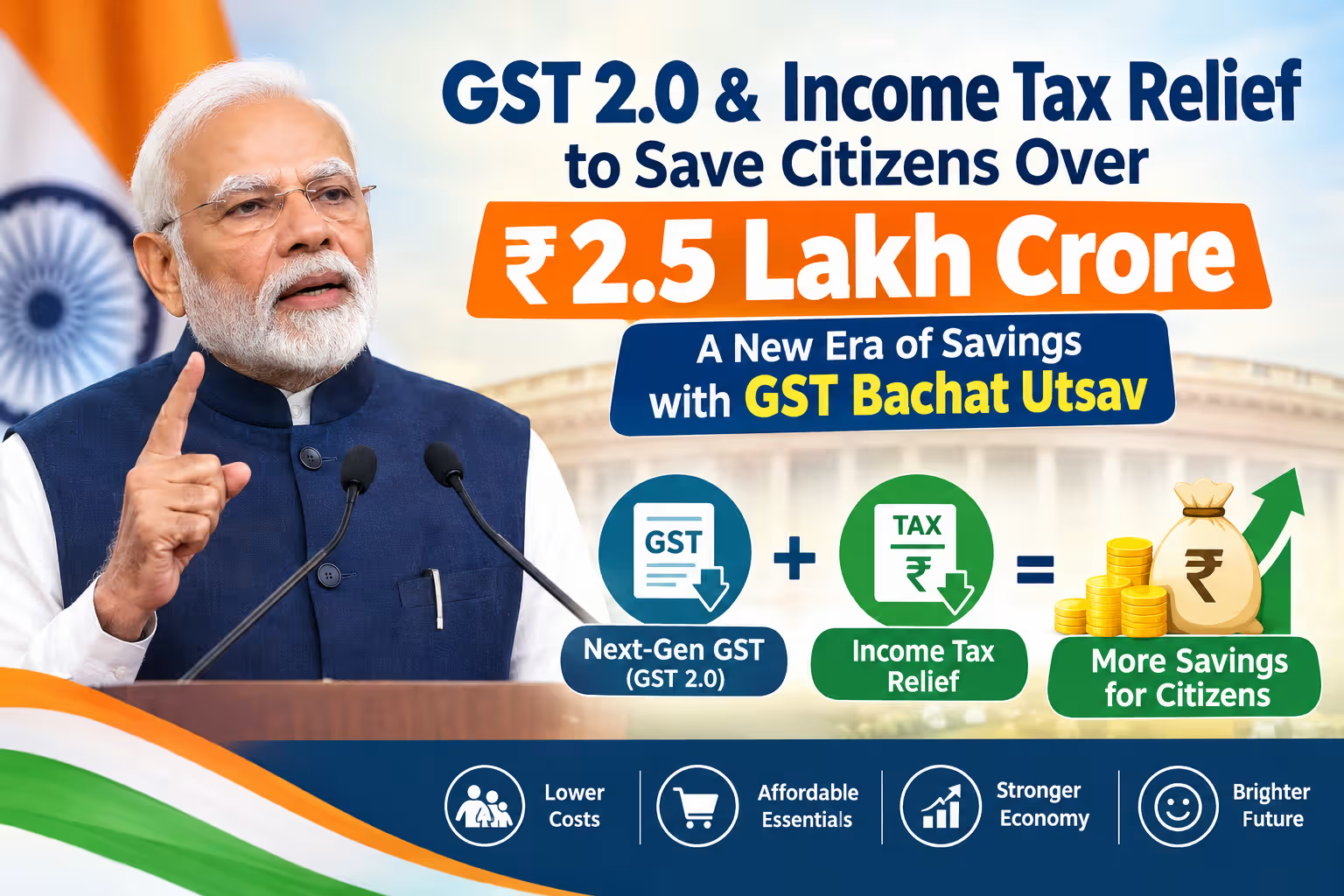
Prime Minister Narendra Modi’s announcement describing the combined benefits of Next-Generation Goods and Services Tax (GST 2.0) reforms and income tax relief as a “GST Bachat Utsav” has drawn attention to a central question for Indian households: How much money could these changes actually save, and what do they mean for everyday expenses, shopping, family budgets, and the wider economy?
The idea behind the savings initiative is straightforward. When indirect taxes on selected goods are reduced and eligible taxpayers pay less income tax, households may have more money available for essential purchases, education, healthcare, savings, and other financial priorities. Businesses may also benefit from changes in input costs and consumer demand.
The announced figure of more than ₹2.5 lakh crore represents the combined savings attributed to GST reforms and income tax relief. However, this headline figure should not be interpreted as a guaranteed payment or an identical cash benefit for every Indian. The actual benefit depends on individual tax eligibility, spending patterns, product prices, and how businesses respond to changes in taxation.
For consumers, the most useful approach is to understand which tax changes apply to their purchases, how income tax relief affects their own finances, and what steps they can take to make the most of any savings.
This guide explains the GST Bachat Utsav announcement, the meaning of GST 2.0, the relationship between GST reductions and income tax relief, practical household examples, possible effects on businesses, and the questions consumers should ask before making financial decisions.
What Is GST Bachat Utsav?
GST Bachat Utsav, translated as the “GST Savings Festival,” is the name Prime Minister Narendra Modi gave to the savings expected from the Next-Generation GST reforms introduced alongside income tax relief.
The announcement was made in September 2025, when the revised GST rates took effect from 22 September 2025. The Prime Minister explained that combining the income tax changes announced earlier in the year with the GST reductions would generate savings exceeding ₹2.5 lakh crore for people across India.
The initiative focuses on three broad objectives:
- Reducing the tax burden: Lower GST rates on selected goods and services can reduce the tax included in consumer prices.
- Increasing disposable income: Eligible individual taxpayers can retain more of their income under the revised income tax arrangements.
- Supporting consumption and business activity: Lower prices and higher disposable income may encourage households to spend, save, or invest.
The term “Bachat Utsav” communicates the intended household benefit in accessible language. It is not a separate cash-transfer scheme, a bank account benefit, or an application-based government subsidy.
Consumers do not need to register for a special GST Bachat Utsav payment. Instead, the potential benefits arise through the applicable tax rates and income tax rules.
Why did the government introduce GST 2.0?
India introduced the Goods and Services Tax on 1 July 2017 to replace a range of central and state indirect taxes with a more unified system. Since then, GST rates and rules have been adjusted through the GST Council process.
The 2025 reforms were presented as a new stage in that evolution. Their central features included simplifying the main rate structure, reducing rates on many products, addressing classification issues, and making the tax system easier for consumers and businesses to understand.
The government highlighted the move towards two principal GST slabs of 5% and 18%, alongside exemptions and special treatment for certain categories. It also stressed the importance of passing tax reductions on to customers.
For households, the practical question is not simply whether GST has been reduced. It is whether the items they regularly buy fall into a lower tax category and whether the resulting reduction is reflected in the price they actually pay.
Understanding the ₹2.5 Lakh Crore Savings Announcement
The headline figure of ₹2.5 lakh crore has attracted considerable attention because it combines two different forms of tax relief.
One works mainly through the prices of taxable goods and services. The other works through the amount of income tax eligible individuals pay.
Understanding this distinction is essential for interpreting the announcement correctly.
What does ₹2.5 lakh crore mean?
One lakh crore equals ₹1 trillion. Therefore, ₹2.5 lakh crore equals ₹2.5 trillion.
The announced amount is a nationwide estimate of the combined savings associated with the tax decisions. It is not a promise that each household will receive a fixed amount.
For example, a family that purchases many goods affected by GST reductions may experience greater indirect tax savings than a household that spends relatively little on those goods. An eligible taxpayer whose income tax liability falls may also benefit from the direct tax changes, while someone who already pays no income tax may receive no additional income tax saving.
The benefits can therefore differ considerably between households.
The government described the combined effect as savings for the people of India, rather than an equal distribution of ₹2.5 lakh crore among citizens.
The two components of the savings initiative
1. GST relief
Indirect tax savings
Lower GST on eligible goods and services can reduce the tax component of purchases, provided the benefit is passed on through pricing.
2. Income tax relief
Direct tax savings
Eligible taxpayers under the applicable income tax regime may pay less tax and retain more of their earnings.
These measures affect finances differently. GST savings are spread across purchases of affected goods and services, whereas income tax relief depends on taxable income, the tax regime selected, available rebates, and other applicable rules.
Is ₹2.5 lakh crore a guaranteed saving for every Indian?
No. It is a combined nationwide figure cited by the government.
The actual amount saved by an individual depends on several factors:
- The goods and services purchased.
- The GST rates applicable before and after the reform.
- Whether businesses pass on the lower tax through prices.
- The individual’s income tax liability before and after the changes.
- The person’s eligibility for rebates, deductions, and exemptions under the applicable regime.
- Changes in consumption, product quantities, and market prices.
This distinction matters because a large national saving estimate cannot, by itself, tell an individual how much money will remain in their own budget.
The best way to evaluate the benefit is to examine actual household purchases and calculate income tax independently.
GST 2.0: What Changed in India’s Indirect Tax System?
GST 2.0 is commonly used to describe the Next-Generation GST reforms introduced in September 2025. It represents a revision of the existing GST framework rather than the introduction of an entirely separate tax.
The reforms focused on rate rationalisation, simplification, and reducing the tax burden on selected consumer goods and services.
1. A simplified principal rate structure
Before the reforms, GST commonly used the 5%, 12%, 18%, and 28% slabs, alongside exemptions and special rates for certain products.
The revised framework moved towards two principal rates: 5% and 18%. Certain goods and services continue to receive exemptions or special treatment, while specified products are subject to a higher special rate.
This means that the description “two-slab GST” should not be understood as a claim that every transaction in India is taxed at either 5% or 18%. Product classifications and applicable exceptions still matter.
For consumers, fewer principal slabs can make tax comparisons easier. For businesses, a simpler structure can reduce some classification disputes and improve the clarity of pricing decisions.
2. Lower rates on selected consumer products
The reforms reduced GST on numerous items, including products in everyday consumption categories.
The government highlighted food products, medicines, soap, toothpaste, and other household essentials as examples of goods receiving lower rates or exemptions. The exact treatment depends on the particular product and its legal classification.
This is particularly relevant for families because routine purchases are repeated throughout the year. A small reduction in the price of a regularly purchased item may seem insignificant on one shopping trip but can accumulate across many purchases.
However, the size of the benefit varies. A product that was already exempt may not become cheaper because of a GST change, and a product that remains in the same tax category may not generate any direct tax saving.
3. Relief for selected services
The changes also addressed certain services, including categories related to accommodation and insurance.
The Prime Minister’s September 2025 address referred to lower GST on most hotel rooms as one example of how the reforms could make travel more affordable.
Consumers should nevertheless check the exact service, price category, policy type, and conditions before assuming that a particular booking or insurance product qualifies for a lower rate.
A reduction in GST does not mean every service provider must reduce all charges by the same percentage. The final bill may include components that are taxed differently or are not affected by the revision.
4. Greater emphasis on passing benefits to consumers
A lower statutory GST rate does not automatically guarantee an identical reduction in the retail price.
For example, a manufacturer may have experienced an increase in raw material costs at the same time as a GST reduction. A retailer may also adjust discounts or margins. Consequently, the price paid by the customer depends on more than the tax rate alone.
The government publicly encouraged shopkeepers and traders to show “before and after” prices so that customers could see how the reforms affected retail prices.
Price transparency is particularly valuable during periods when several tax rates change at once.
5. Simplification for businesses
Businesses must identify the correct GST rate, calculate tax, maintain records, issue compliant invoices, and file returns.
A clearer rate structure can make some of these tasks easier, particularly for small traders and manufacturers handling a broad range of products. However, businesses must still comply with product-specific rules, input tax credit requirements, invoicing obligations, and return-filing procedures.
GST reform should therefore be viewed as both a consumer-price initiative and an effort to improve the tax framework.
Income Tax Relief: How It Complements GST 2.0
GST reductions are only one part of the GST Bachat Utsav announcement. The other major component is income tax relief.
The Union Budget presented on 1 February 2025 introduced substantial relief under the new personal income tax regime. The government subsequently combined this measure with the GST changes when describing the expected nationwide savings.
What is the income tax benefit?
Under the revised new tax regime for the relevant financial year, a resident individual with eligible normal-rate income of up to ₹12 lakh may have no income tax payable because of the Section 87A rebate, subject to the statutory conditions.
For eligible salaried taxpayers, the standard deduction can raise the effective threshold for zero tax on salary income to ₹12.75 lakh, assuming the relevant conditions are met.
These figures refer to the applicable tax calculation, not a blanket exemption from every form of taxation. Special-rate income, such as certain capital gains, may be treated differently, and eligibility depends on the detailed rules.
The distinction between a basic exemption limit and a rebate is important. A rebate reduces the tax payable after the relevant calculation; it does not necessarily mean that every rupee of income below a headline threshold is exempt under every circumstance.
Who may benefit from the income tax changes?
Potential beneficiaries include:
- Salaried employees whose tax liability falls under the revised regime.
- Eligible self-employed individuals and professionals.
- Resident individuals whose taxable income qualifies for the rebate.
- Households in which one or more earning members experience lower income tax liability.
The precise saving depends on the person’s income, deductions where permitted, tax regime, eligible rebates, and the applicable assessment year.
Someone whose income tax liability was already zero may not receive an additional direct tax saving from the revised threshold. Such a household may still benefit from lower GST on eligible purchases.
How can income tax relief increase household savings?
Suppose a salaried employee previously paid income tax and, after recalculating under the revised rules, finds that their annual tax liability has decreased.
The difference between the old and new liabilities represents the direct tax saving for that individual, assuming both calculations use the correct rules and comparable income figures.
That money may then be allocated to:
- Emergency savings.
- Health insurance premiums or medical expenses.
- School or college fees.
- Loan repayments.
- Retirement contributions.
- Essential household spending.
- Long-term investments, depending on personal circumstances.
The benefit is not limited to increased consumption. A household may choose to save more rather than spend more.
This is one reason the combined GST and income tax changes can affect the wider economy: they may change both the amount households spend and the amount they retain.
How GST Bachat Utsav Can Affect Different Types of Households
The impact of GST 2.0 is not identical for everyone. A household’s spending pattern, income level, location, and access to formal financial services all influence how the reforms affect its finances.
1. Lower-income households
Lower-income households often allocate a substantial share of their available money to necessities such as food, personal care products, clothing, transport, and basic household supplies.
When frequently purchased products receive a GST reduction, these families may benefit through lower prices. The value of that relief depends on which products they purchase and whether the price reductions reach them.
For example, a household that regularly purchases a packaged food product affected by a rate reduction may pay less per unit. A household purchasing mostly unprocessed goods that were already exempt may experience a smaller direct benefit from that particular change.
Lower-income households may also have little or no income tax liability, meaning the direct income tax component could be limited or absent for them. Their potential benefits may therefore come primarily from consumption-related savings.
Practical tip: Compare prices on regularly purchased essentials rather than assuming that every product is cheaper simply because GST rates have changed.
2. Middle-class families
Middle-class households may benefit from both components of the reform.
They often purchase everyday essentials and may also spend on appliances, electronics, travel, insurance, education-related products, and other services. Some of these purchases may be affected by GST changes.
Eligible earning members may separately benefit from lower income tax liability under the revised new tax regime.
Consider a family in which both adults earn salaries. One adult might qualify for a reduction in income tax, while the household as a whole may benefit from lower GST on selected purchases. The two benefits should be calculated separately to avoid double counting.
Practical tip: Review the household’s annual tax calculation and compare actual prices for its largest recurring expenses.
3. Farmers and agricultural households
Agricultural households have varied spending patterns. Some purchases relate directly to farming, while others are ordinary household expenses.
GST treatment depends on the specific product or service, and not every agricultural input or transaction necessarily receives a lower rate.
A farmer purchasing eligible consumer goods may benefit from lower prices. A farming business may experience different effects depending on its registration status, the nature of its supplies, and whether input tax credit is available under the applicable rules.
Farmers should not assume that all fertilisers, equipment, machinery, seeds, pesticides, or other agricultural inputs have the same tax treatment. Each product needs to be checked against the current applicable classification.
Practical tip: Keep invoices for farming-related purchases and ask a qualified tax professional how the relevant GST rules apply to the particular activity.
4. Young professionals and first-time earners
Young professionals may see a benefit from income tax relief if they meet the relevant eligibility requirements.
For those with no income tax liability, the more immediate impact may come from reduced GST on eligible purchases.
People starting their careers can use any additional disposable income to establish an emergency fund, pay down expensive debt, or begin investing according to their goals and risk tolerance.
Practical tip: Do not allow a reduction in tax liability to become an automatic increase in discretionary spending. A deliberate savings plan can turn temporary cash-flow relief into a stronger financial foundation.
5. Retirees and senior citizens
Retired households may spend heavily on medicines, healthcare, food, household services, and insurance.
Where an applicable GST reduction lowers the price of a product or service they use, retirees may benefit. But the outcome depends on the precise category and tax treatment of the purchase.
Income tax rules for senior citizens also depend on their income, age, selected tax regime, and other applicable provisions. A senior citizen should not assume that the GST announcement automatically changes their personal income tax position.
Practical tip: Review actual medicine bills, insurance documents, and household expenses, while confirming any personal income tax benefit using the applicable tax rules.
Practical Examples: Calculating Potential GST Savings
Understanding the mechanism is easier when the numbers are visible. The following examples are illustrative calculations, not official estimates of any household’s savings under GST 2.0.
Example 1: A household purchase with a lower GST rate
Suppose a product has a pre-tax price of ₹1,000 and its GST rate falls from 12% to 5%.
Before the change:
- Pre-tax price: ₹1,000
- GST at 12%: ₹120
- Final price: ₹1,120
After the change:
- Pre-tax price: ₹1,000
- GST at 5%: ₹50
- Final price: ₹1,050
Illustrative price before
₹1,120
Illustrative price after
₹1,050
Potential saving per unit
₹70
In this simplified example, the customer saves ₹70 per unit, provided the pre-tax price remains unchanged and the entire tax reduction is reflected in the retail price.
If the customer purchases 12 units over a year, the arithmetic saving would be ₹840.
The example does not imply that every product previously taxed at 12% moved to 5%, or that every retailer will produce this exact price reduction. The actual rate must be verified for the specific product.
Example 2: A monthly household budget
Imagine a family purchases several products whose tax treatment changes. After checking the old and new prices, the family estimates that it saves ₹250 per month on those purchases.
Its annual saving would be:
₹250 × 12 = ₹3,000.
If the family also benefits from a separate income tax reduction, that amount should be calculated independently.
For example, if its verified annual income tax saving were ₹15,000, the combined illustrative benefit would be ₹18,000 for the year.
This calculation is only an example of how two different savings streams can be added together. It is not a forecast of the average household benefit.
Example 3: Why the tax-rate difference is not always the retail-price difference
Consider a product whose pre-tax price is ₹2,000.
At 18% GST, the final price would be ₹2,360.
If the rate fell to 5% and the pre-tax price remained ₹2,000, the final price would be ₹2,100.
The difference would be ₹260.
But suppose the product’s pre-tax price increased to ₹2,100 because of higher production or distribution costs. At 5% GST, its final price would be ₹2,205.
The price would still be lower than the original ₹2,360, but the customer would save ₹155 rather than ₹260.
This illustrates why consumers should compare actual invoices and like-for-like products rather than calculating savings solely from the change in tax rate.
Example 4: Estimating savings from several purchases
A simple household worksheet can make the calculation more realistic.
| Purchase category | Illustrative monthly saving |
|---|---|
| Eligible household products | ₹80 |
| Eligible personal care products | ₹50 |
| Eligible packaged foods | ₹60 |
| Other qualifying purchases | ₹110 |
| Total monthly saving | ₹300 |
| Illustrative annual saving | ₹3,600 |
The figures above are hypothetical. They are not published average savings, and the categories are not a statement that all products within them received a rate reduction.
The method is what matters: use the real price difference for each qualifying purchase, add the monthly figures, and multiply by the number of months for which the saving applies.
How to Calculate Your Own GST Bachat Utsav Savings
A household does not need sophisticated financial software to estimate the impact of tax reductions. A spreadsheet, notebook, or budgeting app can be sufficient.
The goal is to distinguish actual savings from assumptions.
Step 1: Identify your regular purchases
Review household spending for the previous one to three months.
List the products and services that make up a meaningful part of your budget. These might include groceries, toiletries, medicines, household appliances, selected transport-related purchases, or eligible accommodation services.
Do not assume that every expense is affected by GST 2.0.
Step 2: Check the applicable GST rate
For each item, identify its correct product classification and the rate applicable before and after the change.
Useful sources include official GST notifications, government information releases, and invoices showing the applicable tax details.
If the classification is unclear, ask the seller or a qualified tax professional. Product names alone are not always sufficient to establish the correct tax treatment.
Step 3: Compare like-for-like prices
A meaningful comparison uses the same product, pack size, quality, and quantity.
Compare the price before the change with the price after it. Account for discounts, promotional offers, packaging changes, and any change in the underlying price.
Where possible, use dated bills rather than memory.
Step 4: Calculate the difference
Use this simple formula:
\[ \text{Saving per purchase} = \text{Old price}-\text{New price} \]
If a product costs ₹550 before the reform and ₹525 afterward, the observed saving is ₹25 per purchase.
If you buy it four times each month, the estimated monthly saving is ₹100, assuming the price difference remains consistent.
Step 5: Estimate annual savings cautiously
Multiply recurring monthly savings by 12 only if the purchase frequency and price difference are reasonably stable.
For seasonal goods, one-time purchases, or items with fluctuating prices, use a more realistic annual estimate.
For example, a refrigerator bought once should not be treated as a recurring monthly saving. Its potential tax-related benefit belongs in the year of purchase.
Step 6: Calculate income tax relief separately
Use the applicable income tax rules to calculate your tax liability.
Compare the correct tax liability under the relevant old and revised circumstances, taking account of the applicable regime, deductions, rebates, special-rate income, and other relevant provisions.
The difference is your estimated income tax saving.
Avoid using a general online headline such as “zero tax up to ₹12 lakh” as a substitute for an individual tax calculation.
Step 7: Add the two figures without double counting
Once you have calculated the actual or estimated GST-related price savings and the separate income tax benefit, combine them.
For example:
- Annual GST-related purchase savings: ₹3,600.
- Annual income tax saving: ₹15,000.
- Combined illustrative benefit: ₹18,600.
This approach provides a personal estimate that is much more meaningful than dividing the national ₹2.5 lakh crore announcement by the population.
What Should Consumers Check on Bills After GST Rate Changes?
Price transparency is a major part of ensuring that tax reductions produce practical benefits.
A consumer does not need to challenge every small price variation. However, checking a few details can help identify mistakes or misunderstandings.
Check the product description
Confirm that the invoice refers to the product you actually purchased, including the pack size or model where relevant.
Different products that appear similar may fall under different tax classifications.
Check the applicable tax rate
The GST rate shown on the bill should match the applicable classification and effective date.
For an eligible product whose rate has changed, an invoice issued after the effective date should reflect the appropriate treatment, subject to the applicable transitional and invoicing rules.
Compare the final price
A lower tax rate should not be confused with an automatic percentage reduction in the total retail price.
If the pre-tax price changes, the final saving will also change. Discounts, shipping, installation, and other charges may affect the amount paid.
Keep proof of purchase
Retain invoices for larger purchases and any transaction where you want to verify the tax calculation.
For online orders, keep the order confirmation, tax invoice, and refund documentation where applicable.
Raise genuine discrepancies
If the bill appears inconsistent with the applicable rules, ask the seller to explain the calculation.
If the issue remains unresolved, consult the relevant official consumer grievance or tax authority channels. Provide the invoice, product details, date, and explanation of the discrepancy.
A careful, documented query is more useful than assuming every price difference is a tax violation.
GST Bachat Utsav and Small Businesses
The effects of GST 2.0 extend beyond individual consumers. Small businesses, retailers, manufacturers, wholesalers, and service providers may experience changes in costs, demand, compliance requirements, and pricing.
The government has highlighted the potential benefits for micro, small, and medium enterprises (MSMEs), particularly through rate simplification and reduced costs in relevant categories.
However, the outcome for each business depends on its sector and circumstances.
1. Retailers may need to revise prices and billing systems
A retailer selling products whose GST rates have changed may need to update:
- Billing and point-of-sale software.
- Product tax classifications.
- Price labels and displayed offers.
- Inventory records.
- Accounting and tax reporting processes.
The retailer must apply the correct rate based on the product classification and relevant date.
Updating software without checking the underlying tax classification can lead to errors. Businesses should use official notifications and reliable professional advice when needed.
2. Manufacturers may see changes in demand and input costs
A manufacturer can be affected by both the GST rate on its finished goods and the tax treatment of its inputs.
A reduction in the output GST rate may make a product more attractive to buyers. But the manufacturer’s total cost and tax position also depend on input tax credits, procurement prices, production costs, and applicable rules.
A lower output rate does not automatically mean that the manufacturer’s profit margin will increase.
Businesses should assess the complete supply chain rather than considering only the final product’s tax rate.
3. Small traders may benefit from clearer classifications
Complex or disputed product classifications can increase administrative work and create uncertainty.
A more streamlined structure can help businesses price products more consistently and train staff more easily. Nevertheless, businesses must still determine the correct rate for each item.
The reform may reduce some complexity, but it does not eliminate the need for accurate records and compliance.
4. Local businesses can use transparent pricing to build trust
Retailers can explain price changes to customers by displaying accurate old and revised prices where appropriate.
This can help shoppers understand the impact of the reform and make informed choices.
However, any price comparison should use comparable products and genuine prices. Businesses should not advertise a tax saving that cannot be substantiated.
5. Businesses should not assume that all sales become cheaper
Some goods may retain their existing GST treatment, while others may receive different rates depending on their classification.
Businesses should identify the affected products in their own catalogue rather than applying a uniform percentage reduction to every price.
For a small business, the most useful action is to prepare a product-level list of changes, update the accounting system, and review invoices before issuing them.
How GST 2.0 Could Influence India’s Economy
The GST Bachat Utsav announcement has implications for consumption, investment, and economic activity. These effects are possible outcomes of the reforms, not guaranteed results.
Increased consumer purchasing power
If consumers pay less for qualifying goods and eligible taxpayers retain more income, they may have additional disposable money.
Some households could spend that money on everyday necessities, while others might purchase durable goods, repay debt, or build savings.
The overall impact depends on how consumers respond to the additional financial capacity.
Potential support for domestic demand
When demand increases, businesses may receive more orders. Manufacturers and retailers may respond by increasing production, expanding distribution, or investing in additional capacity.
This process can support economic activity if the increased demand is sustained and businesses can meet it efficiently.
However, tax reductions alone do not determine economic growth. Employment, interest rates, inflation, consumer confidence, global conditions, and investment also play important roles.
Possible benefits for manufacturing
Lower GST on certain products may make those goods more affordable and potentially improve demand.
If demand shifts towards domestically manufactured products, local producers may benefit. The actual outcome depends on product quality, competition, production capacity, and the prices of alternatives.
The government has also encouraged consumers to support Indian-made products as part of the broader self-reliance agenda.
Consumers should still compare quality, safety, warranty, service availability, and value for money rather than choosing a product solely because of a tax change.
Effects on government revenue
A reduction in tax rates can lower the tax collected on an individual transaction, all else being equal.
But total government revenue also depends on the volume of transactions, economic growth, compliance, the number of taxpayers, and the composition of spending.
A lower rate may be accompanied by changes in demand or compliance that affect total collections. The overall result cannot be established from the rate reduction alone.
Why implementation matters
The effectiveness of GST reform depends on how well the revised rules are communicated and implemented.
Businesses need clear guidance, consumers need accurate prices, and tax authorities need workable processes for compliance and dispute resolution.
If product classification remains unclear or price changes are not communicated properly, consumers may find it difficult to identify the actual benefit.
For this reason, the long-term success of GST 2.0 should be assessed through evidence on prices, compliance, consumption, business activity, and revenue—not solely through the headline savings figure.
GST Bachat Utsav: Common Mistakes Consumers Should Avoid
Tax reforms can create opportunities to save money, but misunderstandings can lead to poor financial decisions.
Mistake 1: Assuming every product is cheaper
A GST rate reduction applies only to the products or services covered by the relevant change. Products whose rates remain unchanged may not become cheaper because of the reform.
Better approach: Verify the applicable rate and compare the actual selling price.
Mistake 2: Treating the ₹2.5 lakh crore figure as an individual entitlement
The national savings estimate is not a government payment distributed equally among households.
Better approach: Calculate your own GST-related price savings and income tax relief separately.
Mistake 3: Confusing a tax reduction with a retail discount
GST is one component of the final price. The pre-tax price may also change because of production costs, distribution expenses, discounts, and market conditions.
Better approach: Compare final prices for identical products, using invoices wherever possible.
Mistake 4: Assuming everyone qualifies for zero income tax
The income tax relief depends on eligibility, the applicable regime, the rebate rules, and the type of income.
Better approach: Calculate your tax liability using the rules applicable to your financial year rather than relying on a headline threshold alone.
Mistake 5: Spending the entire tax saving
Additional disposable income can be useful, but spending all of it immediately may weaken a household’s financial position.
Better approach: Allocate a portion to savings, debt repayment, or other priorities before increasing discretionary spending.
Mistake 6: Trusting unofficial tax claims
Social media posts may simplify or misrepresent product classifications, eligibility rules, and the effective dates of tax changes.
Better approach: Confirm important information through official government notifications, the GST portal, or a qualified tax professional.
Best Practices for Maximising the Benefits of GST 2.0
The most effective way to benefit from the GST Bachat Utsav changes is to make informed purchasing and financial decisions.
Track your household expenses
Keep a simple record of essential purchases and compare prices over time. This helps you distinguish a genuine tax-related saving from a temporary discount or ordinary price fluctuation.
Review your income tax position
Calculate tax under the applicable regime and confirm whether you qualify for the relevant rebate or deductions. A tax professional can help when your income includes capital gains, business profits, or other complex items.
Create a plan for additional savings
Decide in advance how to use any money saved. Emergency funds, expensive debt repayment, and long-term financial goals may deserve priority over non-essential purchases.
Verify important claims
Use official sources for current GST rates, income tax provisions, and eligibility conditions. Keep relevant bills and tax records so you can check calculations when necessary.
Expert tip: Focus on the annual effect, not just the price of one item
A ₹10 reduction on a frequently purchased product may produce a meaningful annual saving. A much larger reduction on a product bought once may have less influence on the recurring household budget.
For this reason, prioritise recurring expenses when estimating your household’s GST-related savings. Consider one-time purchases separately.
The objective is to understand the total effect on your finances—not simply to identify the biggest advertised price reduction.
How to Verify Official GST and Income Tax Information
Because tax rules can change and product classifications can be technical, consumers and businesses should rely on official information when making financial decisions.
The following resources are useful starting points.

GST portal
Check GST-related services, taxpayer information, and relevant official resources.

Income Tax Department
Consult official income tax information, tax calculation guidance, and applicable rules.
Visit the Income Tax Department portal

Press Information Bureau (PIB)
Read official government announcements and explanations of the GST reforms.
Visit the Press Information Bureau
When checking a GST rate, look for the relevant notification and effective date. A general news report can provide context, but the applicable legal notification is the stronger reference for a specific transaction.
For income tax, confirm the financial year, assessment year, selected tax regime, and applicable rebate provisions. If your circumstances are complex, obtain professional advice before filing your return.
Frequently Asked Questions About GST Bachat Utsav
1. What is GST Bachat Utsav?
GST Bachat Utsav, or GST Savings Festival, is the name Prime Minister Narendra Modi used for the combined savings expected from the Next-Generation GST reforms and income tax relief. The revised GST rates took effect on 22 September 2025, and the combined savings were described as exceeding ₹2.5 lakh crore.
2. How much money will Indians save under GST 2.0?
The government announced combined savings exceeding ₹2.5 lakh crore from GST reductions and income tax relief. This is a nationwide estimate, not a fixed amount that every citizen receives. Individual savings depend on eligible purchases, actual price changes, and personal income tax circumstances.
3. When did the Next-Generation GST reforms take effect?
The revised GST rates took effect on 22 September 2025. The reforms were announced as a new phase of India’s existing GST system, with a focus on simplifying the principal rate structure and reducing rates on selected goods and services.
4. Does GST Bachat Utsav provide direct cash payments?
No. GST Bachat Utsav is not a separate cash-transfer scheme. The intended benefits arise through applicable GST rate reductions and income tax relief. Consumers do not need to register for a special GST Bachat Utsav payment.
5. Who benefits from GST 2.0?
Consumers purchasing eligible goods and services may benefit from lower prices. Eligible taxpayers may also benefit from reduced income tax liability. Small businesses and manufacturers may experience changes in demand, costs, and compliance requirements. The actual impact varies by product, business, and household.
6. Does everyone earning up to ₹12 lakh pay zero income tax?
Not necessarily in every situation. Under the relevant new tax regime, eligible resident individuals with up to ₹12 lakh of qualifying normal-rate income may have zero tax payable because of the applicable rebate. Special-rate income and other statutory conditions can affect the result. Eligible salaried taxpayers may also benefit from the standard deduction, which can raise the effective threshold for zero tax on salary income. Check the rules for the relevant year before drawing a conclusion.
7. How can I calculate my personal GST savings?
List your regular purchases, check which items are covered by a rate reduction, and compare the old and new prices for identical products. Add the actual or estimated price differences across your purchases. Calculate income tax relief separately, then combine the two figures without counting the same benefit twice.
8. What should I do if a shop does not appear to pass on a GST reduction?
First, confirm that the product is covered by the rate change and that the new rate applies to the transaction date. Compare the invoice with the relevant product classification and consider whether the pre-tax price has changed. If the discrepancy remains, ask the seller for clarification and consult the appropriate official grievance channel or a qualified professional.
Conclusion: Turning GST Bachat Utsav Into Real Household Savings
The GST Bachat Utsav announcement brings together two important tax measures: Next-Generation GST reforms and income tax relief. Prime Minister Narendra Modi said that their combined effect would save people more than ₹2.5 lakh crore, highlighting the potential benefits for consumers, families, traders, and businesses.
For households, the value of these reforms depends on how they affect everyday purchases and personal tax liabilities. Lower GST rates can reduce the price of eligible goods and services, while income tax relief can leave qualifying taxpayers with more disposable income.
But the headline figure is only the starting point. The amount an individual saves depends on what they buy, the prices they actually pay, and whether they qualify for income tax relief.
Consumers can make the most of the changes by checking invoices, comparing prices, reviewing their tax calculations, and directing any additional savings towards meaningful financial goals. Businesses can support the process by applying the correct tax rates, maintaining accurate records, and communicating price changes transparently.
The broader economic benefits will depend on how effectively the reforms are implemented and how households and businesses respond over time.
Your next step: Review your regular household expenses, identify products whose GST rates have changed, and calculate your income tax liability under the applicable rules. A simple, evidence-based comparison will help you understand how GST 2.0 affects your own budget.
Stay informed through official government sources, avoid unverified claims about tax benefits, and make financial decisions based on your actual circumstances.
Smart Money Habits That Make You Rich
Share this content:





Post Comment