






How to Manage Money as a First-Time Earner: A Complete Guide to Saving, Budgeting, and Building Wealth

Getting your first salary is one of the most exciting milestones in life. After years of studying, preparing for interviews, and searching for employment, receiving your first paycheck brings a sense of independence and achievement. You finally have money that you have earned yourself, and you can decide how to spend, save, and use it.
However, earning money and managing money are two different skills.
Many first-time earners make financial decisions without a proper plan. They spend heavily on shopping, gadgets, restaurants, entertainment, subscriptions, and lifestyle upgrades. Some save whatever remains at the end of the month, while others struggle to understand where their salary disappears.
The problem is not necessarily a low salary. In many cases, it is the absence of a clear financial strategy.
Learning how to manage money as a first-time earner can help you build healthy financial habits, avoid unnecessary debt, create emergency savings, and start investing early. Even if your first salary is modest, you can make meaningful financial progress by following a few practical money-management principles.
The good news is that you do not need to be a financial expert to manage your income effectively. You need a realistic budget, clear priorities, disciplined spending habits, and a willingness to think about your financial future.
This comprehensive guide explains how to manage your first salary, divide your income, save money every month, control expenses, build an emergency fund, understand investments, and avoid common financial mistakes.
Whether you have recently started your first job, received your first salary, or are preparing to enter the workforce, these strategies can help you become financially independent.
1. Why Money Management Matters for First-Time Earners
Your first salary introduces you to a new level of financial responsibility.
Until you start earning, your financial decisions may depend on your parents, guardians, scholarships, or other sources of support. Once you begin working, you become responsible for managing your income and meeting your personal expenses.
This transition can be challenging because regular income creates new opportunities as well as new responsibilities.
You may want to purchase a smartphone, buy clothes, go on trips, contribute to household expenses, or save for future goals. Without proper planning, these expenses can quickly consume your entire salary.
Money management helps you balance your present lifestyle with your future financial needs.
Benefits of managing money from your first salary
1. Develops financial discipline
Creating a budget teaches you to think before spending. You become more aware of your financial priorities and learn to distinguish between essential purchases and unnecessary expenses.
2. Helps build savings
Saving a fixed amount every month creates a financial foundation. Even small contributions can gradually become meaningful savings.
3. Reduces financial stress
When you know how much money you have, what you need to spend, and how much you can save, financial decisions become easier.
4. Prevents unnecessary debt
Responsible money management reduces the temptation to depend on credit cards, personal loans, or buy-now-pay-later services for everyday purchases.
5. Supports long-term financial goals
You can gradually prepare for higher education, travel, buying a vehicle, purchasing a house, retirement, or other important life goals.
6. Builds confidence and independence
Managing your own money gives you greater control over your decisions and prepares you for future financial responsibilities.
The habits you develop during your first few working years can influence how you manage money throughout your life.
2. Understand Your Actual Take-Home Salary
Before creating a budget, understand how much money you actually receive every month.
One common mistake among new employees is planning their expenses based on their annual Cost to Company (CTC) instead of their monthly take-home salary.
Your CTC may include several components that are not directly deposited into your bank account.
These can include:
- Basic salary.
- House Rent Allowance (HRA).
- Special allowances.
- Employer contributions to provident funds.
- Gratuity provisions.
- Performance bonuses.
- Insurance benefits.
- Other employment-related benefits.
Your actual monthly salary may be lower after applicable deductions.
What is take-home salary?
Take-home salary is the amount credited to your bank account after applicable deductions.
For example, suppose your annual CTC is ₹4,20,000.
Your monthly CTC equivalent is ₹35,000. However, your actual take-home salary may be different because of provident fund contributions, professional tax, income tax where applicable, and other deductions.
The exact amount depends on your salary structure and employment terms.
What should you check in your first payslip?
Carefully review your first salary slip.
Pay attention to:
- Basic salary.
- HRA.
- Other allowances.
- Employee provident fund contribution.
- Professional tax, where applicable.
- Income tax deducted, if applicable.
- Other deductions.
- Net salary credited.
If you do not understand a deduction, ask your HR or payroll department for clarification.
Why this step matters
Suppose you receive ₹28,000 in your bank account every month.
If you create a budget based on ₹35,000, you may plan expenses that exceed your actual available income.
Always prepare your budget using your regular take-home salary rather than your CTC.
3. Create Your First Monthly Budget
A monthly budget is one of the most useful tools for managing money.
It helps you understand where your income goes and how much you can allocate to different financial priorities.
A budget does not mean you must stop enjoying life. Instead, it gives you permission to spend within reasonable limits without sacrificing your savings.
Start by listing your monthly expenses
Divide your expenses into different categories.
Essential expenses:
- Rent or accommodation.
- Groceries.
- Electricity and water bills.
- Transportation.
- Mobile and internet bills.
- Medical expenses.
- Household contributions.
- Education loan repayments, if applicable.
Lifestyle expenses:
- Restaurant visits.
- Shopping.
- Movies.
- Entertainment subscriptions.
- Weekend outings.
- Travel.
- Hobbies.
Financial priorities:
- Emergency fund.
- Savings.
- Investments.
- Insurance premiums.
- Debt repayment.
- Future financial goals.
Once you identify these categories, decide how much money should go into each one.
Try the 50/30/20 budgeting rule
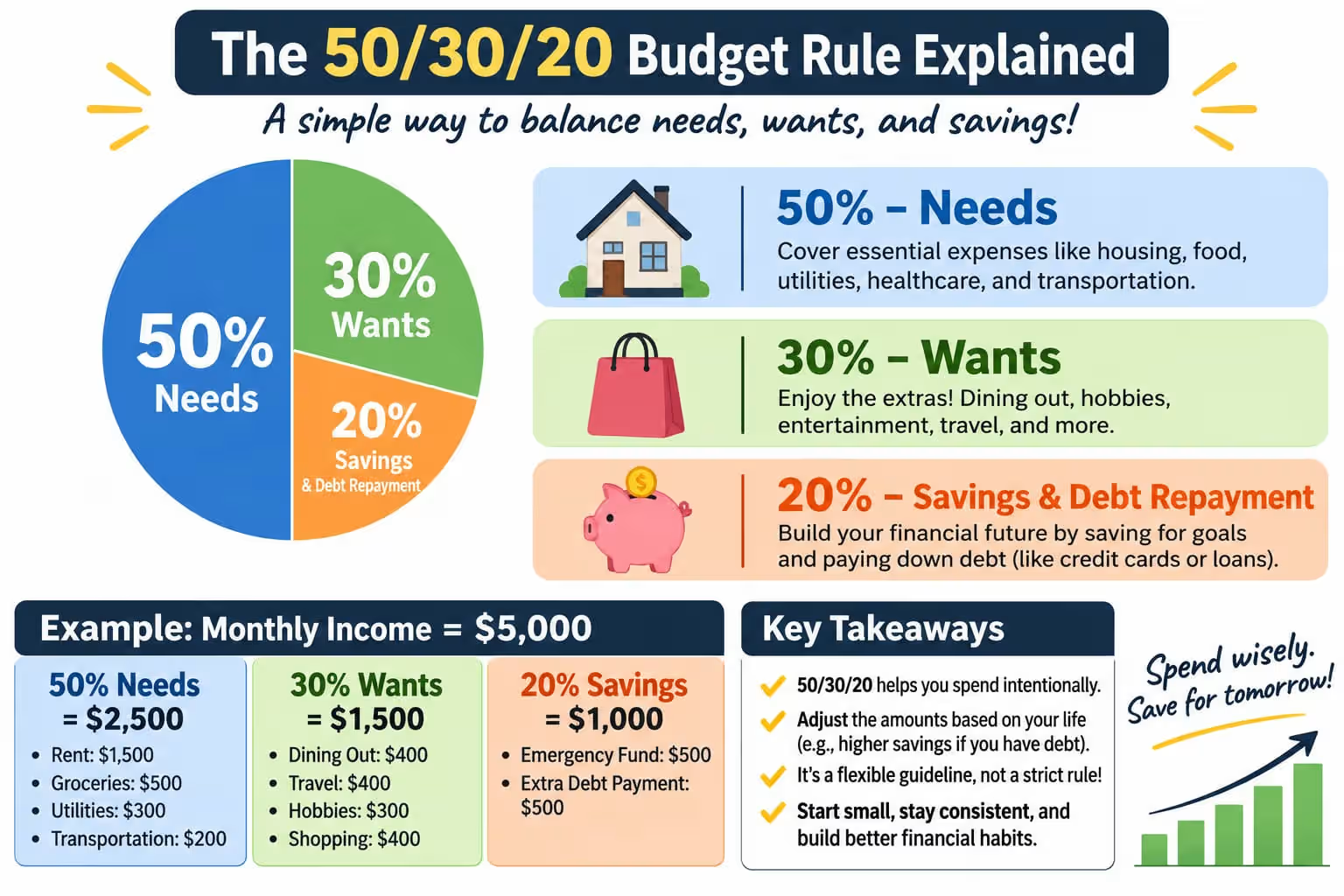
The 50/30/20 rule is a simple budgeting method that divides your after-tax income into three categories.
- 50% for needs.
- 30% for wants.
- 20% for savings and debt repayment.
For example, if your monthly take-home salary is ₹30,000:
| Category | Percentage | Monthly Amount |
|---|---|---|
| Needs | 50% | ₹15,000 |
| Wants | 30% | ₹9,000 |
| Savings and debt repayment | 20% | ₹6,000 |
| Total | 100% | ₹30,000 |
This approach provides a starting point for managing your salary.
However, these percentages are not compulsory.
If you live in an expensive city, your rent may consume more than 50% of your income. If you live with your parents, you may have fewer housing expenses and can save a larger percentage.
Adjust your budget according to your actual financial situation.
Example of a practical monthly budget
Consider a first-time employee earning ₹25,000 per month.
| Expense Category | Monthly Budget |
|---|---|
| Household contribution | ₹4,000 |
| Food and groceries | ₹3,000 |
| Transportation | ₹2,000 |
| Mobile and internet | ₹500 |
| Personal expenses | ₹2,000 |
| Shopping and entertainment | ₹2,000 |
| Emergency savings | ₹3,000 |
| Investments | ₹2,000 |
| Other expenses | ₹1,500 |
| Additional savings | ₹5,000 |
| Total | ₹25,000 |
This is only an illustrative budget. Your actual allocation should reflect your rent, family responsibilities, location, and other commitments.
The most important principle is to assign a purpose to your income before spending it.
4. Pay Yourself First: Save Before You Spend
One of the most effective financial habits for first-time earners is paying yourself first.
This means transferring a portion of your salary into savings immediately after receiving it instead of waiting until the end of the month.
Many people follow the opposite approach:
- Receive salary.
- Pay bills.
- Shop and spend.
- Enjoy weekends.
- Save whatever remains.
Unfortunately, there may be very little left to save.
Paying yourself first changes the process.
How does it work?
Suppose your monthly salary is ₹25,000.
You decide to save ₹5,000 every month.
As soon as your salary arrives:
- Transfer ₹3,000 to your emergency fund.
- Transfer ₹2,000 to your investment or long-term savings account.
- Use the remaining ₹20,000 for your planned expenses.
You have already achieved your savings target before beginning your regular spending.
Start with a realistic savings percentage
If you cannot save 20% of your salary immediately, start with 5% or 10%.
For example:
| Monthly Salary | 10% Savings |
|---|---|
| ₹15,000 | ₹1,500 |
| ₹20,000 | ₹2,000 |
| ₹25,000 | ₹2,500 |
| ₹30,000 | ₹3,000 |
| ₹40,000 | ₹4,000 |
| ₹50,000 | ₹5,000 |
Increase your savings gradually whenever your income improves.
Consistency is more important than choosing an ambitious savings target that you cannot maintain.
5. Build an Emergency Fund Before Taking Financial Risks
An emergency fund is money kept aside for unexpected financial situations.
It acts as a safety net when something goes wrong.
For example:
- You lose your job.
- You face an unexpected medical expense.
- Your family needs urgent financial support.
- Your laptop or phone stops working and is essential for your job.
- You need to travel urgently because of a family emergency.
Without emergency savings, you may have to borrow money or withdraw investments at an inconvenient time.
How much emergency savings should you have?
A common starting target is three to six months of essential living expenses.
For example, suppose your necessary monthly expenses are:
| Expense | Amount |
|---|---|
| Rent | ₹6,000 |
| Food | ₹3,000 |
| Transportation | ₹1,500 |
| Utilities | ₹1,000 |
| Household contribution | ₹2,500 |
| Other essential expenses | ₹1,000 |
| Total | ₹15,000 |
Your emergency fund target would be:
- Three months: ₹45,000.
- Six months: ₹90,000.
If you have unstable employment, dependents, significant financial responsibilities, or limited family support, a larger emergency reserve may be appropriate.
How to build an emergency fund on a low salary
You do not need to save ₹90,000 immediately.
Start with smaller milestones.
Milestone 1: Save ₹5,000
Build your first small financial cushion.
Milestone 2: Save ₹10,000
Continue contributing every month.
Milestone 3: Save one month’s essential expenses
This gives you some protection against unexpected costs.
Milestone 4: Build three to six months of expenses
Continue gradually until you reach your target.
Where should you keep your emergency fund?
Your emergency fund should be safe and accessible.
Possible options include:
- A separate savings bank account.
- A suitable sweep-in fixed deposit.
- Short-term deposits with appropriate withdrawal facilities.
Avoid putting your entire emergency fund into volatile investments such as equity mutual funds or individual stocks.
The purpose of emergency savings is financial security, not maximum returns.
6. Open the Right Bank Accounts and Organize Your Money
Your salary account is an important part of your financial life.
However, keeping all your money in one account can make spending and saving difficult to track.
Consider organizing your money into separate accounts or clearly separated savings categories.
A simple banking structure
1. Salary account
Use this account to receive your monthly salary and handle regular transactions.
2. Savings account
Keep your emergency fund and short-term savings separate from everyday spending.
3. Investment account
Use the appropriate investment platform or account for your long-term financial goals.
You do not necessarily need multiple bank accounts. Maintaining too many accounts can create unnecessary fees, minimum-balance requirements, and administrative work.
Choose a simple structure that you can manage comfortably.
Understand basic banking charges
Before choosing or maintaining an account, check:
- Minimum balance requirements.
- ATM withdrawal limits and charges.
- Debit card annual fees.
- Online transaction charges, if applicable.
- Savings interest rates.
- Account maintenance fees.
- Conditions for zero-balance accounts.
Also enable transaction notifications and use strong passwords.
Never share your OTP, UPI PIN, ATM PIN, or banking password with anyone.
7. Control Lifestyle Inflation When Your Salary Increases
Lifestyle inflation occurs when your spending increases as your income increases.
For example, suppose you initially earn ₹20,000 per month.
After one year, you receive a promotion and your salary increases to ₹30,000.
Instead of saving more, you start spending more on:
- Expensive restaurants.
- Branded clothing.
- A new smartphone.
- Online shopping.
- Premium subscriptions.
- Weekend trips.
- Higher-cost accommodation.
Although your income has increased, your savings may remain unchanged.
This is lifestyle inflation.
How to avoid lifestyle inflation
Whenever you receive a salary increase, avoid upgrading your entire lifestyle immediately.
Instead, divide your additional income.
For example, your salary increases from ₹25,000 to ₹35,000.
You receive an additional ₹10,000 every month.
You could allocate it as follows:
| Purpose | Additional Amount |
|---|---|
| Emergency savings | ₹3,000 |
| Investments | ₹3,000 |
| Skill development | ₹1,000 |
| Lifestyle improvements | ₹2,000 |
| Short-term goals | ₹1,000 |
| Total | ₹10,000 |
This allows you to enjoy your improved income while strengthening your financial position.
You do not have to avoid every luxury. The goal is to prevent your expenses from growing as quickly as your salary.
8. Learn the Difference Between Needs and Wants
Understanding the difference between needs and wants is essential for effective money management.
A need is something necessary for your basic living, responsibilities, or employment.
A want is something that improves comfort, enjoyment, or convenience but is not essential.
Examples of needs
- Rent.
- Basic groceries.
- Electricity.
- Essential transportation.
- Necessary medical expenses.
- Work-related internet access.
- Basic clothing.
Examples of wants
- Expensive branded shoes.
- Premium smartphones.
- Luxury accessories.
- Frequent restaurant visits.
- Multiple streaming subscriptions.
- Impulsive online purchases.
However, needs and wants are not always identical for everyone.
A laptop may be a want for one person but a professional necessity for someone working in software development.
Similarly, transportation costs depend on where you live and how you travel to work.
Ask these questions before purchasing
- Do I genuinely need this item?
- Can I afford it without borrowing money?
- Does it fit into my monthly budget?
- Will I still want it after a few days?
- Is there a less expensive alternative?
- Am I purchasing it because of social pressure?
For non-essential purchases, consider waiting 24 to 48 hours before making the decision.
This simple habit can reduce impulse spending.
9. Avoid Credit Card Debt and Unnecessary Loans
Credit cards can be useful financial tools when used responsibly.
However, they can create serious financial problems when you spend beyond your repayment capacity.
First-time earners may receive credit card offers from banks because they have started receiving regular income.
The availability of credit does not mean you should use the entire credit limit.
Understand how credit cards work
A credit card allows you to make purchases using borrowed money within an approved credit limit.
You receive a statement showing your transactions and outstanding balance.
If you pay the entire statement balance by the due date, eligible purchases generally receive an interest-free period subject to the card’s terms.
However, if you carry an unpaid balance, interest and other applicable charges can become expensive.
Important credit card rules
- Spend only what you can repay.
- Pay the full statement balance whenever possible.
- Avoid cash withdrawals using credit cards.
- Do not treat your credit limit as additional income.
- Track every transaction.
- Understand annual fees and other charges.
- Avoid unnecessary EMI conversions.
Paying only the minimum amount due does not mean your debt has been cleared.
Interest can continue accumulating on the remaining outstanding balance.
Should first-time earners take personal loans?
A personal loan may be useful for certain necessary expenses, but borrowing for lifestyle purchases can create unnecessary financial pressure.
Avoid taking loans simply to purchase:
- Expensive smartphones.
- Luxury watches.
- Designer clothing.
- Unnecessary gadgets.
- Costly vacations.
Before accepting any loan, understand the interest rate, processing fees, repayment schedule, penalties, and total repayment amount.
Borrowing should support a genuine financial need rather than an impulsive purchase.
10. Start Investing Early, But Understand the Risks
Saving money protects your financial stability. Investing can help you work toward long-term financial goals.
As a first-time earner, you have an opportunity to develop investment habits early in your career.
However, investing should begin only after you understand your financial priorities.
You should not invest your entire salary or use emergency savings for risky investments.
Understand the difference between saving and investing
| Saving | Investing |
|---|---|
| Focuses on preserving money | Focuses on growing money |
| Usually suitable for short-term needs | Often suitable for longer-term goals |
| Generally offers greater stability | Returns may fluctuate |
| Examples include savings accounts and deposits | Examples include mutual funds and shares |
Both are important.
The right choice depends on when you need the money and how much risk you can accept.
Investment options for first-time earners in India
1. Recurring Deposits (RDs)
A recurring deposit allows you to deposit a fixed amount regularly for a specified period.
It can help develop disciplined savings habits.
Check the interest rate, tenure, premature withdrawal conditions, and applicable tax treatment.
2. Fixed Deposits (FDs)
Fixed deposits allow you to invest a lump sum for a chosen period.
They are generally suitable for people who prefer predictable returns rather than market-linked fluctuations.
3. Public Provident Fund (PPF)
PPF is a government-backed long-term savings scheme with a 15-year initial maturity period.
It may be suitable for long-term financial planning, especially for individuals seeking a structured savings option.
Understand its contribution rules, withdrawal conditions, interest-rate revisions, and applicable tax treatment before investing.
4. Mutual Funds
Mutual funds collect money from investors and invest it in different financial instruments according to their investment objectives.
Some common categories include:
- Equity mutual funds.
- Debt mutual funds.
- Hybrid mutual funds.
- Index funds.
Equity mutual funds involve market risk and may experience significant short-term fluctuations.
Debt mutual funds also carry risks, including interest-rate and credit risk.
Choose funds according to your financial goals, investment horizon, and risk tolerance.
5. Systematic Investment Plans (SIPs)
An SIP allows you to invest a fixed amount regularly in a mutual fund.
For example, you might invest ₹500, ₹1,000, or ₹2,000 every month.
An SIP is a method of investing, not a separate investment product or a guarantee of returns.
The value of your investment can rise or fall with market conditions.
6. National Pension System (NPS)
NPS is a retirement-oriented investment framework that offers market-linked investment options.
It may be worth understanding once you start planning for retirement.
Check the withdrawal rules, investment choices, charges, and tax provisions before opening an account.
How much should a first-time earner invest?
There is no universal investment percentage.
If your emergency fund is incomplete, prioritize building it while managing essential expenses.
Once you have an adequate financial cushion, you can gradually allocate money toward investments.
For example:
- ₹1,000 monthly SIP.
- ₹1,000 recurring deposit.
- Additional savings for short-term goals.
These amounts are illustrative. You should select products based on suitability rather than following someone else’s investment allocation.
Never invest because of social media pressure
Avoid investing in a product simply because a friend, influencer, or online personality recommends it.
Before investing, understand:
- How the product works.
- What risks are involved.
- Whether returns are guaranteed.
- What charges apply.
- How easily you can withdraw money.
- Whether the investment matches your goals.
Do not confuse high promised returns with safe investments.
11. Understand Income Tax and Salary-Related Benefits
As a first-time earner in India, understanding basic income tax concepts can help you manage your salary more effectively.
Your employer may ask you to submit investment declarations or tax-related information.
You should understand what these documents mean instead of submitting information without reviewing it.
Understand the two income tax regimes
India provides two personal income tax regimes:
- New tax regime.
- Old tax regime.
The availability of deductions and exemptions differs between them.
The new regime is the default regime under the applicable framework, while eligible taxpayers may choose the old regime subject to the relevant rules.
Your suitable regime depends on your income, eligible deductions, exemptions, and personal financial circumstances.
What should first-time earners understand?
Learn the basics of:
- Annual taxable income.
- Standard deduction, where applicable.
- Section 80C deductions under the old regime.
- Health insurance-related deductions, where eligible.
- House Rent Allowance provisions, where applicable.
- Provident Fund contributions.
- Form 16.
- Form 26AS.
- Annual Information Statement (AIS).
Tax provisions and thresholds can change, so check the applicable rules for the relevant financial year.
Do not purchase unnecessary financial products to save tax
Some first-time earners purchase insurance or investment products without understanding their features simply because someone says they will save tax.
This can lead to unsuitable financial commitments.
Tax savings should be one part of your decision, not the only reason to purchase a product.
First understand your protection needs, investment objectives, costs, lock-in periods, and tax eligibility.
12. Get the Right Insurance Coverage
Insurance protects your finances against certain unexpected risks.
As your income and responsibilities grow, appropriate insurance becomes increasingly important.
Two major categories to understand are health insurance and life insurance.
Health insurance
Health insurance can help cover eligible medical expenses according to the policy’s terms and conditions.
Even if your employer provides group health insurance, understand its limitations.
Check:
- Coverage amount.
- Hospital network.
- Room rent limits.
- Waiting periods.
- Exclusions.
- Co-payment conditions.
- Coverage for pre-existing conditions.
- Policy portability and continuity rules.
Depending on your financial situation, you may consider personal health insurance in addition to employer coverage.
Life insurance
Life insurance is primarily intended to provide financial protection to dependents if the insured person dies during the policy term.
If nobody depends on your income, you may not need substantial life insurance immediately.
However, if your parents, spouse, children, or other family members depend on your salary, life insurance deserves attention.
Term insurance is a form of life insurance that provides coverage for a specified period.
It is generally designed for protection rather than investment returns.
Avoid confusing insurance with investment
Insurance and investments serve different purposes.
A protection policy should provide suitable financial coverage, while an investment should support your financial goals.
Compare policies carefully before purchasing them.
13. Set Clear Financial Goals
Saving money becomes easier when you know why you are saving.
Instead of simply deciding to save ₹5,000 every month, connect your savings to specific goals.
For example:
- Build an emergency fund.
- Purchase a laptop.
- Pay for professional certification.
- Plan a vacation.
- Purchase a two-wheeler.
- Save for higher education.
- Contribute toward a house deposit.
Divide goals into three categories
Short-term goals
These are goals you expect to achieve within approximately one year.
Examples:
- Purchasing a smartphone.
- Buying a laptop.
- Creating an initial emergency fund.
- Paying for a course.
Medium-term goals
These generally involve a period of one to five years.
Examples:
- Purchasing a vehicle.
- Saving for a major trip.
- Preparing for higher education.
- Building a house deposit.
Long-term goals
These usually require five years or more.
Examples:
- Retirement.
- Purchasing property.
- Children’s education.
- Long-term wealth creation.
The time horizon helps determine where your money should be kept or invested.
For example, money needed next year should generally not be exposed to substantial equity-market risk.
Use the SMART goal method
A useful financial goal should be:
- Specific.
- Measurable.
- Achievable.
- Relevant.
- Time-bound.
Instead of saying, “I want to save more money,” create a measurable goal:
“I will save ₹30,000 over the next 12 months by transferring ₹2,500 into a separate savings account every month.”
This makes your goal easier to track.
14. Track Your Expenses Every Month
You cannot manage your money effectively if you do not know where it goes.
Expense tracking helps identify unnecessary spending and reveals patterns that may otherwise go unnoticed.
For example, you may believe that you spend very little on food outside your home.
However, after tracking your expenses, you may discover that small restaurant orders and food deliveries consume ₹2,500 every month.
Simple ways to track expenses
1. Use a spreadsheet
Create a basic spreadsheet with the following columns:
| Date | Category | Description | Amount |
|---|---|---|---|
| 1 November | Food | Groceries | ₹1,200 |
| 3 November | Travel | Bus and auto | ₹300 |
| 5 November | Shopping | Clothing | ₹900 |
| 7 November | Entertainment | Movie | ₹400 |
At the end of the month, calculate the total spending in each category.
2. Use a budgeting application
Expense-tracking applications can help categorize transactions and show spending patterns.
Review app permissions and privacy policies before connecting financial accounts.
3. Maintain a simple notebook
If you prefer writing, record daily expenses in a notebook.
The method does not matter as much as consistency.
Review your expenses weekly
You do not have to monitor every transaction throughout the day.
Set aside 10 to 15 minutes once a week to review:
- Total spending.
- Remaining budget.
- Upcoming bills.
- Savings progress.
- Unexpected expenses.
This small routine can prevent overspending.
15. Manage UPI and Digital Payments Carefully
Digital payments have made everyday transactions convenient in India.
UPI allows users to transfer money and make payments through supported applications and banking services.
However, convenient payments can also make spending less noticeable.
When you pay with cash, you physically see money leaving your wallet.
With UPI, a small payment can happen within seconds.
Repeated small transactions can add up.
How to manage digital payments
- Check your bank balance regularly.
- Review UPI transaction history.
- Set a monthly entertainment budget.
- Avoid saving money in unnecessary digital wallets.
- Disable payment notifications only if you have another reliable tracking method.
- Use UPI PINs only when authorizing payments.
- Never share OTPs or UPI PINs.
- Verify the recipient before transferring money.
Remember that receiving money through UPI does not require entering your UPI PIN.
Be cautious of requests asking you to scan a QR code or enter a PIN to receive money.
Avoid unnecessary payment applications
You do not need multiple payment applications simply because they offer cashback or promotional rewards.
Choose reliable applications that meet your requirements and keep your financial activity manageable.
16. Reduce Unnecessary Monthly Expenses
Reducing unnecessary expenses does not mean living an uncomfortable life.
It means identifying expenses that provide little value compared with their cost.
Some expenses appear small individually but become significant when repeated.
Common expenses first-time earners can reduce
1. Food delivery
Ordering food frequently can increase monthly spending.
Try preparing meals at home and reserving restaurant visits for planned occasions.
2. Unused subscriptions
Check whether you are paying for streaming platforms, music services, applications, or memberships you rarely use.
Cancel services that no longer provide value.
3. Impulse shopping
Avoid purchasing products simply because they are discounted.
A discount does not create savings if you did not need the item.
4. Expensive transportation
Compare different commuting options where practical.
Public transportation, shared travel, or carpooling may reduce expenses.
5. Unplanned weekend spending
Set a weekly entertainment budget.
You can still enjoy your weekends without spending excessively.
Example: Small savings can create meaningful progress
Suppose you reduce:
| Expense | Monthly Savings |
|---|---|
| Food delivery | ₹800 |
| Unused subscriptions | ₹300 |
| Impulse shopping | ₹700 |
| Unnecessary transport expenses | ₹400 |
| Total | ₹2,200 |
You could redirect ₹2,200 every month toward savings or investments.
That amounts to ₹26,400 over 12 months, before considering any investment returns.
17. Invest in Skills That Can Increase Your Income
Managing money is not only about reducing expenses.
Increasing your earning potential is equally important.
As a first-time earner, one of the most useful investments may be developing skills that help you qualify for better opportunities.
Depending on your profession, consider learning:
- Advanced Excel.
- Communication skills.
- Digital marketing.
- Programming.
- Software testing.
- Data analytics.
- Project management.
- Financial literacy.
- Industry-specific certifications.
Create a skill-development budget
Suppose you earn ₹25,000 per month.
You decide to allocate ₹1,000 toward learning.
You can use this amount for:
- Online courses.
- Books.
- Professional certifications.
- Practice platforms.
- Relevant workshops.
Choose courses carefully.
Before paying for a certification, check whether employers in your target industry value it.
A course is useful when it improves your actual skills, not simply because it provides a certificate.
Why increasing income matters
If you earn ₹20,000 per month and save ₹2,000, your savings rate is 10%.
If your income eventually increases to ₹35,000 while your essential expenses remain relatively stable, you may be able to save considerably more.
Developing your professional skills can therefore support both career growth and financial independence.
18. Support Your Family Without Ignoring Your Own Financial Needs
Many first-time earners in India contribute to household expenses or support their parents.
This is a meaningful responsibility, but it should be planned carefully.
If you do not establish a fixed contribution, family-related expenses may become unpredictable.
Create a family-support budget
Decide how much you can comfortably contribute every month.
For example:
- Household expenses: ₹3,000.
- Medical support: ₹1,000.
- Additional family savings: ₹500.
The amounts depend entirely on your income and family responsibilities.
Communicate your financial limits clearly.
Supporting your family does not mean you must ignore your own emergency savings, insurance, or future goals.
A balanced approach allows you to contribute consistently without creating financial instability.
19. Prepare for Unexpected Salary Delays or Job Loss
Your first job may feel stable, but employment income is not always guaranteed.
Companies can experience financial difficulties, projects can end, and employees may face unexpected career changes.
First-time earners should prepare for income interruptions.
Financial steps to take
Maintain emergency savings
Build a reserve that can cover essential expenses for several months.
Avoid unnecessary EMIs
Large monthly repayments can become difficult if your income suddenly stops.
Keep your resume updated
Maintain an updated record of your work experience, responsibilities, skills, and achievements.
Continue learning
Develop skills that can help you move into another role.
Maintain professional connections
Build relationships with colleagues, managers, and people in your industry.
Understand employment benefits
Learn about applicable provident fund provisions, gratuity eligibility, health coverage, and other employment benefits.
Financial preparation and career preparation work together.
20. Use the Power of Compounding Carefully
Compounding is the process in which investment returns generate additional returns over time.
It can become an important part of long-term wealth creation.
For example, suppose you invest ₹2,000 every month for 20 years.
Your total contributions would be:
₹2,000 × 12 × 20 = ₹4,80,000.
If your investment earns returns, the final value may be higher because returns can accumulate over time.
However, actual investment returns are not guaranteed, particularly for market-linked investments.
Why starting early helps
Starting early gives your investments more time to grow.
You do not need a large salary to begin developing an investment habit.
A small, affordable contribution made consistently can help you build discipline.
Understand the limitations
Compounding does not eliminate investment risk.
Your actual returns depend on:
- Investment product.
- Market conditions.
- Investment duration.
- Charges.
- Taxes.
- Timing of contributions.
- Whether returns are reinvested.
Avoid financial projections that promise guaranteed wealth through unrealistic returns.
Use calculators as planning tools, not as predictions.
21. Avoid Common Money Management Mistakes Made by First-Time Earners
Many financial mistakes happen because new earners are unfamiliar with the responsibilities that come with regular income.
Recognizing these mistakes early can help you avoid unnecessary financial pressure.
Mistake 1: Spending the entire first salary
Your first salary feels special, and celebrating is perfectly reasonable.
However, spending the entire amount on shopping, parties, or gadgets can create a poor financial habit.
Better approach: Enjoy a small celebration while allocating money toward savings and essential expenses.
Mistake 2: Saving only what remains
Waiting until the end of the month to save often results in little or no savings.
Better approach: Automate your savings immediately after receiving your salary.
Mistake 3: Comparing your lifestyle with friends
Your friends may earn more, receive family support, or have fewer financial responsibilities.
Copying their spending habits can damage your budget.
Better approach: Make financial decisions based on your own income and responsibilities.
Mistake 4: Ignoring insurance
Unexpected medical expenses or financial responsibilities can create pressure.
Better approach: Understand your employer-provided coverage and assess whether additional insurance is appropriate.
Mistake 5: Investing without understanding the product
Following social media recommendations without research can expose you to unnecessary risks.
Better approach: Learn the basics and invest according to your goals and risk tolerance.
Mistake 6: Taking multiple EMIs
A smartphone EMI, shopping EMI, personal loan, and vehicle EMI can collectively consume a large part of your salary.
Better approach: Limit borrowing and calculate total monthly repayment obligations before taking a loan.
Mistake 7: Ignoring financial documents
Not understanding payslips, bank statements, tax documents, or loan agreements can lead to avoidable problems.
Better approach: Review important financial documents regularly.
Mistake 8: Not planning for annual expenses
Some expenses occur once or twice a year rather than every month.
Examples include:
- Insurance premiums.
- Vehicle servicing.
- Annual subscriptions.
- Festival shopping.
- Travel.
- Professional examination fees.
Better approach: Estimate these expenses and save for them monthly.
Mistake 9: Falling for financial scams
Fraudsters may offer guaranteed returns, fake investment opportunities, or fraudulent job-related financial schemes.
Better approach: Verify financial institutions, avoid sharing confidential information, and never transfer money under pressure.
Mistake 10: Delaying financial planning
Some people believe they should start saving only after receiving a higher salary.
Better approach: Begin with whatever amount you can comfortably save today.
22. A Practical 30-Day Money Management Plan for First-Time Earners
If you have recently received your first salary, following a structured plan can help you get started.
Here is a simple 30-day approach.
Week 1: Understand your financial situation
Your first priority is understanding your income.
Tasks:
- Check your salary slip.
- Identify your take-home salary.
- Review bank account charges.
- List all essential monthly expenses.
- Identify existing debts or financial responsibilities.
- Estimate your regular spending.
At the end of the first week, you should know how much money is available for spending and saving.
Week 2: Prepare your first budget
Create categories for:
- Household expenses.
- Food.
- Transportation.
- Utilities.
- Personal spending.
- Entertainment.
- Savings.
- Investments.
Decide how much money should be allocated to each category.
Keep the budget realistic.
Do not set spending limits that are impossible to maintain.
Week 3: Start saving and building financial protection
Tasks:
- Open or identify a suitable separate savings account.
- Start your emergency fund.
- Set up an automatic savings transfer.
- Review your insurance requirements.
- Understand your employer’s provident fund provisions.
Your first goal should be financial stability rather than aggressive investing.
Week 4: Review and improve
At the end of the month:
- Compare your budget with actual spending.
- Identify unnecessary expenses.
- Review your savings progress.
- Check upcoming bills.
- Adjust next month’s budget.
- Set one new financial goal.
Do not worry if your first budget is imperfect.
Budgeting is a learning process. Your plan should improve as you understand your spending patterns.
23. Practical Money Management Examples for Different Salary Levels
The best way to understand money management is to see how it can work at different income levels.
The following examples are illustrative monthly budgets for first-time earners in India.
Example 1: Managing a ₹15,000 salary
A person earning ₹15,000 may have limited flexibility, particularly if they pay rent.
An example budget:
| Category | Amount |
|---|---|
| Household contribution or rent | ₹4,000 |
| Food | ₹2,500 |
| Transportation | ₹1,500 |
| Mobile and utilities | ₹700 |
| Personal expenses | ₹1,300 |
| Emergency savings | ₹2,000 |
| Other expenses | ₹1,000 |
| Additional savings | ₹2,000 |
| Total | ₹15,000 |
The primary goal at this income level should be managing essential expenses and building an initial emergency reserve.
If your essential expenses are higher, reduce discretionary spending rather than forcing an unrealistic savings target.
Example 2: Managing a ₹25,000 salary
A person earning ₹25,000 may have more flexibility.
| Category | Amount |
|---|---|
| Household contribution | ₹4,000 |
| Food | ₹3,000 |
| Transportation | ₹2,000 |
| Utilities | ₹1,000 |
| Personal expenses | ₹2,000 |
| Shopping and entertainment | ₹2,000 |
| Emergency savings | ₹4,000 |
| Investments | ₹2,000 |
| Other savings | ₹5,000 |
| Total | ₹25,000 |
This budget creates opportunities to save while maintaining a reasonable lifestyle.
Example 3: Managing a ₹40,000 salary
A person earning ₹40,000 may be able to allocate more money toward long-term goals.
| Category | Amount |
|---|---|
| Rent and household expenses | ₹10,000 |
| Food | ₹4,000 |
| Transportation | ₹2,500 |
| Utilities | ₹1,500 |
| Personal expenses | ₹3,000 |
| Entertainment | ₹2,000 |
| Emergency savings | ₹5,000 |
| Investments | ₹7,000 |
| Short-term goals | ₹5,000 |
| Total | ₹40,000 |
The important lesson is that a higher salary should create opportunities for higher savings, not automatically higher spending.
24. Best Money Management Practices for Long-Term Financial Success
Developing a few consistent habits can make managing your finances much easier.
1. Automate regular savings
Schedule transfers immediately after payday.
This reduces the temptation to spend money intended for savings.
2. Maintain a separate emergency fund
Avoid mixing emergency savings with everyday spending money.
3. Review subscriptions every three months
Cancel services that are no longer useful.
4. Avoid unnecessary borrowing
Use credit only when you understand the repayment obligations.
5. Track your net worth
Net worth is the difference between your assets and liabilities.
Assets may include:
- Bank balances.
- Deposits.
- Investments.
- Property.
- Other valuable financial holdings.
Liabilities may include:
- Personal loans.
- Credit card outstanding balances.
- Education loans.
- Vehicle loans.
- Home loans.
Reviewing your net worth periodically can help you understand your financial progress.
6. Maintain proper financial records
Keep copies of:
- Salary slips.
- Form 16.
- Tax returns.
- Insurance policies.
- Investment statements.
- Loan agreements.
- Bank statements.
Organized records make future financial decisions easier.
7. Review your financial goals every year
Your financial priorities will change as your career and responsibilities develop.
Update your budget whenever your salary, expenses, or family circumstances change.
8. Avoid get-rich-quick schemes
Be cautious of schemes promising unusually high returns with little or no risk.
Understand the product and verify the provider before investing.
9. Maintain a balance between saving and enjoying life
A budget should not make your life unnecessarily restrictive.
Allocate a reasonable amount for entertainment, hobbies, and personal interests.
Financial discipline should be sustainable.
10. Keep learning about personal finance
Learn about banking, taxes, investments, insurance, and credit management.
Better financial knowledge helps you make informed decisions rather than depending entirely on other people’s recommendations.
25. Expert Tips for First-Time Earners Who Want to Build Wealth
Building wealth is a gradual process. It requires more than saving whatever remains from your monthly salary.
Here are some useful strategies.
Create a salary-day financial routine
Whenever your salary arrives:
- Check the credited amount.
- Transfer money toward savings.
- Pay essential bills.
- Set aside money for upcoming obligations.
- Allocate your discretionary spending budget.
- Review your financial goals.
This routine can help you maintain control over your money.
Increase your savings whenever possible
Whenever your salary increases, direct a portion of the additional income toward savings and investments.
You can also increase your savings after paying off a loan or reducing a recurring expense.
Build multiple financial goals
Do not focus exclusively on retirement.
You may also need money for:
- Career development.
- Higher education.
- Family responsibilities.
- Travel.
- Housing.
- Healthcare.
- Other personal priorities.
Different goals require different savings and investment approaches.
Protect your financial information
Use secure passwords and two-factor authentication where available.
Avoid public Wi-Fi for sensitive banking transactions.
Do not install unknown applications that request access to banking information.
Do not rush into buying property or a vehicle
Major purchases create long-term financial commitments.
Before taking a home or vehicle loan, consider:
- Down payment.
- Monthly EMI.
- Interest rate.
- Loan duration.
- Insurance.
- Maintenance.
- Fuel or utility costs.
- Future income stability.
A purchase should fit your overall financial plan.
Learn to negotiate your salary
Your earning potential is one of the most important factors affecting long-term financial progress.
Research industry salary ranges, document your achievements, and prepare for performance reviews.
When changing jobs, compare the complete compensation structure rather than focusing only on the advertised CTC.
26. How to Manage Money as a First-Time Earner Living in a Different City
Moving to another city for your first job introduces additional expenses.
You may need to pay rent, security deposits, transportation costs, food expenses, and utility bills.
These costs can consume a substantial portion of your salary.
Estimate relocation expenses before moving
Prepare a list of:
- Initial rent.
- Security deposit.
- Brokerage, if applicable.
- Transportation.
- Household essentials.
- Food and groceries.
- Internet and electricity.
- Emergency travel expenses.
Keep some savings available for initial setup costs.
Consider shared accommodation
Sharing accommodation with colleagues or trusted roommates may reduce rent and utility expenses.
However, review the location, safety, cleanliness, and agreement terms before making a decision.
Plan your food expenses
Eating outside every day can become expensive.
Preparing simple meals at home may reduce costs and make your monthly budget easier to manage.
Choose accommodation based on total commuting costs
A cheaper room far from your workplace may not always be the most affordable option.
Compare rent with transportation costs and commuting time.
Keep an additional emergency reserve
People living away from family may benefit from maintaining enough emergency savings to manage unexpected expenses independently.
27. Financial Independence Starts With Small Decisions
Financial independence does not necessarily mean becoming wealthy quickly or purchasing expensive assets.
It means gradually building the ability to meet your financial needs without depending entirely on others.
For a first-time earner, financial independence may begin with simple milestones:
- Paying personal expenses using your salary.
- Contributing to household expenses.
- Maintaining emergency savings.
- Avoiding unnecessary debt.
- Paying bills on time.
- Purchasing suitable insurance.
- Starting long-term investments.
- Saving for major purchases.
Each milestone strengthens your financial position.
Do not compare your progress with people who started earning earlier or have different financial circumstances.
Your goal should be to improve your own financial situation consistently.
28. Frequently Asked Questions About Managing Money as a First-Time Earner
1. How should I manage my first salary?
Start by understanding your take-home salary and listing your essential expenses. Create a monthly budget, transfer a fixed amount into savings, and allocate the remaining money toward household responsibilities, personal expenses, and financial goals. Avoid spending your entire first salary on unnecessary purchases.
2. How much of my salary should I save as a first-time earner?
A common starting recommendation is to save around 20% of your take-home income. However, this percentage depends on your salary, rent, family responsibilities, and debt obligations. If 20% is difficult, begin with 5% or 10% and increase it gradually.
3. What is the best budgeting rule for beginners?
The 50/30/20 rule is a simple method for beginners. It allocates 50% of income to needs, 30% to wants, and 20% to savings and debt repayment. You can adjust these percentages according to your actual financial circumstances.
4. Should I invest my first salary?
You can start investing early, but first make sure you can meet your essential expenses and have a basic emergency reserve. Begin with an amount you can comfortably afford. Understand the investment’s risks, charges, and time horizon before committing money.
5. How can I save money on a ₹15,000 salary?
Track your expenses and prioritize essential spending. Reduce unnecessary shopping, food delivery, and subscriptions. Set aside even ₹500 or ₹1,000 regularly if possible. Build your emergency savings gradually and look for opportunities to improve your professional skills and earning potential.
6. Should a first-time earner get a credit card?
A credit card is not essential for every first-time earner. If you choose to use one, understand its fees, interest charges, and billing cycle. Spend only what you can repay and aim to clear the full statement balance by the due date.
7. How much emergency fund should I maintain?
A common target is three to six months of essential living expenses. If your job is unstable or you have dependents and significant financial responsibilities, consider building a larger reserve. Keep this money in a safe and accessible place.
8. What are the best investment options for beginners in India?
Options worth understanding include recurring deposits, fixed deposits, PPF, mutual funds, index funds, and NPS. Each has different risks, returns, liquidity, tax treatment, and investment periods. Choose according to your financial goals and risk tolerance rather than selecting an investment solely because it is popular.
Conclusion: Start Managing Your Money From Your First Salary
Your first salary is more than just a monthly payment. It is the beginning of your financial journey.
The decisions you make today can influence your financial security, lifestyle, career opportunities, and future goals.
Learning how to manage money as a first-time earner does not require complicated financial strategies. Start with the basics: understand your take-home salary, prepare a realistic monthly budget, save before spending, build an emergency fund, avoid unnecessary debt, and learn about suitable investment options.
Remember that financial progress is not determined only by how much money you earn. It also depends on how wisely you use the money you have.
If your salary is small, start with small savings. If your expenses are high, identify areas where you can reduce unnecessary spending. If you want to increase your income, invest in professional skills and career development.
Do not wait until you receive a higher salary to begin financial planning.
A few practical habits followed consistently can make a meaningful difference over time.
Your next step: Create your first monthly budget today. Write down your take-home salary, calculate your essential expenses, decide how much you can save, and set up a separate emergency fund. Review your progress at the end of every month.
Start small, stay consistent, and make every salary work toward a better financial future.
Take control of your first salary today, because building a financially secure future starts with the way you manage your money now.
https://sarkariyojana24.co.in/
The 50/30/20 Budget Rule Explained with Examples: A Simple Guide to Managing Your Money
Share this content:





Post Comment