






The 50/30/20 Budget Rule Explained with Examples: A Simple Guide to Managing Your Money
Managing money can feel challenging, especially when your monthly income seems to disappear before the next payday. Between rent, groceries, electricity bills, transportation, shopping, subscriptions, savings, and unexpected expenses, it is easy to lose track of where your money goes.
Many people want to save more, reduce unnecessary spending, and build a financially secure future. However, they often struggle because they do not have a clear budgeting system.
This is where the 50/30/20 budget rule can help.
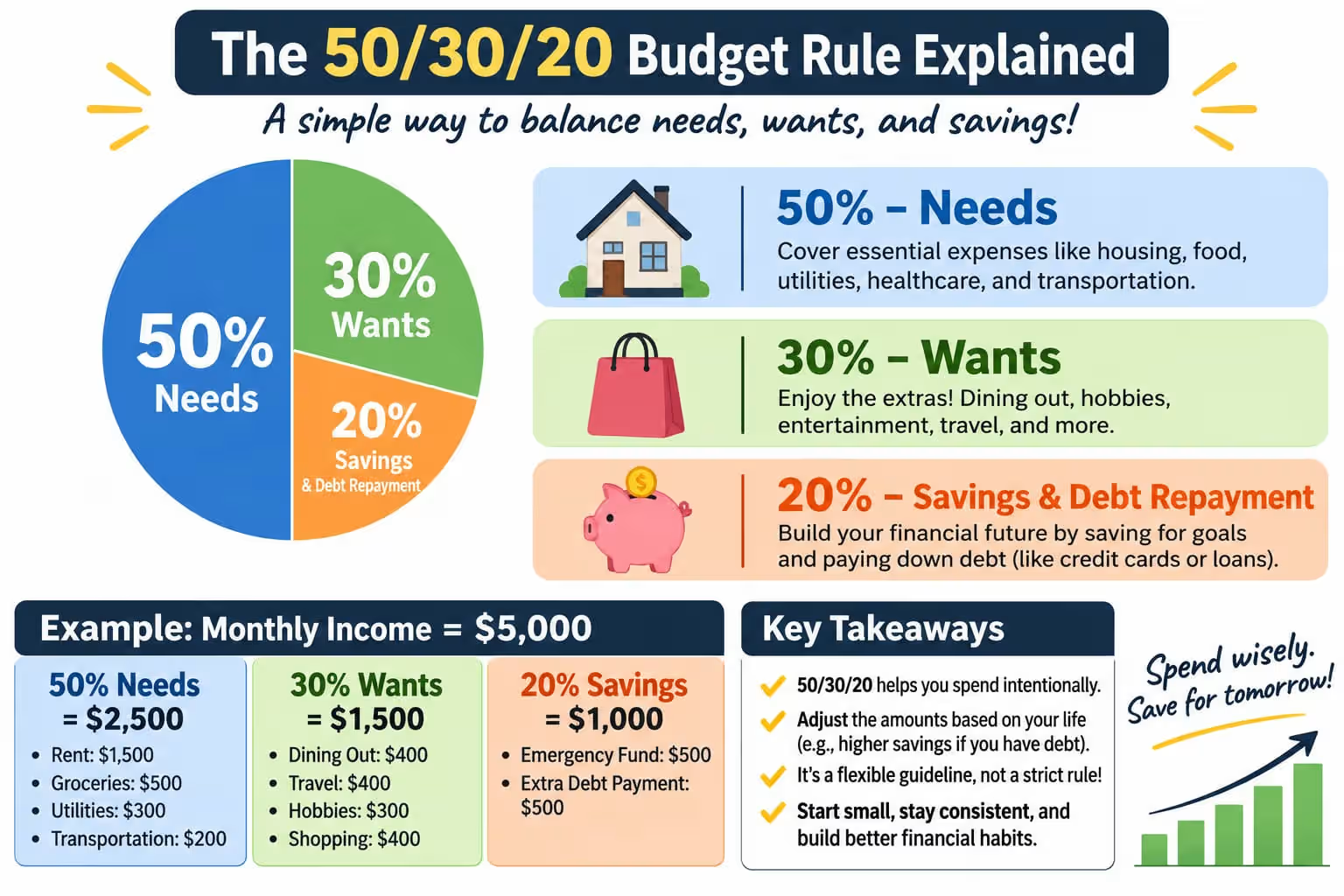
The 50/30/20 budget rule is a simple money management method that divides your monthly after-tax income into three categories: 50% for needs, 30% for wants, and 20% for savings and debt repayment. Instead of tracking hundreds of individual expenses, you follow three easy percentages to create a balanced financial plan.
Whether you are a salaried employee, freelancer, student earning an income, young professional, or someone managing a family budget, this method can help you understand your spending habits and make better financial decisions.
For example, if your monthly take-home salary is ₹40,000, you would allocate:
- ₹20,000 towards essential expenses.
- ₹12,000 towards lifestyle and personal spending.
- ₹8,000 towards savings and debt repayment.
The beauty of this approach is its simplicity. You do not need complicated financial software, advanced investment knowledge, or an expensive financial advisor to begin.
However, following the rule successfully requires understanding what belongs in each category, how to adjust the percentages according to your income, and how to handle situations where essential expenses consume more than half your salary.
In this comprehensive guide, we will explain how the 50/30/20 budget rule works, explore practical examples using different monthly salaries, discuss its benefits and limitations, and provide a step-by-step approach to creating a realistic monthly budget.
By the end, you will have a practical framework for managing your money, controlling unnecessary spending, and building long-term financial stability.
What Is the 50/30/20 Budget Rule?
The 50/30/20 budget rule is a personal finance strategy that divides your monthly after-tax income into three spending categories.
Each percentage represents how much of your income should ideally go towards a particular financial purpose.
The three categories are:
- 50% for Needs: Essential expenses required for everyday living.
- 30% for Wants: Lifestyle expenses that improve comfort, entertainment, and enjoyment.
- 20% for Savings and Debt Repayment: Money reserved for financial security, future goals, investments, and paying down debt.
The method is designed to create a balance between enjoying your present income and preparing for future financial responsibilities.
Rather than spending whatever remains after paying bills, you assign a purpose to your income before spending it.
Understanding the Three Budget Categories
| Budget Category | Recommended Allocation | Purpose |
|---|---|---|
| Needs | 50% | Essential living expenses |
| Wants | 30% | Lifestyle and entertainment |
| Savings and Debt Repayment | 20% | Financial security and future goals |
| Total | 100% | Complete monthly income allocation |
The percentages are guidelines, not strict financial laws. Your actual allocation may depend on your salary, location, family responsibilities, existing debts, and financial priorities.
For example, someone living in a metropolitan city with high rent may need to spend more than 50% of their income on essential expenses. Another person living with family may be able to save more than 20%.
The objective is to use the framework to make thoughtful financial decisions rather than follow percentages blindly.
How Does the 50/30/20 Budget Rule Work?
The 50/30/20 budget rule works by dividing your take-home income into three separate financial groups.
Let’s understand each category in detail.
1. Allocate 50% of Your Income to Needs
Needs are expenses you must pay to maintain a reasonable standard of living.
These expenses are generally necessary, predictable, and difficult to eliminate completely.
Common examples include:
- House rent or essential home loan payments.
- Groceries and basic food supplies.
- Electricity and water bills.
- Cooking gas.
- Basic internet and mobile services required for work or daily life.
- Transportation to work.
- Health insurance premiums.
- Essential medical expenses.
- School fees and necessary educational expenses.
- Childcare costs.
- Minimum required loan and credit card payments.
- Essential household supplies.
For example, if your monthly take-home salary is ₹50,000, your ideal needs allocation would be ₹25,000.
You could divide this amount as follows:
| Essential Expense | Monthly Budget |
|---|---|
| House rent | ₹10,000 |
| Groceries | ₹5,000 |
| Electricity and water | ₹1,500 |
| Transportation | ₹3,000 |
| Mobile and internet | ₹800 |
| Medical and insurance expenses | ₹2,000 |
| Essential household expenses | ₹2,700 |
| Total | ₹25,000 |
This example shows how essential expenses can fit within half of your monthly income.
However, the actual amounts will differ depending on your household size, location, and lifestyle.
Important: Needs should not automatically include every expense you currently pay. An expense is not necessarily essential just because you pay for it regularly.
For instance, a premium television subscription, frequent restaurant visits, and an expensive mobile upgrade may be lifestyle choices rather than necessities.
Understanding this difference is essential for successful budgeting.
2. Allocate 30% of Your Income to Wants
Wants are expenses that make life more enjoyable but are not essential for basic survival.
They include activities, products, and services that improve your comfort, entertainment, convenience, and lifestyle.
Common examples include:
- Eating at restaurants.
- Ordering food online.
- Movie tickets.
- Shopping for fashionable clothes.
- Premium streaming subscriptions.
- Weekend trips.
- Expensive hobbies.
- Gaming subscriptions.
- Buying the latest smartphone when your existing phone works properly.
- Gym memberships beyond basic health requirements.
- Luxury accessories.
- Non-essential home decorations.
If your monthly take-home salary is ₹50,000, the recommended wants allocation is ₹15,000.
A possible spending plan could look like this:
| Lifestyle Expense | Monthly Budget |
|---|---|
| Restaurant visits | ₹3,000 |
| Shopping | ₹3,000 |
| Entertainment | ₹2,000 |
| Streaming subscriptions | ₹800 |
| Weekend activities | ₹2,000 |
| Hobbies and personal interests | ₹2,200 |
| Additional lifestyle spending | ₹2,000 |
| Total | ₹15,000 |
The purpose of this category is not to eliminate enjoyment.
In fact, allowing money for personal interests makes a budget easier to maintain because you do not feel that every purchase is forbidden.
However, wants should remain within a reasonable limit.
If you consistently spend too much on entertainment, shopping, or food delivery, your savings may suffer.
A useful question to ask before making a purchase is:
“Do I genuinely need this, or do I simply want it?”
There is nothing wrong with spending money on things you enjoy. The important thing is ensuring that lifestyle expenses do not interfere with essential financial goals.
3. Allocate 20% of Your Income to Savings and Debt Repayment
The final 20% is dedicated to strengthening your financial position.
This category is particularly important because it helps prepare you for unexpected expenses, future purchases, retirement, and other long-term goals.
It can include:
- Emergency fund contributions.
- Recurring deposits.
- Fixed deposits.
- Mutual fund investments.
- Retirement savings.
- Public Provident Fund contributions.
- National Pension System contributions.
- Additional repayment of high-interest debt.
- Saving for a home down payment.
- Saving for children’s education.
- Long-term financial goals.
For example, if your monthly income is ₹50,000, your savings and debt repayment allocation would be ₹10,000.
You might divide it as follows:
| Savings or Financial Goal | Monthly Allocation |
|---|---|
| Emergency fund | ₹3,000 |
| Mutual fund SIP | ₹3,000 |
| Retirement savings | ₹2,000 |
| Additional loan repayment | ₹2,000 |
| Total | ₹10,000 |
This is only an illustrative allocation. If you have expensive outstanding debt or no emergency savings, your priorities may need to change.
For beginners, building an emergency fund is often a sensible starting point.
Once you have an adequate emergency reserve and have addressed high-interest debt, you can gradually increase long-term investments.
Remember that investments carry different levels of risk. Choose financial products according to your goals, time horizon, and ability to tolerate losses.
50/30/20 Budget Rule Examples for Different Monthly Salaries
One of the easiest ways to understand the 50/30/20 budget rule is to see how it works with different income levels.
The following examples use monthly take-home income rather than gross salary.
Example 1: Monthly Salary of ₹20,000
Suppose you earn ₹20,000 per month after taxes and other payroll deductions.
Your allocation would be:
| Category | Percentage | Amount |
|---|---|---|
| Needs | 50% | ₹10,000 |
| Wants | 30% | ₹6,000 |
| Savings and debt repayment | 20% | ₹4,000 |
| Total | 100% | ₹20,000 |
A possible monthly budget:
Needs: ₹10,000
- Rent contribution: ₹4,000
- Groceries: ₹2,500
- Transportation: ₹1,500
- Electricity and mobile bills: ₹1,000
- Other essentials: ₹1,000
Wants: ₹6,000
- Eating outside: ₹1,500
- Shopping: ₹1,500
- Entertainment: ₹1,000
- Personal interests: ₹2,000
Savings: ₹4,000
- Emergency fund: ₹2,000
- Recurring deposit: ₹1,000
- Investment contribution: ₹1,000
This example demonstrates that even someone earning ₹20,000 can begin developing a savings habit.
However, if rent and basic expenses are higher, it is perfectly reasonable to reduce wants and start with a smaller savings percentage.
Example 2: Monthly Salary of ₹30,000
For someone earning ₹30,000 per month, the budget becomes:
| Category | Percentage | Amount |
|---|---|---|
| Needs | 50% | ₹15,000 |
| Wants | 30% | ₹9,000 |
| Savings and debt repayment | 20% | ₹6,000 |
| Total | 100% | ₹30,000 |
A practical allocation could be:
Needs: ₹15,000
- Rent: ₹6,000
- Groceries: ₹3,000
- Transportation: ₹2,000
- Utilities: ₹1,500
- Insurance and medical expenses: ₹1,500
- Other essentials: ₹1,000
Wants: ₹9,000
- Shopping: ₹2,000
- Restaurant visits: ₹2,000
- Entertainment: ₹1,000
- Travel and outings: ₹2,000
- Personal activities: ₹2,000
Savings: ₹6,000
- Emergency fund: ₹2,500
- Mutual fund SIP: ₹2,000
- Recurring deposit or other savings: ₹1,500
A person earning ₹30,000 can use this framework to balance household responsibilities, personal spending, and financial progress.
Example 3: Monthly Salary of ₹40,000
Suppose your monthly take-home income is ₹40,000.
Your budget would look like this:
| Category | Percentage | Amount |
|---|---|---|
| Needs | 50% | ₹20,000 |
| Wants | 30% | ₹12,000 |
| Savings and debt repayment | 20% | ₹8,000 |
| Total | 100% | ₹40,000 |
A sample monthly spending plan:
Needs: ₹20,000
- Rent: ₹8,000
- Groceries: ₹4,000
- Transportation: ₹2,000
- Electricity and water: ₹1,500
- Mobile and internet: ₹700
- Insurance: ₹1,800
- Other essentials: ₹2,000
Wants: ₹12,000
- Shopping: ₹2,500
- Restaurant visits: ₹2,000
- Entertainment: ₹1,500
- Travel: ₹3,000
- Hobbies: ₹1,500
- Other personal expenses: ₹1,500
Savings: ₹8,000
- Emergency fund: ₹3,000
- Mutual fund SIP: ₹3,000
- Retirement savings: ₹1,000
- Additional debt repayment: ₹1,000
This structure gives you room for lifestyle spending while consistently directing money towards future financial needs.
Example 4: Monthly Salary of ₹50,000
For an individual earning ₹50,000 monthly:
| Category | Percentage | Amount |
|---|---|---|
| Needs | 50% | ₹25,000 |
| Wants | 30% | ₹15,000 |
| Savings and debt repayment | 20% | ₹10,000 |
| Total | 100% | ₹50,000 |
You can use this amount to create a more balanced financial plan.
For example:
- ₹25,000 for household and essential expenses.
- ₹15,000 for entertainment, shopping, travel, and hobbies.
- ₹10,000 for emergency savings, investments, and additional debt repayment.
Someone earning ₹50,000 may also have an opportunity to increase savings by reducing unnecessary subscriptions, eating out less frequently, and controlling impulsive shopping.
Example 5: Monthly Salary of ₹75,000
For a higher monthly take-home income of ₹75,000:
| Category | Percentage | Amount |
|---|---|---|
| Needs | 50% | ₹37,500 |
| Wants | 30% | ₹22,500 |
| Savings and debt repayment | 20% | ₹15,000 |
| Total | 100% | ₹75,000 |
A possible allocation:
Needs: ₹37,500
- Rent or home loan payment: ₹15,000
- Groceries: ₹6,000
- Transportation: ₹4,000
- Utilities: ₹2,500
- Insurance and healthcare: ₹4,000
- Family essentials: ₹6,000
Wants: ₹22,500
- Dining: ₹4,000
- Shopping: ₹4,000
- Entertainment: ₹2,500
- Travel: ₹5,000
- Hobbies: ₹3,000
- Other lifestyle spending: ₹4,000
Savings: ₹15,000
- Emergency fund: ₹4,000
- Mutual fund investments: ₹5,000
- Retirement savings: ₹3,000
- Additional debt repayment: ₹3,000
With higher income, you may also have an opportunity to save more than 20%.
You do not need to increase lifestyle spending every time your salary increases.
Example 6: Monthly Salary of ₹1,00,000
If your monthly take-home salary is ₹1 lakh, the traditional 50/30/20 allocation becomes:
| Category | Percentage | Amount |
|---|---|---|
| Needs | 50% | ₹50,000 |
| Wants | 30% | ₹30,000 |
| Savings and debt repayment | 20% | ₹20,000 |
| Total | 100% | ₹1,00,000 |
At this income level, your financial goals might include:
- Building a substantial emergency fund.
- Investing regularly for long-term goals.
- Saving for a home.
- Planning for children’s education.
- Increasing retirement contributions.
- Paying off outstanding loans.
A person with manageable expenses may choose a 40/30/30 or even 40/20/40 allocation to accelerate savings.
The key is to avoid allowing lifestyle inflation to consume every salary increase.
50/30/20 Budget Rule Calculator: Calculate Your Monthly Budget
You do not need to calculate percentages manually every month.
Use the following calculator to estimate how much money should go towards each category.
Enter your monthly take-home income to see the recommended allocation.
Example: If you receive ₹45,000 after deductions, enter 45000.
| Monthly Take-Home Income | Needs (50%) | Wants (30%) | Savings (20%) |
|---|---|---|---|
| ₹20,000 | ₹10,000 | ₹6,000 | ₹4,000 |
| ₹30,000 | ₹15,000 | ₹9,000 | ₹6,000 |
| ₹40,000 | ₹20,000 | ₹12,000 | ₹8,000 |
| ₹50,000 | ₹25,000 | ₹15,000 | ₹10,000 |
| ₹75,000 | ₹37,500 | ₹22,500 | ₹15,000 |
| ₹1,00,000 | ₹50,000 | ₹30,000 | ₹20,000 |
You can use this simple formula:
- Needs = Monthly take-home income × 0.50
- Wants = Monthly take-home income × 0.30
- Savings = Monthly take-home income × 0.20
The results provide a starting budget. Adjust the allocation if your actual living costs require a different distribution.
How to Create a 50/30/20 Budget Step by Step
Understanding the rule is easy. Applying it consistently requires planning.
Here is a practical process for creating your own monthly budget.
Step 1: Calculate Your Monthly Take-Home Income
Start by identifying how much money you actually receive each month.
Do not automatically use your annual package or gross salary.
Your take-home income is the amount available after relevant payroll deductions, such as:
- Income tax and TDS.
- Employee provident fund contributions.
- Professional tax, where applicable.
- Other salary deductions.
For example:
| Salary Component | Amount |
|---|---|
| Gross monthly salary | ₹55,000 |
| Total monthly deductions | ₹5,000 |
| Monthly take-home income | ₹50,000 |
Your 50/30/20 budget should be calculated using ₹50,000 in this example.
If you earn through freelancing, commissions, or self-employment, calculate your available income after setting aside money for applicable taxes and necessary business expenses.
If your income changes monthly, consider using a conservative estimate based on your reliable earnings rather than your best month.
Step 2: Track Your Current Expenses
Before changing your spending habits, understand where your money currently goes.
Review your bank statements, UPI transactions, debit card payments, credit card bills, and cash expenses.
Divide your spending into three categories:
- Needs.
- Wants.
- Savings and debt repayment.
Track your expenses for at least one complete month if possible.
You may discover that small transactions are consuming a significant part of your available income.
For example:
- ₹100 daily for snacks.
- ₹150 for frequent food delivery.
- ₹300 for unnecessary shopping.
- ₹500 for unused subscriptions.
Individual purchases may appear small, but repeated spending can affect your monthly budget.
Step 3: Separate Needs from Wants
This is one of the most important parts of the 50/30/20 budgeting method.
Some expenses are easy to classify, while others require judgment.
For example:
| Expense | Category | Reason |
|---|---|---|
| Basic groceries | Need | Essential food |
| Premium restaurant meal | Want | Optional dining |
| Basic mobile recharge | Need | Essential communication |
| Premium mobile plan | Want | Optional upgrade |
| Public transportation | Need | Essential commuting |
| Luxury vehicle upgrade | Want | Lifestyle choice |
| Basic healthcare | Need | Health requirement |
| Optional beauty treatment | Want | Personal preference |
| Minimum loan EMI | Need | Required repayment |
| Extra loan repayment | Savings/Debt | Reduces outstanding debt |
Some expenses can belong to different categories depending on the circumstances.
For example, a gym membership may be a health-related priority for one person and an optional lifestyle expense for another.
Similarly, internet service may be essential for someone working remotely but optional or less important for someone who uses it mainly for entertainment.
Classify expenses based on their actual purpose rather than their name.
Step 4: Calculate Your Three Budget Limits
Once you know your take-home income, calculate the recommended allocation.
Suppose your monthly income is ₹60,000.
- Needs: ₹30,000.
- Wants: ₹18,000.
- Savings: ₹12,000.
These figures become your monthly spending targets.
You can create separate bank accounts, savings pockets, or spreadsheet categories to make tracking easier.
Step 5: Prioritize Your Financial Goals
Do not save money without understanding why you are saving it.
Create specific goals.
For example:
| Financial Goal | Target Amount | Suggested Priority |
|---|---|---|
| Emergency fund | ₹1,50,000 | High |
| Short-term travel | ₹30,000 | Medium |
| Home down payment | ₹5,00,000 | Long-term |
| Retirement savings | Depends on retirement plan | Long-term |
| Debt repayment | Outstanding balance | Based on interest rate |
Your savings category should reflect your financial situation.
If you have no emergency fund, begin building one.
If you have expensive credit card debt, reducing that balance may be more beneficial than increasing discretionary investments.
Step 6: Automate Your Savings
One effective budgeting practice is to save before spending.
On receiving your salary:
- Transfer your planned savings amount.
- Keep sufficient money for essential bills.
- Set a monthly limit for discretionary spending.
- Monitor your remaining balance throughout the month.
For example, if you earn ₹40,000 and follow the standard rule, transfer ₹8,000 towards your savings and financial goals.
Automation reduces the temptation to spend money that should be reserved for the future.
However, ensure that your account has enough funds for upcoming bills and automatic payments.
Step 7: Review Your Budget Every Month
A budget should be flexible.
Your rent may increase, medical expenses may arise, or transportation costs may change.
Review your spending at the end of every month.
Ask yourself:
- Did I stay within my needs budget?
- Did I overspend on wants?
- Did I save the planned amount?
- Which expenses can I reduce?
- Do my financial priorities need to change?
Make small adjustments instead of abandoning the entire budgeting system.
Consistency is more useful than trying to achieve a perfect budget immediately.
How to Apply the 50/30/20 Rule in India
The 50/30/20 budget rule can be useful for Indian households, but it should be adapted to local living costs and financial responsibilities.
Expenses in India can vary considerably between cities, towns, and rural areas.
For example, someone living in Mumbai, Bengaluru, Pune, or Delhi may have different housing and transportation costs from someone living in a smaller town.
Family responsibilities also influence budgeting decisions.
Consider Common Indian Household Expenses
Your needs category may include:
- House rent.
- Grocery purchases.
- Milk and vegetables.
- Electricity bills.
- LPG cylinder expenses.
- Water bills.
- School and college fees.
- Petrol, diesel, or public transportation.
- Health insurance.
- Medical expenses.
- Mobile recharge and internet.
- Home loan or essential loan EMIs.
Your wants category may include:
- Online food delivery.
- Restaurant visits.
- Shopping through e-commerce platforms.
- Movie tickets.
- Weekend outings.
- Premium OTT subscriptions.
- Vacations.
- Expensive gadgets.
- Non-essential lifestyle purchases.
Your savings category may include:
- Bank savings.
- Recurring deposits.
- Fixed deposits.
- Public Provident Fund.
- Mutual fund SIPs.
- National Pension System.
- Emergency fund contributions.
- Additional loan repayments.
The right financial products depend on your financial objectives, risk tolerance, tax situation, and investment horizon.
Example: A Family Budget with ₹60,000 Monthly Income
Consider an Indian family with a combined monthly take-home income of ₹60,000.
A standard allocation would be:
| Category | Amount |
|---|---|
| Needs | ₹30,000 |
| Wants | ₹18,000 |
| Savings and debt repayment | ₹12,000 |
| Total | ₹60,000 |
A possible household budget:
Needs: ₹30,000
- House rent: ₹10,000.
- Groceries: ₹6,000.
- School expenses: ₹3,000.
- Transportation: ₹3,000.
- Electricity and utilities: ₹2,000.
- Healthcare and insurance: ₹3,000.
- Other essentials: ₹3,000.
Wants: ₹18,000
- Dining and food delivery: ₹3,000.
- Shopping: ₹4,000.
- Entertainment: ₹2,000.
- Family outings: ₹3,000.
- Travel savings: ₹3,000.
- Other personal expenses: ₹3,000.
Savings: ₹12,000
- Emergency fund: ₹4,000.
- Mutual fund SIP: ₹4,000.
- Retirement savings: ₹2,000.
- Additional debt repayment: ₹2,000.
This is an illustrative family budget, not a recommendation that every Indian household should spend the same amounts.
Families with children, dependent parents, higher rent, or substantial medical costs may need a different allocation.
What If Your Essential Expenses Are More Than 50%?
One of the biggest challenges with the 50/30/20 budget rule is that essential expenses may consume more than half your income.
This is common for people with lower salaries, high housing costs, dependent family members, or significant loan obligations.
Suppose your take-home salary is ₹30,000, but your monthly essential expenses are ₹19,000.
That means your needs account for approximately 63% of your income.
Trying to force your expenses into a ₹15,000 limit may be unrealistic.
Instead, adjust your budget temporarily.
For example:
| Category | Adjusted Percentage | Amount |
|---|---|---|
| Needs | 65% | ₹19,500 |
| Wants | 20% | ₹6,000 |
| Savings | 15% | ₹4,500 |
| Total | 100% | ₹30,000 |
This alternative still allows you to save money while acknowledging your actual responsibilities.
Ways to Reduce Essential Expenses
Consider the following options:
1. Review Housing Costs
Housing is often one of the largest monthly expenses.
If rent is consuming too much income, consider a more affordable location, shared accommodation, or renegotiating your rental agreement when appropriate.
2. Reduce Transportation Costs
Compare public transportation, carpooling, and personal vehicle expenses.
If possible, combine errands to reduce unnecessary travel.
3. Plan Grocery Purchases
Prepare a weekly meal plan and shopping list.
Buying only what your household needs can reduce food waste and unnecessary purchases.
4. Review Recurring Bills
Check electricity consumption, mobile plans, internet packages, and other recurring charges.
You may find less expensive plans that meet your actual requirements.
5. Avoid Taking New Unnecessary Debt
New EMIs can increase your fixed monthly expenses.
Before financing a purchase, evaluate whether it is necessary and whether the repayment comfortably fits your budget.
The goal is to gradually improve your financial position rather than create additional pressure.
Benefits of Following the 50/30/20 Budget Rule
The 50/30/20 budget rule is popular because it provides a simple structure for managing personal finances.
Here are its major advantages.
1. Easy to Understand and Follow
Many budgeting systems involve tracking numerous expense categories.
The 50/30/20 approach simplifies the process into three broad groups.
You do not need advanced financial knowledge to begin.
2. Encourages Regular Savings
By allocating 20% towards savings and debt repayment, you make future financial goals part of your monthly spending plan.
This reduces dependence on whatever money happens to remain at the end of the month.
3. Balances Saving and Enjoyment
A budget that allows no personal spending can become difficult to maintain.
The 30% wants category gives you room for entertainment, hobbies, travel, and other lifestyle activities.
This can make budgeting feel more practical.
4. Helps Control Unnecessary Spending
When you set a limit for discretionary expenses, you become more aware of impulsive purchases.
You can identify spending patterns and make better decisions.
5. Supports Emergency Fund Creation
Regular contributions can help build money for unexpected situations, such as:
- Medical emergencies.
- Temporary unemployment.
- Urgent home repairs.
- Essential travel.
- Unexpected family responsibilities.
An emergency fund reduces the need to depend entirely on borrowing when something goes wrong.
6. Helps Build Long-Term Financial Discipline
Following a monthly budget develops useful financial habits.
You become more conscious of spending, saving, borrowing, and planning.
Over time, these habits can support important financial goals.
7. Works with Different Income Levels
The percentages can be applied to many income levels.
Someone earning ₹25,000 and someone earning ₹1,00,000 can use the same basic framework, although their actual expenses will differ.
Limitations of the 50/30/20 Budget Rule
Although useful, the 50/30/20 rule is not suitable for every financial situation.
Understanding its limitations helps you use it more effectively.
1. It May Not Work with Low Incomes
When income is limited, essential expenses may consume most of the available money.
Forcing a 50% needs limit may not be realistic.
In such cases, prioritize basic expenses and save whatever amount is genuinely affordable.
2. It Does Not Consider Every Financial Goal
The rule groups savings and debt repayment together.
However, emergency savings, retirement investments, education funds, and loan repayment have different purposes.
You may need a more detailed financial plan to manage these goals properly.
3. It Does Not Automatically Account for Irregular Expenses
Many people forget about expenses that occur once or twice a year.
Examples include:
- Annual insurance premiums.
- Vehicle maintenance.
- School admission fees.
- Festival expenses.
- Property taxes.
- Annual subscriptions.
- Planned medical expenses.
These expenses should be included in your monthly plan.
One way to handle them is to create a separate sinking fund by setting aside a small amount every month.
4. It May Be Difficult for People with Variable Income
Freelancers, business owners, commission-based employees, and gig workers may not receive the same amount every month.
Using fixed percentages without considering income fluctuations can create problems.
A better approach is to prepare a conservative budget using your dependable income and adjust discretionary spending when earnings are higher or lower.
5. It Does Not Replace Financial Planning
A monthly budget helps you manage cash flow.
It does not automatically provide adequate insurance, investment diversification, retirement planning, or debt management.
These areas require additional consideration.
Common 50/30/20 Budgeting Mistakes to Avoid
Even a simple budgeting method can become ineffective when applied incorrectly.
Avoid these common mistakes.
Mistake 1: Using Gross Salary Instead of Take-Home Income
The rule should generally be applied to your income after relevant deductions.
If you calculate percentages using your gross salary, you may allocate more money than you actually receive.
How to avoid it: Use the amount credited to your bank account after payroll deductions.
Mistake 2: Classifying Every Purchase as a Need
People sometimes justify unnecessary purchases by treating them as essential.
For example, upgrading a perfectly functional smartphone may be a want rather than a need.
How to avoid it: Ask whether the purchase is necessary for your basic living requirements, work, or important responsibilities.
Mistake 3: Ignoring Small Expenses
Small purchases may appear insignificant individually.
However, frequent snacks, coffee, delivery charges, and digital subscriptions can add up.
How to avoid it: Record all transactions, including small cash and UPI payments.
Mistake 4: Saving Only at the End of the Month
If you wait until all your spending is complete, you may have little money left to save.
How to avoid it: Transfer your planned savings soon after receiving your income.
Mistake 5: Forgetting Annual and Irregular Bills
Annual expenses can disrupt an otherwise well-planned monthly budget.
How to avoid it: Divide predictable annual expenses into monthly savings targets.
For example, if an annual insurance premium is ₹12,000, setting aside ₹1,000 each month can help prepare for the payment.
Mistake 6: Following the Percentages Too Strictly
The percentages are guidelines.
They should not prevent you from paying necessary medical bills, supporting dependent family members, or meeting essential financial responsibilities.
How to avoid it: Adjust your budget based on your real circumstances.
Mistake 7: Increasing Lifestyle Spending Every Time Your Salary Increases
When income rises, people sometimes increase spending immediately.
This is known as lifestyle inflation.
How to avoid it: Direct a portion of every salary increase towards savings, investments, and debt reduction before upgrading your lifestyle.
Mistake 8: Ignoring High-Interest Debt
Paying only the minimum amount on expensive debt can increase the total interest you pay.
How to avoid it: Understand your outstanding balances and interest rates. Prioritize high-interest debt while maintaining essential payments and a basic financial safety reserve.
How to Make the 50/30/20 Budget Rule More Effective
The following practices can help you get better results from your budgeting routine.
1. Use Separate Bank Accounts or Savings Pockets
Keeping spending money and savings separate can make financial management easier.
For example:
- Account 1: Salary and essential expenses.
- Account 2: Emergency savings.
- Account 3: Investment contributions.
- Account 4: Personal spending, if needed.
You do not necessarily need multiple bank accounts. Budgeting features or separate savings pockets may provide similar organization.
2. Follow the Pay Yourself First Method
Pay yourself first means reserving money for savings before spending on optional purchases.
For example, if your monthly savings target is ₹6,000, transfer that amount after receiving your salary.
This makes savings a planned responsibility rather than an afterthought.
3. Build an Emergency Fund
An emergency fund provides financial protection against unexpected expenses and income interruptions.
A common planning target is approximately three to six months of essential living expenses, although the appropriate amount depends on your job stability, family responsibilities, insurance coverage, and other circumstances.
Keep emergency money in an accessible and relatively low-risk place.
Do not invest your entire emergency reserve in volatile assets that may lose value when you need the money.
4. Review Subscriptions Regularly
Many people continue paying for services they rarely use.
Review:
- OTT subscriptions.
- Music applications.
- Premium mobile applications.
- Online memberships.
- Gaming subscriptions.
- Unused gym memberships.
Cancel services that no longer provide sufficient value.
5. Plan Large Purchases in Advance
Avoid making major purchases impulsively.
If you want to buy a laptop, smartphone, vehicle, or household appliance, create a separate savings target.
For example, if you want to purchase a laptop worth ₹60,000 after 12 months, you would need to set aside approximately ₹5,000 per month, excluding any interest or price changes.
Planning makes large purchases more manageable.
6. Review Your Financial Goals Every Three to Six Months
Your financial situation may change over time.
You may receive a salary increase, move to a different city, start supporting family members, or take on a new loan.
Review your budget periodically and adjust it accordingly.
7. Increase Your Savings Percentage Gradually
If saving 20% is difficult initially, begin with a smaller amount.
For example:
- Month 1: Save 5%.
- Month 2: Save 7%.
- Month 3: Save 10%.
- Month 4: Save 12%.
- Month 5: Save 15%.
Gradually increasing your savings rate can help you develop a sustainable habit.
You can work towards 20% or more as your income and financial circumstances improve.
50/30/20 Budget Rule vs. Other Budgeting Methods
The 50/30/20 method is not the only way to manage money.
Other budgeting methods may be more suitable depending on your financial goals and spending habits.
50/30/20 Rule vs. Zero-Based Budgeting
Zero-based budgeting assigns every rupee of income a specific purpose.
Your income minus planned expenses, savings, and debt payments should equal zero.
For example:
If you earn ₹40,000, you allocate the complete amount to rent, groceries, transportation, entertainment, savings, investments, and other categories.
The goal is not to spend everything. Savings are also assigned a purpose.
Which is better?
The 50/30/20 method is simpler and easier for beginners.
Zero-based budgeting provides more detailed control and may be useful for people who want to track every rupee.
50/30/20 Rule vs. 70/20/10 Budget Rule
The 70/20/10 method generally divides income into:
- 70% for spending.
- 20% for savings.
- 10% for debt repayment, giving, or another defined financial purpose, depending on the version used.
Unlike the 50/30/20 approach, it does not always distinguish essential expenses from lifestyle spending.
Which is better?
The 50/30/20 rule is useful when you want to control lifestyle expenses separately.
The 70/20/10 approach may be easier for people who prefer fewer spending categories.
50/30/20 Rule vs. 80/20 Budget Rule
The 80/20 budget rule is a simpler approach.
It generally suggests:
- 80% for spending.
- 20% for savings.
The remaining 80% is not necessarily divided between needs and wants.
Which is better?
The 80/20 method works well for people who already manage their spending responsibly.
The 50/30/20 method provides more visibility into how much goes towards essential and optional expenses.
Should You Save More Than 20% of Your Income?
Yes. Saving more than 20% can be a sensible decision if your income, responsibilities, and financial circumstances allow it.
The 50/30/20 rule is not a maximum savings limit.
For example, someone earning ₹80,000 monthly with relatively low living costs may be able to save 30% or 40%.
A modified allocation could be:
| Category | Percentage | Amount |
|---|---|---|
| Needs | 40% | ₹32,000 |
| Wants | 25% | ₹20,000 |
| Savings | 35% | ₹28,000 |
| Total | 100% | ₹80,000 |
This approach may be suitable for someone who wants to build an emergency fund faster, prepare for a home purchase, or increase retirement investments.
However, saving more should not mean ignoring important healthcare needs, adequate insurance, or reasonable quality of life.
The right savings percentage is one you can maintain consistently without creating unnecessary financial pressure.
How the 50/30/20 Rule Helps You Build Wealth
Budgeting and wealth building are closely connected.
A budget does not directly create wealth, but it helps you manage income, control expenses, and create money that can be directed towards long-term financial goals.
1. It Creates a Consistent Savings Habit
Regular savings provide the starting capital for investments and future financial requirements.
Even modest monthly contributions can become meaningful over time.
2. It Helps Reduce Expensive Debt
By reserving money for debt repayment, you can work towards reducing outstanding balances.
Lower debt obligations may also free up more money for future investments.
3. It Supports Long-Term Investing
Once essential expenses, emergency savings, and expensive debt are addressed, you can consider investing for long-term goals.
Depending on your circumstances, options may include:
- Equity mutual funds.
- Debt mutual funds.
- Public Provident Fund.
- National Pension System.
- Fixed deposits.
- Other suitable regulated financial products.
Each product has different risks, returns, liquidity conditions, tax treatment, and investment periods.
Choose investments according to your specific goals rather than selecting products simply because they are popular.
4. It Reduces Lifestyle Inflation
A structured budget helps prevent unnecessary increases in spending when your income grows.
You can enjoy salary increases while directing more money towards wealth creation.
5. It Improves Financial Preparedness
A well-managed savings plan can help you prepare for major life events.
Examples include:
- Buying a house.
- Funding higher education.
- Marriage expenses.
- Starting a business.
- Children’s education.
- Retirement.
The more clearly you understand your monthly finances, the easier it becomes to plan for these responsibilities.
Advanced Tips for Different Financial Situations
The traditional 50/30/20 rule may need adjustments depending on your personal circumstances.
If You Are a Student
Students who earn part-time income, stipends, or freelance payments can use the framework to build good financial habits.
Focus on:
- Essential transportation.
- Food and study expenses.
- Educational requirements.
- Limited entertainment.
- Small emergency savings.
Your first goal should be developing financial discipline rather than investing aggressively.
If You Are a Young Professional
The early stages of a career can provide an opportunity to build strong money habits.
Consider:
- Creating an emergency fund.
- Avoiding unnecessary EMIs.
- Getting appropriate health insurance.
- Starting long-term investments after understanding the risks.
- Increasing savings as your salary grows.
Avoid spending heavily just to maintain a lifestyle that does not match your income.
If You Are Married
Couples can use the rule to manage combined household income.
Begin by discussing:
- Individual earnings.
- Shared household expenses.
- Personal spending limits.
- Existing debts.
- Family responsibilities.
- Joint savings goals.
You can also maintain individual discretionary budgets to preserve personal financial independence.
If You Have Children
Parents may have higher essential expenses because of childcare, education, healthcare, and other family requirements.
Consider creating separate savings goals for:
- Emergency expenses.
- School fees.
- Higher education.
- Healthcare.
- Retirement.
Do not sacrifice your own long-term financial security entirely to fund every possible future expense for your children.
If You Are Self-Employed
Self-employed individuals may have irregular income and business expenses.
First, separate personal finances from business finances.
Calculate your personal take-home amount after accounting for necessary business costs and applicable taxes.
Then apply a flexible budgeting framework.
For months with higher earnings, consider increasing savings instead of immediately increasing lifestyle spending.
Practical Monthly Budget Template
A monthly budget template can help you apply the 50/30/20 rule without complicated calculations.
Here is a simple example for someone earning ₹50,000.
| Category | Planned Budget | Actual Spending |
|---|---|---|
| Needs | ₹25,000 | |
| Rent | ₹10,000 | |
| Groceries | ₹5,000 | |
| Utilities | ₹2,000 | |
| Transportation | ₹3,000 | |
| Insurance and healthcare | ₹2,500 | |
| Other essentials | ₹2,500 | |
| Wants | ₹15,000 | |
| Shopping | ₹3,000 | |
| Dining | ₹3,000 | |
| Entertainment | ₹2,000 | |
| Travel | ₹4,000 | |
| Hobbies and personal expenses | ₹3,000 | |
| Savings and debt repayment | ₹10,000 | |
| Emergency fund | ₹3,000 | |
| Investments | ₹4,000 | |
| Additional debt repayment | ₹3,000 | |
| Total | ₹50,000 |
You can copy this template into a spreadsheet or notebook.
At the end of each month, enter your actual spending and compare it with your planned budget.
This helps you identify areas where you need to make adjustments.
Tools That Can Help You Follow the 50/30/20 Budget Rule
You do not need expensive software to manage a monthly budget.
Several simple tools can help.
1. Google Sheets or Microsoft Excel
A spreadsheet is one of the most flexible ways to track monthly income and expenses.
You can create columns for:
- Date.
- Expense description.
- Amount.
- Category.
- Payment method.
- Planned spending.
- Actual spending.
You can also use formulas to calculate the percentage of income spent in each category.
2. Banking Applications
Many banking applications provide transaction histories and spending information.
Review these regularly to understand your cash flow.
3. Personal Finance Applications
Budgeting applications can help categorize expenses, monitor spending, and create monthly financial reports.
Before connecting an application to your bank account, review its privacy policy, permissions, and security practices.
4. A Simple Notebook
If you prefer a traditional method, record your expenses in a notebook.
Write down every purchase and classify it as a need, want, or savings-related transaction.
The best budgeting tool is the one you will actually use.
Frequently Asked Questions About the 50/30/20 Budget Rule
1. What is the 50/30/20 budget rule in simple words?
The 50/30/20 budget rule is a simple method of dividing your monthly take-home income into three categories. Spend 50% on needs, 30% on wants, and reserve 20% for savings and debt repayment. It helps balance essential expenses, lifestyle spending, and future financial goals.
2. Is the 50/30/20 budget rule good for beginners?
Yes. It is particularly useful for beginners because it does not require complicated calculations or detailed expense tracking. You only need to understand your monthly take-home income and divide it into three broad categories. You can later create more detailed spending categories as your financial knowledge improves.
3. How does the 50/30/20 rule work with a ₹30,000 salary?
For a monthly take-home salary of ₹30,000, the recommended allocation is:
- ₹15,000 for needs.
- ₹9,000 for wants.
- ₹6,000 for savings and debt repayment.
You can adjust these amounts if your essential living expenses are higher.
4. Should I calculate the 50/30/20 rule using gross salary or net salary?
You should generally calculate it using your monthly take-home income after relevant payroll deductions. This is the amount actually available for your household expenses, lifestyle purchases, savings, and debt repayment.
5. Does the 50/30/20 rule include rent and EMI?
Yes. Rent and essential housing loan payments generally belong in the needs category. Minimum required loan payments should also be accounted for when calculating essential obligations. Additional payments towards reducing outstanding debt can be included in the savings and debt repayment category.
6. What should I do if I cannot save 20% of my income?
Start with an amount you can comfortably afford. Even saving 5% or 10% regularly can help develop financial discipline. Review your expenses, reduce optional spending where possible, and gradually increase your savings rate as your income improves.
7. Can I save 30% or 40% of my salary instead of 20%?
Yes. The 20% savings allocation is a guideline, not a maximum. If your essential expenses are manageable and you have sufficient money for reasonable lifestyle spending, you can increase your savings percentage. This may help you reach financial goals sooner, depending on investment performance and other circumstances.
8. Is the 50/30/20 budget rule suitable for Indian families?
Yes. Indian families can use this budgeting method by including expenses such as rent, groceries, school fees, electricity, LPG, transportation, healthcare, and insurance under needs. Lifestyle expenses can be included under wants, while emergency funds, investments, and additional debt repayment belong in the final category. The percentages should be adjusted according to family size, location, income, and financial responsibilities.
Conclusion: Take Control of Your Money with the 50/30/20 Budget Rule
Managing money does not have to involve complicated calculations or strict financial restrictions.
The 50/30/20 budget rule provides a straightforward framework for organizing your monthly income and making better spending decisions.
By allocating 50% towards needs, 30% towards wants, and 20% towards savings and debt repayment, you can create a financial routine that balances present responsibilities with future goals.
However, remember that the percentages are starting guidelines rather than fixed requirements.
If your essential expenses are high, adjust your budget accordingly. If your income increases, consider directing more money towards savings and investments. If you have outstanding high-interest debt, make repayment a priority.
The most important part is consistency.
You do not need to transform your financial life overnight. Begin by calculating your take-home income, tracking your expenses, identifying unnecessary purchases, and setting a realistic savings target.
Your next step: Calculate your monthly income today and divide it into needs, wants, and savings. Follow your budget for the next 30 days, review your results, and make improvements where necessary.
A well-planned budget gives every rupee a purpose. With regular effort, better spending habits, and thoughtful financial decisions, you can gradually build a stronger and more secure financial future.
Start with the 50/30/20 rule today, stay consistent, and make your money work towards the life you want to build.
https://sarkariyojana24.co.in/
How to Build Wealth on an Average Salary: A Practical Guide to Financial Freedom
Share this content:






1 comment