







Tax Deadline Extended: Tax Audit Report Due by October 21 and ITR Filing by November 21, 2026
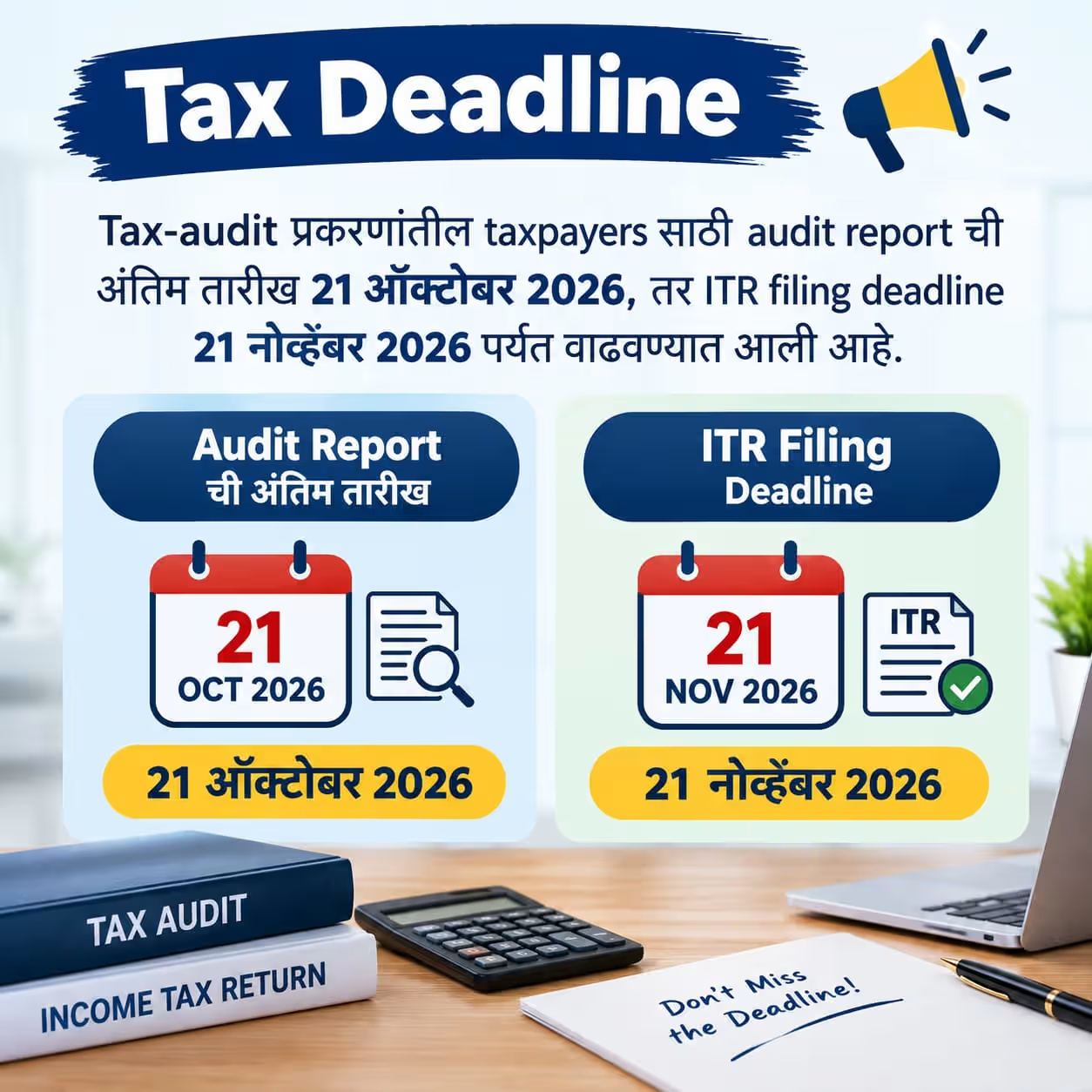
Taxpayers whose income-tax returns for Assessment Year (AY) 2026-27 are subject to tax audit have received additional time to complete an important compliance process. The Central Board of Direct Taxes (CBDT) has extended the deadline for furnishing the tax audit report from September 30, 2026, to October 21, 2026, while the corresponding deadline for filing the income-tax return has been extended from October 31, 2026, to November 21, 2026 for the specified category of taxpayers.
The extension was announced through CBDT Circular No. 07/2026 dated September 28, 2026. The Income Tax Department has also published the revised dates on its e-filing portal.
For businesses, professionals, firms and other taxpayers covered by the applicable tax-audit provisions, the change is significant. It provides additional time to complete accounting adjustments, coordinate with a Chartered Accountant, reconcile tax information, review audit disclosures and finally submit the ITR.
However, an extended deadline should not be mistaken for a reason to postpone the entire process. Tax audit and ITR filing involve several interconnected steps, and errors discovered at the last minute can create avoidable pressure.
This guide explains the tax audit deadline 2026, the ITR filing deadline 2026, who the extension applies to, how the audit-report and return deadlines are connected, what documents taxpayers should prepare, common mistakes to avoid and how to use the additional time effectively.
Tax audit deadline 2026- What Has Changed in the 2026 Tax Filing Deadlines?
The most important change is straightforward:
| Compliance | Earlier deadline | Revised deadline |
|---|---|---|
| Tax audit report for specified AY 2026-27 cases | September 30, 2026 | October 21, 2026 |
| Income-tax return for specified audit cases | October 31, 2026 | November 21, 2026 |
The CBDT announcement specifically covers the persons referred to at Serial No. 2 in the relevant table under Explanation 2 to Section 139(1) of the Income-tax Act, 1961. The government release states that the return deadline has been moved from October 31 to November 21, 2026, and the specified date for the audit report has consequently moved from September 30 to October 21, 2026.
The Income Tax Department’s portal likewise confirms the revised deadlines through its September 29, 2026 update referring to Circular No. 07/2026.
Why Are There Two Different Deadlines?
Taxpayers sometimes assume that the audit report and ITR are filed together. They are related, but they are separate compliance requirements.
A taxpayer who is required to obtain a tax audit generally needs the audit report to be furnished before filing the corresponding income-tax return. The audit report provides important financial and tax information that is subsequently relevant to the return.
For AY 2026-27, the Income Tax Department identifies Form 3CA-3CD and Form 3CB-3CD as the relevant tax-audit forms under the Income-tax Act, 1961, depending on the taxpayer’s circumstances.
Therefore, the practical sequence is generally:
- Finalise books and financial records.
- Complete the required tax audit.
- Furnish the applicable audit report.
- Review the audited information and tax computations.
- Prepare and file the ITR.
- Complete verification of the return.
The extension gives taxpayers more time for this entire chain.
What Is the Tax Audit Deadline for AY 2026-27?
For the specified taxpayers covered by the CBDT extension, the tax audit report deadline is October 21, 2026.
Previously, the specified date was September 30, 2026. The government has extended it by 21 days.
This deadline is particularly relevant to taxpayers who are required to get their accounts audited under the applicable tax-audit provisions.
The Income Tax Department describes Form 3CA-3CD as the audit report and statement of particulars for taxpayers whose accounts are audited under another law, while Form 3CB-3CD applies in the relevant cases where the taxpayer is required to have accounts audited under the income-tax provisions.
Do Not Confuse the Audit Deadline With the ITR Deadline
A taxpayer cannot simply interpret October 21 as the final date for everything.
The audit report has its own deadline, while the income-tax return has a later deadline.
For the specified AY 2026-27 cases:
October 21, 2026 → Tax audit report
November 21, 2026 → Income-tax return
That distinction is important because completing the audit report does not automatically mean that the ITR has been filed.
What Is the ITR Filing Deadline for AY 2026-27?
The revised ITR filing deadline is November 21, 2026 for the specified taxpayers covered by the CBDT extension.
The earlier deadline was October 31, 2026. The CBDT extended it to November 21, 2026.
This means taxpayers covered by the extension have an additional period after the revised audit-report deadline to complete their return.
That additional time can be useful for:
- Reviewing the final audited figures
- Checking tax computations
- Reconciling TDS and TCS
- Reviewing AIS information
- Checking advance-tax payments
- Confirming self-assessment tax, if applicable
- Verifying deductions and exemptions
- Reviewing business or professional income
- Checking balance-sheet information
- Confirming bank-account details
- Reviewing foreign-income or foreign-asset disclosures, where applicable
- Filing and verifying the ITR correctly
The Income Tax Department has stated that ITR-1 through ITR-7 for AY 2026-27 are available through the online and offline utilities.
Who Is Covered by the Extended Deadline?
This is one of the most important questions.
The extension is not a blanket extension for every taxpayer in India.
The CBDT circular specifically refers to persons mentioned at Serial No. 2 in the relevant table under Explanation 2 to Section 139(1) of the Income-tax Act, 1961. The government press release describes these as persons subject to audit under the Income-tax Act for the relevant return category.
Therefore, taxpayers should not automatically assume that the November 21 deadline applies to every individual, salaried taxpayer, investor or small taxpayer.
Examples of taxpayers who may need to examine the audit provisions
Depending on their facts and applicable provisions, the relevant population can include:
- Businesses required to undergo tax audit
- Professionals covered by the applicable audit requirements
- Partnership firms and LLPs where the audit provisions apply
- Certain companies and other entities
- Taxpayers whose circumstances trigger audit requirements under the applicable provisions
- Taxpayers covered by specific provisions relating to presumptive taxation and opting out, where the statutory conditions require audit
The exact applicability depends on the taxpayer’s income, turnover or receipts, nature of activity, accounting circumstances and the relevant provisions.
The Income Tax Department’s current guidance notes that the tax-audit thresholds under the Income Tax Act, 2025 correspond to the earlier Section 44AB framework, while also explaining the transition between the old and new statutory frameworks.
For a taxpayer with a complicated business or professional profile, it is safer to determine the applicable deadline based on the exact return category and statutory provision rather than relying on general social-media posts or informal advice.
Understanding AY 2026-27 and FY 2025-26
Another common source of confusion is the difference between a financial year and an assessment year.
For this particular filing cycle:
- Financial Year (FY): 2025-26
- Assessment Year (AY): 2026-27
The income earned during FY 2025-26 is generally reported through the relevant return for AY 2026-27.
This is why a taxpayer may see references to both years in tax documents.
The Income Tax Department has specifically clarified that a tax-audit report for FY 2025-26 relates to AY 2026-27 and, for this transition period, the report continues to use the forms prescribed under the Income-tax Act, 1961, such as Forms 3CA/3CB and Form 3CD, as applicable.
This distinction becomes particularly important in 2026 because the tax system is transitioning to the Income Tax Act, 2025.
Why the Tax Audit Report Matters
A tax audit is not simply an administrative formality.
Its purpose is to provide prescribed information concerning the taxpayer’s accounts and relevant tax particulars. For taxpayers subject to audit, the report forms an important part of the compliance process.
The Income Tax Department explains that Form 3CA-3CD and Form 3CB-3CD contain the audit report and statement of particulars required under the applicable provisions of the Income-tax Act, 1961.
A tax audit can involve examination of areas such as:
- Turnover or gross receipts
- Business expenses
- Professional receipts
- Fixed assets
- Depreciation
- Loans and borrowings
- Payments
- Statutory dues
- Tax deductions
- Transactions requiring specific reporting
- Accounting records
- Certain related-party transactions
- Cash transactions
- Other prescribed particulars
The precise information required depends on the taxpayer and applicable provisions.
Form 3CA-3CD vs Form 3CB-3CD
Taxpayers frequently search for “Form 3CA vs 3CB” when preparing their audit compliance.
The distinction can be broadly understood as follows.
Form 3CA-3CD
Form 3CA-3CD is relevant where the accounts of the business or profession have already been audited under another law.
The Income Tax Department describes Form 3CA as the audit report used in such cases, accompanied by the statement of particulars in Form 3CD.
Form 3CB-3CD
Form 3CB-3CD is relevant in cases covered by the tax-audit provisions where the accounts are not required to be audited under another law.
The Income Tax Department provides Form 3CB-3CD for taxpayers requiring audit under the applicable income-tax provisions.
The correct form should be determined based on the taxpayer’s circumstances and applicable law.
What the November 21 Deadline Means for Taxpayers
The extended ITR deadline gives eligible taxpayers more breathing room, but it should be viewed as an opportunity for better compliance rather than an invitation to delay.
Consider a business owner whose books were not fully reconciled by the original September deadline.
Under the revised timeline, the taxpayer can coordinate with the accountant, complete the audit process by October 21 and then use the period leading up to November 21 to review the return carefully.
That can be especially useful when there are:
- Multiple bank accounts
- Several business locations
- Large numbers of transactions
- GST-related reconciliations
- TDS differences
- Foreign transactions
- Capital gains
- Loans
- Depreciation schedules
- Partner remuneration
- Interest calculations
- Previous-year losses
- Multiple sources of income
The extra time is valuable because tax compliance is not just about submitting a form. It is about submitting the right information.
A Practical Tax Filing Checklist for 2026
If your return is covered by the extended audit deadline, start with a document checklist.
1. Finalise your books of account
Make sure the accounting records for FY 2025-26 are complete.
Check:
- Sales
- Purchases
- Expenses
- Receivables
- Payables
- Bank transactions
- Cash balances
- Loans
- Interest
- Fixed assets
- Depreciation
- Capital accounts
Do not leave unexplained balances for the final days.
2. Reconcile bank accounts
Compare the books with bank statements.
Look for:
- Unrecorded bank charges
- Interest income
- EMI payments
- Cheque differences
- Unidentified credits
- Unidentified debits
- Duplicate entries
- Transfers between accounts
A bank reconciliation can reveal issues before they become tax-return problems.
3. Check GST-related information
Where GST applies, reconcile relevant turnover and tax records with the accounting books.
Differences do not automatically mean there is an error, but unexplained differences should be investigated.
4. Review TDS and TCS
Taxpayers should verify available tax-credit information before filing.
The Income Tax Department’s AIS includes information relating to tax deducted or collected at source, specified financial transactions, tax payments and other information.
Compare the information available to you with:
- Form 26AS
- AIS
- TIS
- TDS certificates
- TCS records
- Tax-payment challans
If something does not match, investigate it before submitting the ITR.
5. Check advance tax
Review all advance-tax payments.
Make sure:
- Challan details are correct
- Amounts are reflected correctly
- Payments belong to the correct taxpayer
- Any outstanding tax has been identified
6. Review self-assessment tax
If additional tax becomes payable after the final computation, calculate and pay the required amount before completing the filing process.
Do not assume that tax payable shown during an earlier calculation will remain unchanged after the books and audit are finalised.
AIS Reconciliation Should Be a Priority
The Annual Information Statement, commonly known as AIS, has become an important source of tax-related information for taxpayers.
It can contain information relating to:
- TDS
- TCS
- Specified financial transactions
- Tax payments
- Refunds
- Certain other information available to the department
The Income Tax Department explains that several items previously available through Form 26AS are now reflected through AIS.
Why should taxpayers check AIS?
Suppose a taxpayer’s books show interest income of ₹85,000, but information available in AIS indicates a different amount.
That difference should be investigated.
Possible reasons could include:
- Timing differences
- Duplicate reporting
- Incorrect reporting by a reporting entity
- Transactions recorded differently
- Income omitted from the taxpayer’s books
- Information that belongs to another transaction or period
Ignoring the difference can create unnecessary complications later.
How to Use the Extra Time Before November 21
A good strategy is to divide the additional time into stages.
Stage 1: Before October 21
Focus on the audit.
Complete:
- Books
- Reconciliations
- Audit schedules
- Supporting documents
- Tax computations
- Audit queries
- Required disclosures
- Applicable audit report
Stage 2: After the audit report
Once the audit report has been furnished, carefully review the audited figures that will flow into the return.
Check whether:
- Profit figures are correct
- Income adjustments are properly reflected
- Depreciation is correctly considered
- Disallowances have been incorporated
- Tax payments are reflected
- TDS/TCS credits are correct
- Other income has been included
- Losses are properly considered
Stage 3: Before November 21
Prepare and review the final ITR.
Do not treat “return prepared” and “return successfully filed and verified” as identical milestones.
Maintain enough time for portal issues, corrections and verification.
Step-by-Step Guide to Filing After the Audit
Step 1: Confirm the applicable ITR
The appropriate ITR depends on the taxpayer’s nature and sources of income.
The Income Tax Department has made ITR-1 through ITR-7 available for AY 2026-27 through the applicable online and offline utilities.
Do not select a form simply because it appears easier.
Step 2: Keep the audit report details ready
If your case requires an audit report, ensure the relevant audit information has been properly furnished.
Step 3: Review personal and entity details
Check:
- PAN
- Name
- Address
- Contact information
- Bank accounts
- Residential status
- Filing status
- Entity details, where applicable
Even basic information should be reviewed carefully.
Step 4: Review income
Check every relevant income source.
Depending on the taxpayer, this could include:
- Business income
- Professional income
- Salary
- Interest
- Rental income
- Capital gains
- Dividend income
- Foreign income
- Other taxable receipts
Step 5: Review deductions and tax treatment
Check deductions and other tax adjustments that are actually available under the applicable regime and circumstances.
Do not claim a deduction merely because it was claimed in an earlier year.
Step 6: Reconcile tax credits
Compare the return with:
- AIS
- TIS
- Form 26AS, where relevant
- TDS certificates
- TCS information
- Advance-tax payments
- Self-assessment tax
Step 7: Calculate final tax liability
Confirm whether the taxpayer has:
- Refund
- No further tax payable
- Additional tax payable
If additional payment is required, complete the applicable payment process.
Step 8: File the return
Submit the appropriate ITR through the Income Tax Department’s e-filing system.
Step 9: Verify the return
After filing, complete the applicable verification process.
The Income Tax Department has stated that electronic verification mechanisms continue under the new framework, including prescribed electronic methods such as Aadhaar OTP and other available modes.
Common Mistakes Taxpayers Should Avoid
Mistake 1: Assuming November 21 Applies to Everyone
The extension is category-specific.
The CBDT circular does not simply move every taxpayer’s deadline to November 21. It specifically applies to the relevant persons covered by the stated provision.
Mistake 2: Waiting Until October 21 to Start the Audit
October 21 is the deadline, not the recommended starting date.
A proper audit may require multiple rounds of clarification and supporting documents.
Mistake 3: Treating the Audit Report as the ITR
The audit report and ITR are separate compliance steps.
Filing one does not automatically complete the other.
Mistake 4: Ignoring AIS Differences
An unexplained AIS mismatch should be investigated.
Mistake 5: Forgetting Tax Payments
A taxpayer may complete the return but overlook outstanding tax or incorrectly reported advance-tax credits.
Mistake 6: Copying Last Year’s Return
Prior-year data can be useful, but it should not be blindly copied.
Business conditions, deductions, income sources and reporting requirements may change.
Mistake 7: Ignoring Foreign Information
Taxpayers with foreign assets, accounts or income may have additional reporting requirements.
The Income Tax Department has also highlighted specific disclosure considerations for foreign assets and income in its tax-filing guidance.
Mistake 8: Leaving Verification Until the Last Moment
A filed return should be properly verified within the applicable process and timeframe.
What Businesses Should Ask Their Chartered Accountant
Business owners can make the process smoother by asking specific questions rather than simply asking whether “the return is ready.”
Useful questions include:
- Has the tax audit been completed?
- Has the audit report been furnished?
- Which audit form applies to my case?
- Does the turnover in the books reconcile with the relevant records?
- Are there any significant audit qualifications or observations?
- Does AIS match the books and tax records?
- Are TDS and TCS credits complete?
- Is any additional tax payable?
- Are all required disclosures included?
- Has the ITR been prepared based on the final audited figures?
- Has the return been filed?
- Has the return been successfully verified?
These questions help distinguish between a return that is merely being prepared and one that has actually completed the compliance process.
Practical Example: Small Business Owner
Suppose a proprietor operates a trading business and is subject to tax audit.
The business owner initially expected the audit report to be furnished by September 30 and the ITR by October 31.
Following the CBDT extension:
- Audit report deadline: October 21
- ITR deadline: November 21
The owner can use the additional time to reconcile the books, verify bank transactions, check TDS credits, review AIS information and discuss any audit observations with the accountant.
The key lesson is not simply that the taxpayer has “more days.”
The real benefit is the opportunity to complete the process with fewer rushed decisions.
Practical Example: Professional
Consider a professional with significant receipts who falls within the applicable tax-audit provisions.
The professional may have:
- Multiple clients
- TDS deductions from several clients
- Professional expenses
- Bank interest
- Investments
- Advance-tax payments
If TDS information differs between client certificates and AIS, the taxpayer can use the extended timeline to identify and resolve discrepancies before filing.
This is preferable to discovering the problem after submitting the return.
Practical Example: Partnership Firm or LLP
A partnership firm or LLP may have additional accounting and tax considerations involving:
- Partner remuneration
- Interest to partners
- Capital accounts
- Loans
- Business expenses
- TDS
- GST
- Audit disclosures
Such taxpayers should coordinate closely with the tax professional preparing the audit and return.
The Income Tax Department provides specific AY 2026-27 guidance for partnership firms and LLPs, including the applicable audit forms where relevant.
What Taxpayers Should Do Before October 21
Create an internal deadline earlier than the statutory deadline.
A useful target could be:
By October 10
- Finalise accounting records
- Collect missing documents
- Resolve major reconciliation differences
By October 15
- Complete audit queries
- Review draft audit information
- Confirm tax adjustments
By October 21
- Ensure the required audit report has been furnished
By November 5
- Complete ITR preparation
- Reconcile AIS and tax credits
- Review tax computation
By November 15
- Perform final review
- Resolve discrepancies
- Confirm tax payment
By November 21
- File the applicable ITR
This is a planning framework rather than an official government schedule. The statutory dates remain the dates notified by the CBDT.
What If You Miss the Extended Deadline?
Taxpayers should not assume that missing the revised deadline is harmless.
The consequences of late filing can depend on the taxpayer’s circumstances, applicable provisions, income, losses, audit requirements and other facts.
Potential consequences may include:
- Late-filing consequences
- Interest implications
- Restrictions or complications concerning certain loss carry-forwards
- Additional compliance requirements
- Greater risk of notices or follow-up
- Difficulty correcting certain mistakes within preferred timelines
Because the consequences can vary, taxpayers who believe they may miss the deadline should obtain professional tax advice rather than simply waiting.
The safest approach is to file correctly within the applicable deadline.
Does the Extension Mean You Can Delay Tax Payments?
Not necessarily.
The extension concerns the specified audit-report and ITR filing deadlines. It should not automatically be interpreted as a blanket extension of every tax-payment obligation.
Taxpayers should separately examine their tax-payment position, including advance tax and self-assessment tax, based on the applicable provisions.
A filing extension and a payment extension are not automatically the same thing.
This is an important distinction for taxpayers planning cash flow.
What About Taxpayers Who Are Not Subject to Audit?
The November 21 deadline discussed in the CBDT announcement is specifically for the category of persons covered by the extension.
Therefore, a taxpayer who is not subject to tax audit should not automatically assume that their return deadline has also moved to November 21.
The correct deadline depends on the taxpayer’s category.
This is particularly relevant for:
- Salaried individuals
- Pensioners
- Investors
- Small taxpayers
- Individuals with income from property
- Other taxpayers whose return is not covered by the audit category
Always check the deadline applicable to your specific return.
The 2026 Tax-Law Transition Adds Another Layer
AY 2026-27 is also notable because of the transition from the Income-tax Act, 1961 to the Income Tax Act, 2025.
This can create confusion because taxpayers may encounter references to both laws in official guidance.
The Income Tax Department has clarified that tax-audit reports relating to FY 2025-26 and AY 2026-27 continue under the earlier framework and use the applicable Forms 3CA/3CB/3CD. For Tax Year 2026-27, the new framework introduces Form 26, which combines the earlier audit forms.
This distinction matters because taxpayers should use the form and procedure applicable to the relevant tax year rather than assuming that every 2026 filing automatically uses the new forms.
How the New Tax Framework May Affect Future Compliance
The transition is likely to make terminology especially important for taxpayers and tax professionals.
The Income Tax Department says that for Tax Year 2026-27, Form 26 under the new Income Tax Act, 2025 merges the earlier Forms 3CA, 3CB and 3CD.
But this should not be confused with AY 2026-27 filings relating to FY 2025-26.
For taxpayers, the practical lesson is simple:
Always identify the relevant financial year, assessment year or tax year before selecting a form.
This prevents one of the most basic compliance errors during a period of legislative transition.
Best Practices for Error-Free ITR Filing
Keep one master tax file
Maintain a digital folder containing:
- Financial statements
- Audit documents
- Bank statements
- TDS certificates
- Tax challans
- AIS/TIS downloads
- Investment statements
- Loan documents
- GST records, where relevant
- Property documents, where relevant
- Foreign-income documents, where relevant
Maintain a reconciliation sheet
A simple reconciliation table can be useful:
| Item | Books | AIS/Tax Records | Difference | Action |
|---|---|---|---|---|
| Interest income | ₹X | ₹Y | ₹Z | Investigate |
| TDS | ₹X | ₹Y | ₹Z | Reconcile |
| Turnover | ₹X | ₹Y | ₹Z | Verify |
| Tax paid | ₹X | ₹Y | ₹Z | Confirm |
The exact figures will vary by taxpayer, but the method is useful.
Review the return independently
Even if a professional prepares the return, the taxpayer should review major information before authorising filing.
At minimum, check:
- Income
- Tax regime, where relevant
- Deductions
- TDS
- Bank accounts
- Tax payable/refund
- Major disclosures
Expert Tips for the 2026 Tax Deadline
Tip 1: Use October 21 as an internal deadline
If possible, aim to finish audit work before October 21 instead of planning everything for the final day.
Tip 2: Do not wait for the ITR to identify accounting problems
Resolve accounting issues before the audit is finalised.
Tip 3: Reconcile tax credits early
TDS and TCS differences can take time to investigate.
Tip 4: Keep supporting documents
Do not rely only on figures entered into the ITR.
Tip 5: Review unusual transactions
Large loans, asset sales, property transactions, foreign transactions and significant cash movements deserve careful attention.
Tip 6: Keep evidence for deductions
Where deductions or exemptions are claimed, retain supporting documents.
Tip 7: Verify after filing
Do not treat successful submission as the final step if verification is still pending.
Tip 8: Do not rely on old tax articles
The 2026 filing cycle involves important legislative and procedural changes. Use current official guidance when confirming forms and deadlines.
Frequently Asked Questions
1. What is the tax audit deadline for AY 2026-27?
For the specified taxpayers covered by CBDT Circular No. 07/2026, the tax audit report deadline has been extended to October 21, 2026, from September 30, 2026.
2. What is the ITR filing deadline for taxpayers subject to audit?
For the specified audit cases covered by the extension, the ITR filing deadline for AY 2026-27 has been extended to November 21, 2026, from October 31, 2026.
3. Does the November 21 deadline apply to every taxpayer?
No. The CBDT extension specifically applies to the category of persons referred to in the relevant provision. Taxpayers who are not covered by that category should check the deadline applicable to their own return.
4. Which tax-audit forms apply for AY 2026-27?
For FY 2025-26/AY 2026-27, the applicable tax-audit framework continues to use Forms 3CA/3CB and 3CD, depending on the taxpayer’s circumstances. The Income Tax Department has specifically clarified this for the transition period.
5. Is the tax audit report the same as the ITR?
No. The tax audit report and income-tax return are separate compliance requirements. The audit report generally needs to be furnished before the corresponding ITR is filed.
6. Should I wait until November 21 to file my ITR?
No. The extended deadline is the latest date for the covered category, not a recommended filing date. If your audit and return are ready earlier, filing earlier can reduce last-minute risk.
7. Should I check AIS before filing?
Yes. Reviewing AIS, TDS/TCS information and tax-payment records can help identify discrepancies before the ITR is submitted. The Income Tax Department describes AIS as containing tax-related information such as TDS/TCS, specified financial transactions, tax payments and other information.
8. What should I do if I am unsure whether tax audit applies to me?
Do not rely solely on the November 21 deadline. Ask a Chartered Accountant or qualified tax professional to determine whether your facts trigger the applicable audit requirement and which return deadline applies.
Final Checklist Before You File
Before submitting your AY 2026-27 ITR, run through this checklist:
Audit
- Tax-audit applicability confirmed
- Books finalised
- Bank reconciliation completed
- GST reconciliation completed where applicable
- Audit queries resolved
- Correct audit form selected
- Audit report furnished by the applicable deadline
Income
- Business/professional income checked
- Interest income checked
- Rental income checked
- Capital gains checked
- Dividend and other income checked
- Foreign income checked where applicable
Tax credits
- AIS reviewed
- TDS checked
- TCS checked
- Advance tax checked
- Self-assessment tax checked
Return
- Correct ITR selected
- Personal/entity details verified
- Bank details verified
- Deductions reviewed
- Tax regime checked where relevant
- Final tax liability checked
- Refund details checked
- Required disclosures completed
- ITR filed
- ITR verified
Why Taxpayers Should Act Now
The revised deadlines are helpful, but the additional time can disappear quickly for businesses and professionals with complicated records.
A taxpayer who waits until October 20 to address missing invoices, unexplained bank entries, TDS differences or accounting adjustments may discover that the additional deadline does not provide much practical relief.
The better approach is to work backward from the statutory dates.
October 21, 2026 should be treated as the final audit deadline.
November 21, 2026 should be treated as the final ITR deadline for the specified covered taxpayers.
The CBDT’s extension gives eligible taxpayers additional time, but it does not remove the need for careful compliance.
Conclusion: Use the Extended Tax Deadline Wisely
The extension of the tax audit deadline to October 21, 2026 and the ITR filing deadline to November 21, 2026 provides valuable additional time to taxpayers covered by the CBDT’s Circular No. 07/2026.
The most important point is that the extension is category-specific. It is not a universal November 21 deadline for every taxpayer.
For eligible businesses, professionals and other audit cases, the best strategy is to use the additional time for accuracy rather than procrastination. Finalise the books, complete reconciliations, coordinate with the Chartered Accountant, review AIS and tax credits, complete the audit report and then prepare the ITR from the final audited information.
Taxpayers should also remember that AY 2026-27 is part of an important transition period between the Income-tax Act, 1961 and the Income Tax Act, 2025. The applicable forms and procedures therefore need to be checked carefully. For FY 2025-26/AY 2026-27, the Income Tax Department has clarified that the tax-audit reporting framework continues under the earlier Act using Forms 3CA/3CB/3CD as applicable.
If you are covered by the extension, do not wait for November 21 to begin your return preparation. Treat October 21 as your audit milestone and aim to have the final ITR reviewed well before November 21.
For complex businesses, professionals, firms, companies or taxpayers with foreign income, significant transactions or unresolved tax discrepancies, professional advice can help ensure that the additional filing window is used effectively.
Your next step: confirm whether the CBDT extension applies to your taxpayer category, check the status of your tax audit, reconcile your AIS/TDS information and create an internal filing target comfortably before November 21, 2026.
AI in Banking: Enhancing Security and Personalization in Indian Financial Services
Share this content:




Post Comment