






Fuel Taxes Change From October 1: Diesel Export Duty Cut to ₹16, ATF to ₹10.5, While Commercial LPG Gets Costlier
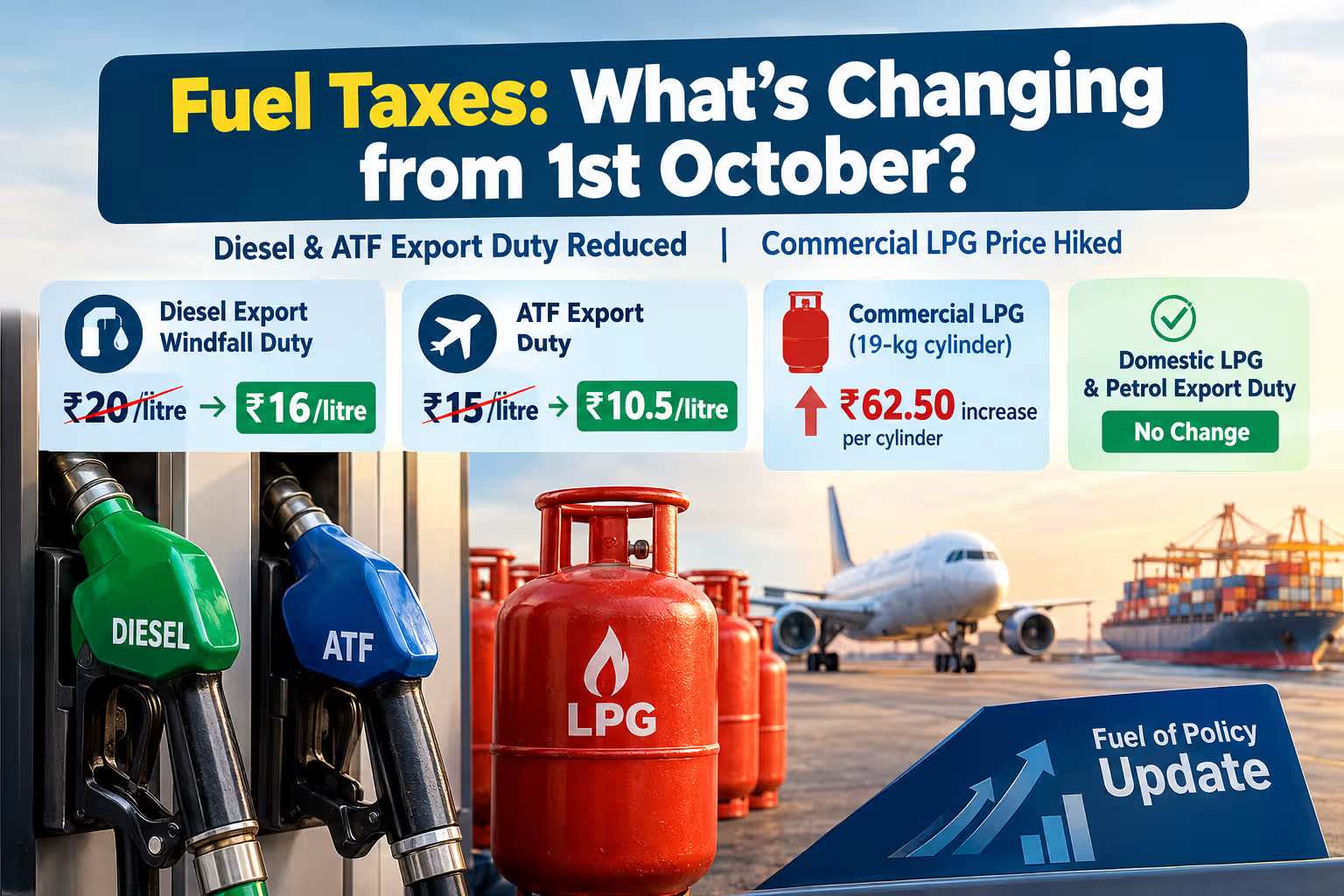
Fuel taxes October 2026 India’s fuel market entered October 2026 with a mixed set of changes. From October 1, the export duty on diesel has been reduced from ₹20 to ₹16 per litre, while the duty on aviation turbine fuel (ATF) has been cut from ₹15 to ₹10.50 per litre. At the same time, businesses using commercial LPG are facing a higher fuel bill, with the price of a 19-kg commercial LPG cylinder increasing by about ₹62.50 in Delhi.
For households, the picture is different. Domestic LPG prices have remained unchanged, and the petrol export duty has also remained unchanged under the latest revision.
These changes may appear to be separate announcements, but they are connected to the way India manages fuel supplies, international petroleum prices, export economics and domestic energy costs. For consumers, businesses, airlines, restaurants, transport operators and fuel exporters, understanding the difference between an export tax, a domestic fuel price and a commercial LPG price revision is important.
This article explains what changed from October 1, why fuel export duties are revised, how the changes can affect businesses and consumers, and what to watch in the coming weeks.
Fuel taxes October 2026- What Changed in Fuel Taxes From October 1, 2026?
The October 1 revision contains several important developments across India’s petroleum and LPG markets.
The major changes can be summarized as follows:
| Fuel / Product | Earlier Rate / Price | From October 1 | Change |
|---|---|---|---|
| Diesel export duty | ₹20/litre | ₹16/litre | Down ₹4/litre |
| ATF export duty | ₹15/litre | ₹10.50/litre | Down ₹4.50/litre |
| Petrol export duty | ₹0.50/litre | ₹0.50/litre | No change |
| Commercial LPG, Delhi | ₹2,747.50/19 kg | ₹2,810/19 kg | Up ₹62.50 |
| Domestic LPG, Delhi | ₹942/14.2 kg | ₹942/14.2 kg | No change |
The export-duty changes apply to petroleum products shipped overseas. They should therefore not be interpreted as a direct reduction in the retail price of diesel or petrol purchased by motorists in India.
Similarly, the increase in commercial LPG should not be confused with an increase in the domestic household LPG cylinder price.
This distinction is one of the most important points for consumers to understand.
Diesel Export Duty Reduced From ₹20 to ₹16 Per Litre
The government has reduced the export duty on diesel from ₹20 per litre to ₹16 per litre, effective October 1.
That represents a reduction of ₹4 per litre, or 20% compared with the previous ₹20 rate.
The levy applies to diesel exports rather than diesel sold directly to Indian motorists through domestic retail outlets.
For a company exporting a large volume of diesel, even a few rupees per litre can have a meaningful effect on the economics of an overseas shipment.
Why does the export duty matter?
Petroleum products are traded internationally. Indian refineries can sell refined products in the domestic market or export them, depending on demand, prices, refining economics and market conditions.
When international prices rise sharply, exporting refined petroleum products can become particularly attractive.
A government can use export levies as one policy instrument to influence that equation.
The basic idea is straightforward:
Higher export levy → higher cost of exporting → potentially less incentive to export.
Lower export levy → lower export cost → potentially better export economics.
The actual commercial outcome depends on international prices, freight, refinery margins, exchange rates, supply conditions and other factors.
The government introduced the current export levy framework in March 2026 and has been reviewing rates periodically. The government has said the rates are linked to prevailing international petroleum prices and are reviewed on a fortnightly basis.
ATF Export Duty Cut From ₹15 to ₹10.50 Per Litre
A second major change concerns Aviation Turbine Fuel, commonly called ATF.
The export duty on ATF has been reduced from:
₹15 per litre → ₹10.50 per litre
That is a reduction of ₹4.50 per litre.
ATF is the fuel used by commercial aircraft. However, the export duty discussed here applies to ATF exported from India. It should not be confused with the domestic price at which airlines purchase aviation fuel.
This distinction becomes particularly important because the domestic ATF price moved in the opposite direction at the beginning of October.
Reports on October 1 indicated that domestic ATF prices increased by about ₹16 per litre, from ₹121 to ₹137 per litre.
So there are two different developments happening at the same time:
- ATF export duty decreased
- Domestic ATF price increased
There is no contradiction here because the two figures refer to different parts of the fuel market.
Why Are Fuel Export Duties Revised Every Fortnight?
One of the most important features of India’s current fuel export-duty system is that the rates can be revised frequently.
The government has indicated that petroleum export levies are reviewed every two weeks, with rates determined partly by international prices of crude oil and petroleum products.
This approach allows the duty to respond more quickly to major movements in the global oil market than a fixed annual tax rate would.
For example, suppose international crude prices rise sharply.
Indian refiners may potentially receive stronger economic incentives to export petroleum products. If policymakers are concerned about domestic availability or export incentives, they have the ability to adjust export levies.
Conversely, if international prices or market conditions change, reducing the levy can alter the economics of exports.
The framework introduced in March 2026 specifically involved export levies on petrol, diesel and ATF, with periodic revisions.
What does fortnightly review mean for consumers?
It means today’s export duty should not automatically be treated as a permanent rate.
The October 1 rates apply to the relevant review period. Another revision can occur later depending on market conditions and government notifications.
This is why headlines about “windfall tax” or “export duty” should always be read with the effective date.
What Is a Windfall Tax on Fuel?
The term windfall tax is commonly used to describe a special tax imposed when companies or industries are perceived to be receiving unusually high gains because of exceptional market conditions.
In India’s petroleum sector, the terminology often refers to a Special Additional Excise Duty (SAED) and related export levies.
The policy question is not simply about whether oil companies are profitable.
It is also about the relationship between:
- international crude prices,
- refined-product prices,
- domestic fuel availability,
- export economics,
- refinery margins,
- government revenue, and
- consumer prices.
The export levy can therefore influence the economics of selling petroleum products overseas.
India’s current export levy framework was introduced on March 27, 2026, during a period of significant disruption in global energy markets. The government said the measures were intended to discourage excessive exports and support domestic availability.
Does the Diesel Export Duty Cut Mean Diesel Is Cheaper at Petrol Pumps?
Not directly.
This is perhaps the most common misunderstanding surrounding the October 1 announcement.
The reduction from ₹20 to ₹16 per litre applies to diesel exports.
It does not mean that the retail price of diesel sold to consumers in India automatically falls by ₹4 per litre.
Domestic fuel prices depend on a broader combination of factors, including:
- international crude oil prices,
- refining costs,
- exchange rates,
- central and state taxes,
- marketing and distribution costs,
- oil marketing company pricing decisions, and
- broader market conditions.
Therefore, motorists should not calculate the expected retail diesel price simply by subtracting ₹4 from the pump price.
The government has also stated in earlier notifications that changes in export levies do not necessarily change the existing excise-duty rates on petrol and diesel intended for domestic consumption.
Petrol Export Duty Remains Unchanged
The latest revision did not change the petrol export duty, which remains at ₹0.50 per litre for the applicable period.
This creates a notable difference between the treatment of the three major products:
- Diesel export duty: ₹16/litre
- ATF export duty: ₹10.50/litre
- Petrol export duty: ₹0.50/litre
The rates can change in future review periods, so these figures should be understood as the rates applicable from October 1 under the latest revision rather than permanent tax rates.
Commercial LPG Gets Costlier From October 1
While export duties on diesel and ATF were reduced, businesses using commercial LPG faced a price increase.
In Delhi, the price of a 19-kg commercial LPG cylinder increased by ₹62.50, moving from ₹2,747.50 to ₹2,810.
The increase varies from city to city because LPG prices are location-specific.
Reported October 1 prices included:
- Delhi: ₹2,810
- Mumbai: about ₹2,764.50
- Kolkata: ₹2,954
- Chennai: ₹2,983
- Hyderabad: ₹3,065
- Patna: ₹3,100.50
The exact increase also varies between locations.
Why Commercial LPG Matters So Much to Businesses
Commercial LPG is widely used by businesses that require cooking or heating fuel.
Examples include:
- restaurants,
- hotels,
- cafés,
- catering businesses,
- food stalls,
- bakeries,
- canteens,
- cloud kitchens,
- institutional kitchens,
- some manufacturing and service establishments.
For an individual household, an increase of ₹62.50 on a single cylinder may not be the central issue.
For a restaurant using dozens or hundreds of cylinders every month, however, the cumulative effect can become more noticeable.
Example
Suppose a restaurant uses 40 commercial cylinders per month.
At an additional ₹62.50 per cylinder:
40 × ₹62.50 = ₹2,500
The direct monthly increase would therefore be ₹2,500 before considering any other operating-cost changes.
A business using 100 cylinders would face:
100 × ₹62.50 = ₹6,250
Again, this is only an arithmetic illustration based on the Delhi increase. Actual business impact depends on the location and the number of cylinders consumed.
Domestic LPG Prices Remain Unchanged
One of the most important consumer-friendly aspects of the October revision is that the 14.2-kg domestic LPG cylinder price has not been increased as part of this commercial LPG revision.
For example, the reported Delhi domestic LPG price remains ₹942 for a 14.2-kg cylinder.
This means the October 1 commercial LPG increase does not automatically translate into a higher household cooking-gas bill.
The two categories serve different markets and are priced separately.
Commercial LPG vs Domestic LPG
| Feature | Domestic LPG | Commercial LPG |
|---|---|---|
| Typical cylinder | 14.2 kg | 19 kg |
| Main users | Households | Businesses |
| October 1 revision | No change | Price increased |
| Main applications | Household cooking | Restaurants, hotels, catering and businesses |
| Price category | Domestic | Commercial/non-domestic |
Consumers should therefore check which type of LPG connection they are using before interpreting news about LPG price changes.
Why Did Commercial LPG Prices Rise?
LPG prices are influenced by international energy prices and currency movements, among other factors.
India imports a substantial portion of its energy requirements, meaning global market conditions can influence domestic petroleum and LPG economics.
Commercial LPG prices are generally revised periodically by oil marketing companies.
The October 1 increase came at the beginning of the festive period, when commercial establishments such as restaurants, hotels and catering businesses may experience higher activity.
Reports have linked the broader fuel-price movements to changes in international benchmark prices and market conditions.
It is important, however, not to assume that every price change has a single cause. LPG pricing reflects multiple variables rather than one isolated factor.
The Bigger Picture: Why Are Some Fuel Costs Falling While Others Rise?
At first glance, October’s fuel announcements may seem contradictory.
Diesel export duty is lower.
ATF export duty is lower.
Commercial LPG is more expensive.
Domestic LPG is unchanged.
Domestic ATF is more expensive.
Petrol export duty is unchanged.
The key is that these are different markets and different pricing mechanisms.
A tax on exports is not the same thing as a domestic retail price.
Similarly, commercial LPG pricing is different from household LPG pricing.
Think of the market as several separate layers
Layer 1: Crude oil
India imports crude oil and processes it in refineries.
Layer 2: Refined petroleum products
Refineries produce products such as petrol, diesel, ATF and other fuels.
Layer 3: Domestic market
Some products are sold within India.
Layer 4: Export market
Some refined products are exported.
Layer 5: Government taxes and levies
Taxes and duties can apply differently depending on the product and whether it is being sold domestically or exported.
Layer 6: Retail and commercial pricing
Oil marketing companies and other market participants determine prices according to applicable rules and market conditions.
Understanding these layers makes the October changes much easier to interpret.
Impact on Fuel Exporters
The reduction in diesel export duty from ₹20 to ₹16 per litre improves the headline tax position for exporters.
Similarly, the reduction in ATF export duty from ₹15 to ₹10.50 per litre reduces the export levy.
For an exporter, the reduction can improve the difference between the international selling price and the total cost of exporting.
But it would be incorrect to assume that the entire tax reduction becomes profit.
An exporter’s economics depend on many variables.
These include:
- international selling prices,
- crude acquisition costs,
- refinery margins,
- shipping costs,
- insurance,
- port charges,
- currency movements,
- destination-market taxes,
- product specifications,
- demand conditions,
- inventory costs.
Therefore, a ₹4 reduction in export duty does not automatically mean ₹4 of additional profit per litre.
Impact on Indian Refineries
India has a large refining industry and is an important exporter of petroleum products.
Refineries make decisions based on the relative attractiveness of different markets.
When export economics improve, exporters may have more flexibility in selling refined products internationally.
When export taxes rise, the relative attractiveness of overseas sales can decrease.
The October reduction therefore changes the economic environment for diesel and ATF exports.
The exact effect will differ among companies because refineries have different configurations, crude sources, product yields, contracts and export markets.
Impact on Airlines
The ATF situation deserves particular attention because airlines are highly sensitive to jet-fuel costs.
The export duty on ATF has fallen to ₹10.50 per litre, but domestic ATF prices increased by around ₹16 per litre from October 1, according to reports.
Domestic ATF in Delhi was reported at ₹137 per litre, compared with ₹121 previously.
Fuel is a significant airline operating expense.
Therefore, airlines may pay close attention to ATF prices when managing:
- ticket pricing,
- route economics,
- capacity,
- operating margins,
- fuel surcharges,
- fleet utilization.
However, it would be too simplistic to say that a ₹16-per-litre ATF increase will automatically result in a specific increase in airfares.
Airline fares are determined by several factors, including:
- demand,
- competition,
- route,
- booking timing,
- seasonality,
- aircraft capacity,
- airport charges,
- currency movements,
- fuel prices.
Impact on Restaurants and Hotels
Commercial LPG is one of the more direct October cost increases for hospitality businesses.
Restaurants use LPG for cooking, particularly in kitchens where gas-based equipment forms a major part of daily operations.
A higher cylinder price increases the cost of each refill.
But the total effect depends on how much fuel a business consumes.
A simple business calculation
Assume a restaurant previously paid ₹2,747.50 per cylinder and now pays ₹2,810.
The increase is:
₹2,810 − ₹2,747.50 = ₹62.50
If the restaurant uses:
- 10 cylinders → ₹625 additional cost
- 25 cylinders → ₹1,562.50 additional cost
- 50 cylinders → ₹3,125 additional cost
- 100 cylinders → ₹6,250 additional cost
These calculations do not include changes in food ingredients, wages, electricity, transportation or other costs.
This is why businesses should track fuel consumption rather than looking only at the per-cylinder price.
Impact on Catering Businesses
Catering businesses may feel commercial LPG changes differently from restaurants.
A caterer may operate temporarily at large events and consume substantial quantities of cooking fuel over a short period.
During periods of high demand, fuel efficiency becomes particularly important.
Businesses can monitor:
- Cylinders consumed per event
- Number of meals prepared
- Fuel cost per meal
- LPG wastage
- Equipment efficiency
- Kitchen operating hours
This creates a better picture of the real impact of LPG price changes.
What Does This Mean for Ordinary Households?
For households, the October 1 changes are relatively straightforward.
The commercial LPG increase does not mean that the household 14.2-kg cylinder automatically became more expensive.
The domestic LPG price remained unchanged in the reported October revision.
Similarly, the reduction in diesel export duty does not automatically reduce the amount a consumer pays at a fuel station.
Therefore, households should distinguish between:
Export tax changes and retail fuel-price changes.
They are not interchangeable.
Could Fuel Tax Changes Affect Inflation?
Energy prices can influence inflation because fuel is connected to transportation, manufacturing, logistics and food distribution.
But the impact of one specific tax change cannot be determined in isolation.
For example, a reduction in diesel export duty might influence refinery export economics without changing domestic diesel prices.
Meanwhile, an increase in commercial LPG prices can raise operating costs for food businesses.
Higher ATF prices can affect airline operating costs.
These effects can move through the economy in different ways.
The eventual inflation impact depends on the size and duration of the price changes and on other economic conditions.
How Businesses Should Respond to Higher Commercial LPG Costs
Businesses do not necessarily need to make large pricing changes immediately.
A better approach is to first calculate the actual cost impact.
Step 1: Track monthly LPG consumption
Record the number of cylinders used every month.
Do not rely on memory.
Step 2: Calculate the cost increase
Multiply the number of cylinders by the price increase.
For example:
60 cylinders × ₹62.50 = ₹3,750
Step 3: Calculate fuel cost per unit of output
A restaurant can calculate:
Total LPG cost ÷ number of meals sold
This gives a more meaningful operational metric.
Step 4: Identify wastage
Check whether:
- burners are functioning correctly,
- cooking equipment is maintained,
- gas leakage is absent,
- flame settings are appropriate,
- kitchen staff follow efficient cooking practices.
Step 5: Review menu economics
High-volume, LPG-intensive menu items should be evaluated separately.
Step 6: Monitor future revisions
Commercial LPG prices can change again.
Businesses should avoid treating one month’s price as a permanent benchmark.
Practical Example: How a Restaurant Can Measure the Impact
Imagine a restaurant using 80 cylinders per month.
If the increase is ₹62.50 per cylinder:
80 × ₹62.50 = ₹5,000
Now assume the restaurant serves 10,000 meals per month.
The additional LPG cost per meal would be:
₹5,000 ÷ 10,000 = ₹0.50
That is an illustrative calculation.
It demonstrates why looking at the total monthly impact is more useful than simply saying, “LPG increased by ₹62.50.”
The actual business decision should be based on the restaurant’s complete cost structure.
Common Mistakes When Reading Fuel Tax News
Fuel-related headlines can be confusing because they often use similar terminology for different prices.
Here are some mistakes to avoid.
Mistake 1: Assuming export duty equals petrol-pump tax
It does not.
An export levy applies to products shipped abroad.
Mistake 2: Assuming lower diesel export duty means cheaper diesel domestically
There is no automatic one-to-one relationship.
Mistake 3: Assuming commercial LPG and domestic LPG are the same
They are different categories with different cylinder sizes and pricing.
Mistake 4: Assuming every tax revision is permanent
The current export levy system is reviewed periodically.
Mistake 5: Ignoring the effective date
A headline can refer to an earlier or later review period.
Always check when the rate became effective.
Mistake 6: Calculating business impact only from the headline increase
A restaurant should calculate the increase based on actual monthly consumption.
What Consumers Should Watch After October 1
The next few weeks could be important because fuel export duties are subject to periodic review.
Readers should monitor:
1. Diesel export duty
The government may revise the levy depending on international market conditions.
2. ATF export duty
Another revision could affect the economics of aviation-fuel exports.
3. Commercial LPG prices
Businesses should check monthly cylinder prices in their city.
4. Domestic LPG prices
Households should monitor official monthly price announcements separately.
5. International crude prices
Crude oil remains a major underlying variable for the energy market.
6. Exchange rates
The rupee’s movement against the US dollar can influence imported energy costs.
7. Global geopolitical developments
Major disruptions affecting oil production, shipping or refining can quickly change energy-market conditions.
What Businesses Should Put in Their October Budget
Businesses that use commercial LPG should update their operating budgets rather than waiting for the month-end accounts.
A simple fuel-cost worksheet can include:
| Metric | September | October |
|---|---|---|
| LPG cylinders used | Actual | Estimated |
| Price per cylinder | Previous | New |
| Total LPG cost | Calculate | Calculate |
| Meals/output | Actual | Estimated |
| LPG cost per unit | Calculate | Calculate |
This makes it easier to determine whether the price increase is materially affecting profitability.
Should Restaurants Immediately Increase Menu Prices?
There is no universal answer.
A restaurant should first evaluate the total increase in operating costs.
For a business using only a few cylinders, the additional monthly cost may be relatively small.
For a large kitchen using hundreds of cylinders, the effect can be more significant.
Menu pricing should consider the full cost structure, including:
- ingredients,
- LPG,
- electricity,
- rent,
- salaries,
- delivery commissions,
- packaging,
- maintenance,
- taxes,
- wastage.
Fuel costs are only one component.
How Fuel Export Taxes Work in Simple Terms
Consider a simplified example.
Suppose an exporter sells diesel overseas for an international-equivalent price of ₹100 per litre.
If the applicable export duty is ₹20, the exporter has ₹80 remaining before other costs and taxes.
If the duty falls to ₹16, the corresponding amount becomes ₹84.
This is only an illustrative example and does not represent an actual export transaction.
It demonstrates the basic economic effect of reducing an export levy.
The actual exporter still has to account for crude costs, refining expenses, logistics, financing, insurance and other factors.
Why the Word “Windfall” Matters
The word “windfall” describes an unusually large or unexpected gain.
In the energy sector, exceptionally high international prices can create conditions where refined-product exporters receive unusually attractive margins.
Governments can respond with special taxes or levies.
However, the actual profitability of a refinery depends on much more than the selling price of its final product.
For example, if crude oil also becomes dramatically more expensive, a high petroleum-product price does not necessarily translate into an equivalent increase in refinery profit.
This is why fuel taxation is better understood through the relationship between multiple prices rather than one headline number.
Export Duty vs Excise Duty vs Retail Price
These terms are often mixed together in online discussions.
Export duty
A levy associated with products being exported.
Excise duty
A central government tax applied under the relevant tax framework.
Retail price
The amount paid by the final consumer.
These are different concepts.
The October diesel and ATF changes concern export levies. They do not mean that the same amount is automatically removed from the retail price of fuel in India.
This distinction is essential for accurate financial reporting.
Why the October 1 Changes Matter
The importance of the October fuel changes lies in the combination of several developments rather than any single number.
The country is seeing:
- lower diesel export duty,
- lower ATF export duty,
- unchanged petrol export duty,
- higher commercial LPG prices,
- unchanged domestic LPG prices,
- higher domestic ATF prices.
Together, these changes illustrate how different parts of the energy market can move in different directions at the same time.
For businesses, the commercial LPG increase may be the most immediately relevant change.
For fuel exporters, the reduced diesel and ATF duties may be more significant.
For airlines, domestic ATF pricing is particularly important.
For households, domestic LPG and retail petrol/diesel prices are the numbers that matter most.
Expert Tips for Tracking Fuel Prices
If you regularly write about or monitor fuel prices, avoid relying on a single headline.
Instead:
- Check the effective date.
- Identify whether the figure is domestic or export-related.
- Identify the fuel category.
- Check whether the rate applies nationally or varies by location.
- Compare the current rate with the previous rate.
- Check whether the revision is temporary or subject to periodic review.
- Look for the underlying government notification where available.
- Check reports from established business and financial publications.
- Avoid assuming that a tax change automatically changes retail prices.
- For businesses, calculate the impact using actual consumption.
This approach helps prevent common misunderstandings.
What Could Happen Next?
The most important thing to remember is that the October 1 export-duty rates are part of a system that can be reviewed periodically.
Future rates could change depending on:
- international crude prices,
- refined-product prices,
- refinery margins,
- domestic availability,
- export economics,
- global supply disruptions,
- geopolitical developments,
- currency movements.
Similarly, commercial LPG and ATF prices can be revised according to market conditions and applicable pricing mechanisms.
Therefore, businesses and consumers should treat October 1 as the current reference point rather than assuming these rates will remain unchanged indefinitely.
Frequently Asked Questions
1. What is the diesel export duty from October 1, 2026?
The diesel export duty has been reduced from ₹20 per litre to ₹16 per litre, effective October 1, 2026.
2. What is the new ATF export duty?
The ATF export duty has been reduced from ₹15 per litre to ₹10.50 per litre.
3. Has petrol export duty changed?
No. The petrol export duty remains at ₹0.50 per litre under the October 1 revision.
4. Did domestic diesel become ₹4 cheaper?
No. The ₹4 reduction applies to the diesel export duty. It does not mean domestic retail diesel prices automatically fall by ₹4 per litre.
5. How much has commercial LPG increased?
In Delhi, the price of a 19-kg commercial LPG cylinder increased by ₹62.50, from ₹2,747.50 to ₹2,810.
The increase varies by city.
6. Has domestic LPG become more expensive?
No. The October 1 commercial LPG revision did not increase the reported domestic 14.2-kg LPG price. Delhi’s domestic cylinder price remained ₹942.
7. Why does commercial LPG cost more for businesses?
Commercial LPG is priced separately from domestic household LPG. Restaurants, hotels, caterers and other businesses generally use the larger commercial cylinders.
8. Will airline tickets immediately become more expensive because of ATF?
Not necessarily. Domestic ATF prices increased, which can increase airline operating costs, but airfares depend on several factors, including demand, competition, route economics, capacity and booking patterns.
Conclusion: What the October Fuel Changes Really Mean
The October 1, 2026 fuel-market changes are a reminder that India’s energy market cannot be understood through a single headline.
The diesel export duty has fallen from ₹20 to ₹16 per litre, while the ATF export duty has dropped from ₹15 to ₹10.50 per litre. These reductions affect export economics rather than automatically lowering the prices consumers pay at domestic fuel stations.
At the same time, businesses face a different development: the 19-kg commercial LPG cylinder has become more expensive, with the Delhi price rising by ₹62.50 to ₹2,810. Domestic LPG prices, however, have remained unchanged in the latest revision.
For households, the most important distinction is between domestic LPG and commercial LPG. For fuel exporters, the key issue is the revised export levy. For airlines, domestic ATF pricing deserves closer attention. For restaurants and caterers, LPG consumption should be incorporated into October operating budgets.
The bigger lesson is simple: always check which fuel, which market, which tax and which effective date a headline refers to.
If you are a business owner, update your fuel-cost calculations for October and monitor subsequent LPG and petroleum-price revisions. If you are a consumer, track domestic fuel prices separately from export-duty announcements.
For future fuel-price updates, compare the latest government notifications and oil-company price revisions rather than relying solely on social-media headlines.
Share this content:





Post Comment