







WhatsApp Business Messages Paid in India From October 1, 2026: What Businesses Need to Know
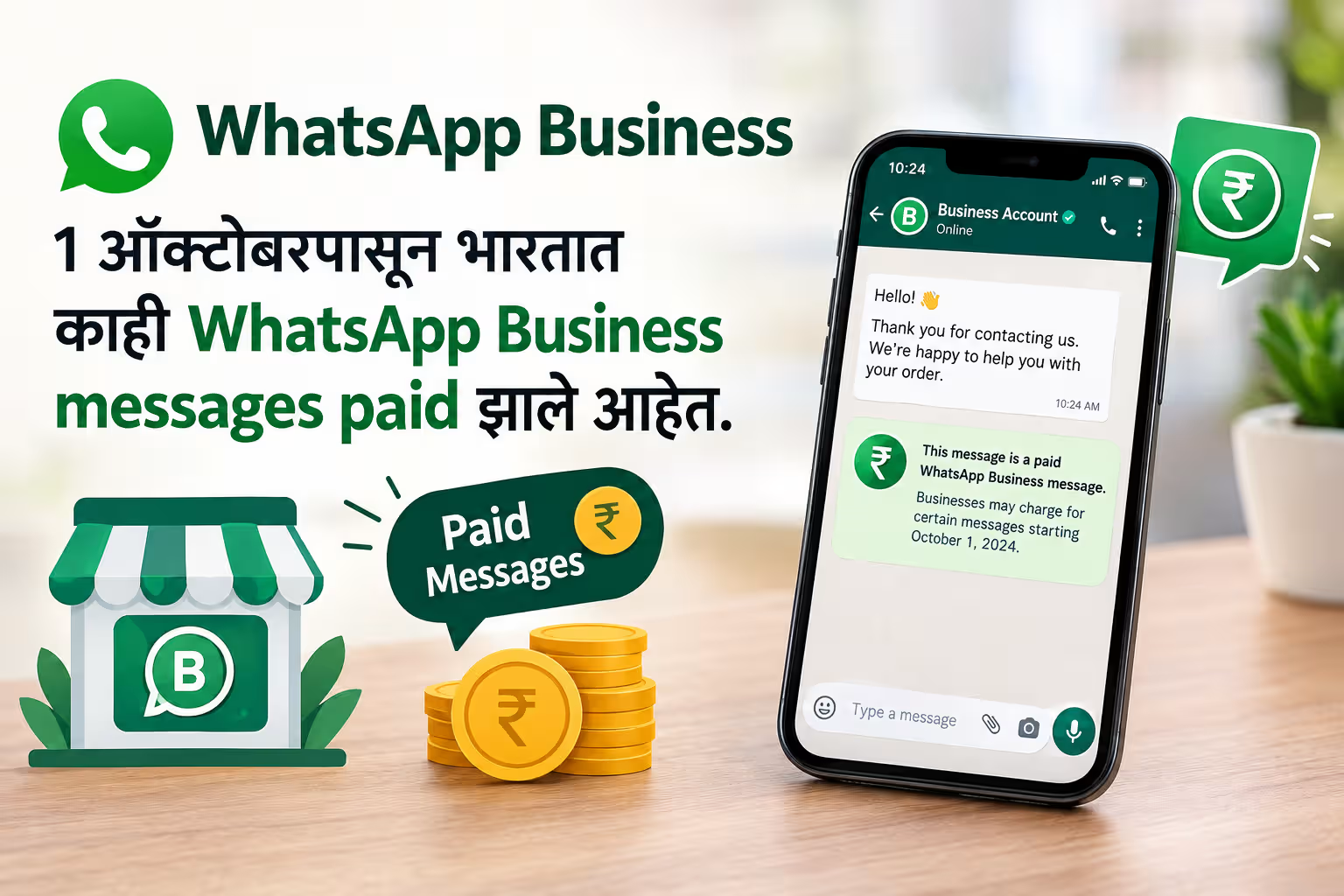
WhatsApp Business paid messages If your business uses WhatsApp to answer customer questions, confirm orders, share delivery updates, provide support, or manage customer conversations, a pricing change effective October 1, 2026 deserves your attention.
Meta has revised the pricing structure for the WhatsApp Business Platform in India. Under the new model, businesses can be charged for certain service and utility messages that were previously free in specific circumstances. The change is particularly relevant to companies that handle a large number of customer conversations through WhatsApp.
For customers, this does not mean that sending ordinary WhatsApp messages will suddenly become a paid activity. The change primarily concerns businesses using the WhatsApp Business Platform, including businesses connected directly or through solution providers.
The details also depend on the type of message being sent, whether the customer-service window is open, the applicable market rate, and whether the business uses Meta Business Agent.
This guide explains what changed, who may be affected, how WhatsApp Business pricing works, what businesses in India should check, and practical ways to control messaging costs without reducing customer service quality.
What Changed in WhatsApp Business From October 1, 2026?
Starting October 1, 2026, Meta changed the way certain WhatsApp Business Platform messages are charged in India.
One of the major changes is the return of charges for non-template service messages. These are messages a business sends in response to a customer during an active 24-hour customer-service window.
Meta had previously allowed these types of service responses without a separate message charge. The revised system brings per-message pricing back for applicable service messages.
At the same time, utility messages sent during an open 24-hour customer-service window can also attract a charge under the updated structure.
For India, reports based on Meta’s updated pricing indicate a rate of ₹0.115 per delivered service message, while the same ₹0.115 rate applies to utility and authentication messages under the applicable pricing structure.
There is also a separate pricing system for Meta Business Agent, which uses token-based billing rather than the ordinary per-message model. Meta Business Agent pricing began earlier, on August 1, 2026.
WhatsApp Business paid messages – The important distinction
The headline “WhatsApp Business messages are now paid” can be misleading.
It does not mean:
- Every WhatsApp message sent by every person is paid.
- WhatsApp users must pay to chat with businesses.
- Every business using the WhatsApp Business app automatically faces the same charges.
- Every message has the same price.
- Every conversation becomes expensive.
The changes primarily concern WhatsApp Business Platform messaging, where businesses use WhatsApp infrastructure for customer communication, automation, integrations and large-scale messaging.
WhatsApp Business Pricing Change at a Glance
Here is a simplified view of the October 1 change for businesses operating in India:
| Message/Service | What happens under the updated structure? |
|---|---|
| Service messages | Chargeable under the revised pricing |
| Utility messages during an open customer-service window | Chargeable |
| Authentication messages | Charged under the applicable authentication rate |
| Marketing messages | Continue under Meta’s marketing-message pricing |
| Meta Business Agent | Separate token-based pricing |
| Customer sending a message to a business | The customer does not pay WhatsApp for the message |
| Ordinary personal WhatsApp chats | Not affected by this business-platform pricing change |
According to reporting on Meta’s revised Indian pricing, the service-message rate is ₹0.115 per delivered message, while the marketing-message rate remains ₹0.8631 per delivered message. Applicable taxes and third-party provider charges can be separate.
Businesses should therefore distinguish between Meta’s messaging charge and any additional amount charged by a third-party WhatsApp solution provider, CRM platform, automation service or technology partner.
What Is a WhatsApp Business Service Message?
To understand the new pricing, businesses first need to understand message categories.
A service message is generally a non-template response sent by a business to a customer during an active customer-service interaction.
For example, suppose a customer messages a clothing store:
“Is my order dispatched?”
The business responds:
“Yes. Your order has been dispatched and should arrive tomorrow.”
This type of customer-support response can fall under service messaging.
Other examples may include:
- Answering a customer’s product question
- Responding to a complaint
- Explaining an account issue
- Providing customer support
- Answering questions about an existing order
- Helping a customer complete a process
- Responding to a customer-requested enquiry
The key point is that service messages are associated with customer-initiated conversations and the 24-hour customer-service window.
What Is the 24-Hour Customer-Service Window?
The 24-hour window is one of the most important concepts for businesses using WhatsApp Business Platform.
When a customer sends a message to a business, a customer-service window opens. During that period, businesses can respond using non-template messages, subject to WhatsApp’s applicable policies and pricing.
The window is connected to the customer’s latest message. If the customer sends another message, the window can reset.
Example
Imagine a customer messages a restaurant at 10:00 AM:
Customer:
“Can I reserve a table for tonight?”
The restaurant replies at 10:02 AM.
The customer then asks another question at 2:00 PM:
Customer:
“Do you have parking?”
That subsequent customer message can extend/reset the applicable customer-service period.
The business can continue responding within the permitted service window.
However, businesses should not assume that the 24-hour window makes all messages free. The October 1, 2026 pricing change specifically affects applicable service and utility messages even within the open window.
That is one of the biggest differences businesses need to understand.
Why Is This Change Important for Indian Businesses?
WhatsApp has become an important communication channel for businesses in India.
Businesses use it for:
- Customer support
- Order management
- Delivery updates
- Appointment reminders
- Account communication
- Product enquiries
- Lead generation
- Marketing
- Payments and commerce
- Automated support
- AI-assisted conversations
Meta itself continues to expand WhatsApp’s business and commerce capabilities in India. In 2026, for example, Meta announced Business AI for small businesses in India, including capabilities for answering customer queries, recommending products, booking appointments and supporting sales.
This makes WhatsApp messaging costs increasingly relevant to businesses that depend heavily on conversational commerce.
A small local shop sending a few hundred support messages may see a relatively limited impact.
A large e-commerce company, bank, travel company, education platform or service provider handling hundreds of thousands or millions of messages needs to monitor the change much more carefully.
How Much Does WhatsApp Business Messaging Cost in India?
One of the most commonly searched questions is:
“How much does WhatsApp Business charge per message in India?”
For the October 2026 pricing structure, reporting indicates that the applicable rate for service messages in India is ₹0.115 per delivered message. Utility and authentication messages are also reported at ₹0.115 per message under the applicable pricing structure.
However, businesses should not calculate their total WhatsApp bill simply by multiplying every message they send by ₹0.115.
There are several reasons.
1. Message category matters
Marketing messages have a different rate.
2. Delivered messages matter
The pricing structure refers to delivered messages rather than simply messages attempted.
3. Meta Business Agent uses a different model
AI-agent messaging has separate token-based pricing.
4. Third-party providers may charge separately
A company using WhatsApp through a solution provider may have additional platform, software or service fees.
5. Taxes can apply
Meta’s published messaging rates do not necessarily represent the final amount on a business’s invoice because applicable taxes and other provider charges can be separate.
What Does ₹0.115 Per Message Mean in Practice?
₹0.115 may look like a very small amount.
But message volume changes the calculation.
For example:
| Delivered messages | Example messaging charge at ₹0.115 |
|---|---|
| 1,000 | ₹115 |
| 5,000 | ₹575 |
| 10,000 | ₹1,150 |
| 50,000 | ₹5,750 |
| 100,000 | ₹11,500 |
| 500,000 | ₹57,500 |
| 1,000,000 | ₹1,15,000 |
These are illustrative calculations before applicable taxes or additional provider charges.
The calculation demonstrates why businesses should focus on messaging volume rather than only the per-message price.
For a small business, the cost may be manageable.
For a business sending hundreds of thousands of messages every month, communication design can have a meaningful effect on operating expenses.
Are WhatsApp Business Users Required to Pay?
This depends on what “WhatsApp Business user” means.
There is an important difference between the WhatsApp Business app used by many small businesses and the WhatsApp Business Platform used for larger-scale messaging, automation and integrations.
The October 1 change being widely reported relates to the WhatsApp Business Platform pricing structure.
Therefore, a local business owner using WhatsApp Business mainly for one-to-one conversations should not assume that the new Platform pricing automatically means they will receive a per-message Meta bill identical to a company operating through the Business Platform.
Businesses should check exactly which WhatsApp product, account setup, API connection or solution provider they use.
This distinction can prevent unnecessary confusion.
Which Businesses Could Be Most Affected?
The effect depends heavily on message volume and business model.
E-commerce businesses
Online retailers commonly use WhatsApp for:
- Order confirmations
- Delivery updates
- Customer support
- Returns
- Refund communication
- Product enquiries
Because these companies can have high message volumes, even small per-message charges can become noticeable.
Banks and financial services
Financial businesses may use WhatsApp for:
- Transaction notifications
- Service requests
- Account communication
- Authentication
- Customer support
Their messaging infrastructure is usually more structured, so they need to carefully categorize messages and monitor pricing.
Travel companies
Airlines, hotels, travel agencies and booking platforms may use WhatsApp for:
- Booking information
- Reservation updates
- Customer support
- Travel reminders
- Changes to itineraries
Healthcare and appointment-based businesses
Businesses and organizations using WhatsApp for appointments may use it for:
- Appointment confirmations
- Customer enquiries
- Reminders
- Support
They should also ensure that their messaging practices comply with applicable privacy and WhatsApp policies.
Education businesses
Coaching centres, online education platforms and institutions can use WhatsApp for:
- Course enquiries
- Admissions
- Reminders
- Support
- Student communication
Local businesses
Even smaller businesses such as:
- Restaurants
- Salons
- Clinics
- Repair services
- Real-estate agencies
- Retail shops
- Home-service providers
may eventually need to consider message economics if they use WhatsApp Platform integrations at significant volume.
What About Marketing Messages?
Marketing messages are different from service messages.
A business might send:
- Festival offers
- Product launches
- Discounts
- Promotional campaigns
- New-product announcements
- Special sales
- Retargeting communication
These are generally marketing communications rather than customer-service replies.
According to reporting on the Indian pricing structure, the marketing message rate is ₹0.8631 per delivered message.
That means businesses should avoid treating all WhatsApp messages as one category.
A useful internal classification might look like this:
Customer asks a question → Service
Business sends an order-related update → Utility
Business sends a promotional offer → Marketing
Business sends an authentication code → Authentication
The exact classification should follow Meta’s current documentation and the purpose for which the message is sent.
What Are Utility Messages?
Utility messages generally relate to a customer’s existing transaction, account or requested service.
Examples can include:
- Order updates
- Delivery information
- Booking updates
- Account notifications
- Transaction-related information
- Other customer-requested operational communication
The pricing change is particularly relevant because utility messages sent within an open customer-service window were previously treated differently.
From October 1, 2026, applicable utility messages sent in that window can be charged.
Businesses should therefore review automated workflows that previously assumed a customer-service window meant no messaging cost.
What Is Meta Business Agent?
Another important part of the 2026 WhatsApp Business changes is Meta Business Agent.
Meta introduced Business AI capabilities for businesses in India, allowing eligible small businesses to use AI to respond to customers, recommend products, answer frequently asked questions, support lead generation and assist with sales.
Meta Business Agent uses a different pricing mechanism from ordinary service messages.
According to reporting on Meta’s pricing plans, Business Agent uses token-based pricing, rather than simply charging a fixed per-message rate.
This matters because AI-powered conversations can have different processing requirements.
A simple customer question may require less processing than a long, complex interaction involving multiple pieces of business information.
Businesses adopting AI support should therefore monitor both:
- AI usage
- Messaging costs
rather than looking at only the traditional message count.
Does the New Rule Mean Customers Will Pay?
No.
The October 1 change concerns charges to businesses using WhatsApp Business Platform services.
Customers are not being asked to pay ₹0.115 every time they reply to a business.
For example:
Customer:
“Where is my order?”
The customer does not receive a WhatsApp invoice simply for sending that question.
The relevant cost is on the business side when applicable messaging is delivered.
This distinction is important because social-media headlines saying “WhatsApp messages are now paid” can create unnecessary confusion.
Will Normal WhatsApp Users Be Affected?
For ordinary personal WhatsApp users, this specific WhatsApp Business Platform pricing change does not turn personal messaging into a paid service.
If you use WhatsApp to:
- Message family
- Chat with friends
- Send photos
- Make calls
- Participate in groups
the October 1 business messaging pricing change does not mean those personal messages suddenly cost ₹0.115 each.
The pricing change is focused on business messaging infrastructure.
Payment Method Requirement for Businesses
Businesses using the WhatsApp Business Platform should pay particular attention to payment configuration.
Reports on Meta’s change state that businesses directly integrated with the WhatsApp Business Platform or using it through a solution provider needed to have a payment method on file. Businesses without a payment method could have service-message delivery stopped once the new charges became effective.
This is not simply an accounting issue.
It can become an operational issue.
Imagine an online store that receives hundreds of customer questions every day but has not configured the required payment method.
If applicable service messages stop being delivered, customers could experience:
- Delayed responses
- Unanswered support requests
- Poor service experience
- Increased support calls
- Higher complaint volumes
Businesses should therefore verify their WhatsApp Business Platform billing setup rather than waiting for a failed message to reveal the problem.
How Businesses Can Prepare for the New WhatsApp Business Charges
The best approach is not simply to reduce messages.
Instead, businesses should make their messaging more purposeful and measurable.
Step 1: Identify your WhatsApp setup
First determine whether you use:
- WhatsApp Business app
- WhatsApp Business Platform
- Cloud API
- A third-party solution provider
- CRM integration
- Chatbot
- AI-based customer support
This establishes whether the October pricing structure applies to your workflow.
Step 2: Audit your message volume
Look at the previous several months.
Record:
- Total messages
- Delivered messages
- Service messages
- Utility messages
- Marketing messages
- Authentication messages
- AI-generated conversations
Do not rely on a rough estimate.
Actual usage data gives you a much better picture of potential costs.
Step 3: Identify unnecessary messages
Many businesses send too many automated messages.
For example, a customer may receive:
- Order received
- Payment received
- Order processing
- Order packed
- Order dispatched
- Courier assigned
- Delivery reminder
- Delivery completed
- Feedback request
Some of these may be useful.
Others may be redundant.
The goal is not to eliminate useful communication, but to determine whether every notification provides enough value to justify its cost.
Step 4: Improve message design
Instead of sending five short messages, businesses may sometimes combine related information into one clear message.
For example:
Poor workflow:
“Your order has shipped.”
Then:
“Tracking ID: 12345.”
Then:
“Expected delivery: tomorrow.”
A well-designed message could contain all three pieces of relevant information.
However, businesses should not combine unrelated messages merely to reduce message counts if doing so makes customer communication unclear.
Example: Small Online Store
Consider a small online clothing business.
It receives approximately 2,000 customer-service interactions every month through its WhatsApp Platform setup.
Suppose 1,500 applicable delivered service messages are charged at ₹0.115.
Illustrative cost:
1,500 × ₹0.115 = ₹172.50
This is before taxes or additional provider fees.
For such a business, the direct Meta message charge may be relatively modest.
Now consider a larger retailer processing 500,000 applicable messages:
500,000 × ₹0.115 = ₹57,500
The difference illustrates why scale matters.
The correct strategy will vary according to the business’s actual messaging volume, customer-service model and provider arrangement.
Example: Restaurant Using WhatsApp
Imagine a restaurant that receives customer messages about:
- Table reservations
- Menu
- Delivery
- Opening hours
- Location
- Special requests
A customer sends:
“Do you have a table for four tonight?”
The restaurant responds:
“Yes. We have availability at 8 PM. Would you like us to reserve it?”
The conversation continues within the customer-service window.
The business should now understand that the 24-hour window does not automatically mean applicable service or utility messages are free under the October 2026 structure.
The restaurant can still use WhatsApp effectively, but it should understand its billing model and monitor message volume.
Example: E-Commerce Delivery Update
Suppose an online customer places an order.
The business sends:
“Your order #4521 has been dispatched. Expected delivery: October 4.”
This is operational information associated with an existing order.
It is different from:
“Flash Sale! Get 30% off all shoes today.”
The first is a transactional/utility-style communication.
The second is promotional marketing.
Businesses should classify and design their messaging accordingly rather than attempting to label promotional content as service communication simply to reduce charges.
Can Businesses Reduce WhatsApp Costs?
Yes, but cost reduction should come from better communication design, not from violating WhatsApp policies.
Useful strategies include:
Reduce redundant notifications
Avoid sending multiple messages that communicate essentially the same information.
Improve FAQs
If customers repeatedly ask the same basic questions, businesses can build effective automated answers.
Use customer-requested conversations efficiently
A well-structured support flow can resolve issues without unnecessary back-and-forth.
Track message categories
Separate service, utility, authentication and marketing activity.
Measure delivered messages
Billing analysis should use the relevant metric rather than simply counting attempted messages.
Review AI usage
If using Business Agent or another AI system, monitor token consumption and conversation patterns.
Improve opt-in quality
Businesses should send messages users reasonably expect to receive.
Meta’s Business Messaging policy recommends clear opt-in practices and clear ways for people to stop receiving particular categories of messages.
WhatsApp Business Best Practices After October 1
The pricing change creates a good reason to revisit messaging strategy.
1. Send useful messages
Every business message should answer a customer need or provide meaningful information.
2. Avoid unnecessary promotional communication
Sending irrelevant promotions can increase costs while also creating a poor customer experience.
3. Use clear opt-ins
Customers should understand what types of messages they are agreeing to receive.
Meta specifically recommends setting expectations around message categories such as order updates, offers and product recommendations.
4. Respect opt-outs
If customers no longer want a particular type of communication, businesses should respect that request.
5. Monitor blocking and reporting
Poor-quality or unwanted messaging can damage a business’s relationship with customers and potentially affect platform access.
6. Keep support accessible
Automated responses should not become a dead end.
WhatsApp’s Business Messaging policy describes escalation options such as human-agent transfer, phone, email, web support and other direct support channels.
Common Mistakes Businesses Should Avoid
Mistake 1: Assuming the change affects personal WhatsApp
It does not.
The key change is about business messaging infrastructure.
Mistake 2: Assuming every message costs ₹0.115
The price depends on the message category and applicable pricing structure.
Marketing messages, for example, have a different rate.
Mistake 3: Assuming the 24-hour window makes everything free
This is particularly important after October 1, 2026.
Applicable service and utility messages can now incur charges within the open customer-service window.
Mistake 4: Ignoring third-party provider charges
A business may pay Meta messaging fees plus fees charged by its technology provider.
Always check the complete invoice.
Mistake 5: Treating all messages as marketing
Correct classification matters.
A delivery update is not the same thing as a promotional campaign.
Mistake 6: Ignoring payment configuration
Businesses using affected Platform integrations should ensure their payment method and billing setup are properly configured.
What Small Businesses Should Do Now
Small businesses do not necessarily need to panic about the October 1 pricing change.
Instead, they should answer five questions:
- Am I using the WhatsApp Business Platform?
- How many business messages do I send each month?
- Which message categories do I use?
- Do I use a third-party WhatsApp provider?
- Is my payment and billing setup configured correctly?
If the business sends only a small number of customer messages, the impact may be limited.
If the business operates a large automated customer-support operation, a detailed cost audit is more appropriate.
What Medium and Large Businesses Should Do
Larger organizations should consider a more formal WhatsApp messaging audit.
Create a monthly dashboard
Track:
- Delivered service messages
- Delivered utility messages
- Marketing messages
- Authentication messages
- Cost per category
- Total messaging expenditure
- Customer response rate
- Resolution rate
- AI usage
Calculate cost per resolved customer issue
This is more useful than looking only at total message cost.
For example:
If a support workflow costs ₹10,000 per month but resolves 20,000 customer enquiries, the business can evaluate the cost against the value of those resolved interactions.
Review automation
Automate repetitive tasks where automation genuinely improves service.
But don’t automate every interaction simply because automation is technically possible.
Is WhatsApp Still Useful for Businesses?
The pricing change does not by itself determine whether WhatsApp is useful for a particular business.
That depends on:
- Customer adoption
- Conversion rates
- Support efficiency
- Messaging volume
- Customer expectations
- Integration costs
- Alternative channels
- Business objectives
Meta continues to expand WhatsApp’s role in commerce and services in India. Recent launches include bill payments and other utility-oriented experiences, reinforcing the platform’s broader role beyond ordinary messaging.
For businesses, the more useful question is therefore not simply:
“Is WhatsApp messaging paid?”
It is:
“Does the value generated by WhatsApp justify the total cost of operating the channel?”
That is a business-specific calculation.
WhatsApp Business and the Future of Customer Communication
Business messaging is moving toward a combination of:
- Human support
- Automation
- AI
- Payments
- Commerce
- Notifications
- Customer data
- CRM integration
WhatsApp is becoming part of that larger ecosystem.
Meta’s 2026 Business AI launch in India is one example of this direction. The company says its Business AI tools can help eligible small businesses answer customer questions, recommend products, capture leads, book appointments and support sales.
As AI becomes more common, businesses will increasingly need to monitor not just message counts but also:
- AI processing
- Conversation quality
- Customer satisfaction
- Automation accuracy
- Human escalation
- Cost per conversation
This means messaging strategy is likely to become more sophisticated over time.
A Practical Checklist for Businesses
Use this checklist to review your WhatsApp setup after October 1, 2026:
Account and billing
- Confirm whether you use WhatsApp Business Platform.
- Check your payment method.
- Review your billing account.
- Check third-party provider charges.
- Verify applicable taxes.
Messaging
- Measure monthly delivered messages.
- Separate service and utility messages.
- Review marketing messages.
- Monitor authentication messages.
- Check AI-generated conversations.
Customer service
- Review the 24-hour customer-service workflow.
- Remove unnecessary automated replies.
- Improve frequently asked question responses.
- Maintain human escalation options.
- Monitor customer complaints.
Compliance
- Maintain appropriate opt-ins.
- Respect opt-outs.
- Avoid unsolicited bulk messaging.
- Follow WhatsApp Business policies.
- Keep customer information secure.
How to Estimate Your WhatsApp Business Cost
A simple planning formula can help:
Estimated Meta messaging cost = applicable delivered messages × applicable per-message rate
For example:
If your business expects 25,000 applicable service messages:
25,000 × ₹0.115 = ₹2,875
This is only an illustrative base calculation.
Your actual bill may differ because of:
- Message category
- Applicable Meta pricing
- Taxes
- Third-party provider charges
- AI usage
- Other account-level charges
Therefore, businesses should use their actual billing data rather than relying solely on a theoretical calculation.
Should Businesses Stop Using WhatsApp?
There is no universal answer.
Businesses should compare WhatsApp with their other customer-communication channels based on actual performance.
Consider:
| Factor | Questions to ask |
|---|---|
| Reach | Do customers actively use WhatsApp? |
| Support | Does WhatsApp resolve issues effectively? |
| Cost | What is the total monthly cost? |
| Conversion | Does WhatsApp contribute to sales? |
| Retention | Does it improve repeat engagement? |
| Automation | Can routine support be handled efficiently? |
| Customer experience | Do customers prefer it to email or phone support? |
| Compliance | Can the business operate within platform rules? |
This approach is more useful than making a decision based solely on the new per-message charge.
Frequently Asked Questions
1. Are WhatsApp Business messages paid from October 1, 2026?
Certain messages sent through the WhatsApp Business Platform became chargeable under the revised pricing structure from October 1, 2026. This includes applicable service messages and utility messages sent during an open customer-service window.
2. How much does WhatsApp Business charge per message in India?
For the revised October 2026 structure, reporting indicates a ₹0.115 per delivered message rate for applicable service messages in India. Utility and authentication messages also use the applicable ₹0.115 rate reported for India. Marketing messages have a separate rate.
3. Do customers have to pay for WhatsApp messages?
No. The pricing change concerns businesses using WhatsApp Business Platform services. Customers are not charged simply for sending messages to businesses.
4. Are personal WhatsApp chats becoming paid?
No. The October 1, 2026 change concerns business messaging rather than ordinary personal WhatsApp communication.
5. Are messages sent during the 24-hour customer-service window free?
Not necessarily. Under the revised pricing structure, applicable service messages and utility messages sent during an open 24-hour customer-service window can be charged.
6. Does the change apply to every WhatsApp Business app user?
The reported October 1 pricing change specifically concerns the WhatsApp Business Platform. Businesses using the standalone WhatsApp Business app should distinguish their setup from Platform/API-based messaging before assuming that the same billing structure applies.
7. What happens if a business does not add a payment method?
Meta has said that businesses using the Platform through direct integration or solution providers that do not have a payment method on file can have service-message delivery stopped when the applicable charges take effect.
8. Are WhatsApp marketing messages also charged?
Yes. Marketing messages have a separate pricing structure. In India, reporting on the current rate lists ₹0.8631 per delivered marketing message, although businesses should verify the latest applicable Meta pricing before budgeting.
Final Takeaway: What the October 1 WhatsApp Business Change Really Means
The October 1, 2026 WhatsApp Business pricing change is significant for companies that depend on the WhatsApp Business Platform, but the headline can easily be misunderstood.
WhatsApp has not suddenly become a paid messaging service for ordinary users.
Instead, Meta has changed how it monetizes certain categories of business communication. Applicable service messages are now chargeable, and utility messages sent within an open customer-service window can also attract charges. India has a reported ₹0.115 per delivered message rate for applicable service messaging, while marketing and AI-agent messaging operate under different pricing structures.
For businesses, the practical response is straightforward: understand your setup, audit your message categories, monitor delivered-message volume, verify billing, reduce unnecessary communication, and make sure your customer-support workflows comply with WhatsApp’s policies.
The businesses best positioned to manage the change will not necessarily be those that send the fewest messages. They will be those that know why each message is being sent, what it costs, and what value it creates.
If your company uses WhatsApp Business Platform, review your September and October messaging data now, compare the categories and costs, and update your customer-communication strategy accordingly.
UPI Payments Above ₹2,000: New Merchant Charges From October 15, 2026 Explained
https://developers.facebook.com
Share this content:




Post Comment