






UPI Payments Above ₹2,000: New Merchant Charges From October 15, 2026 Explained
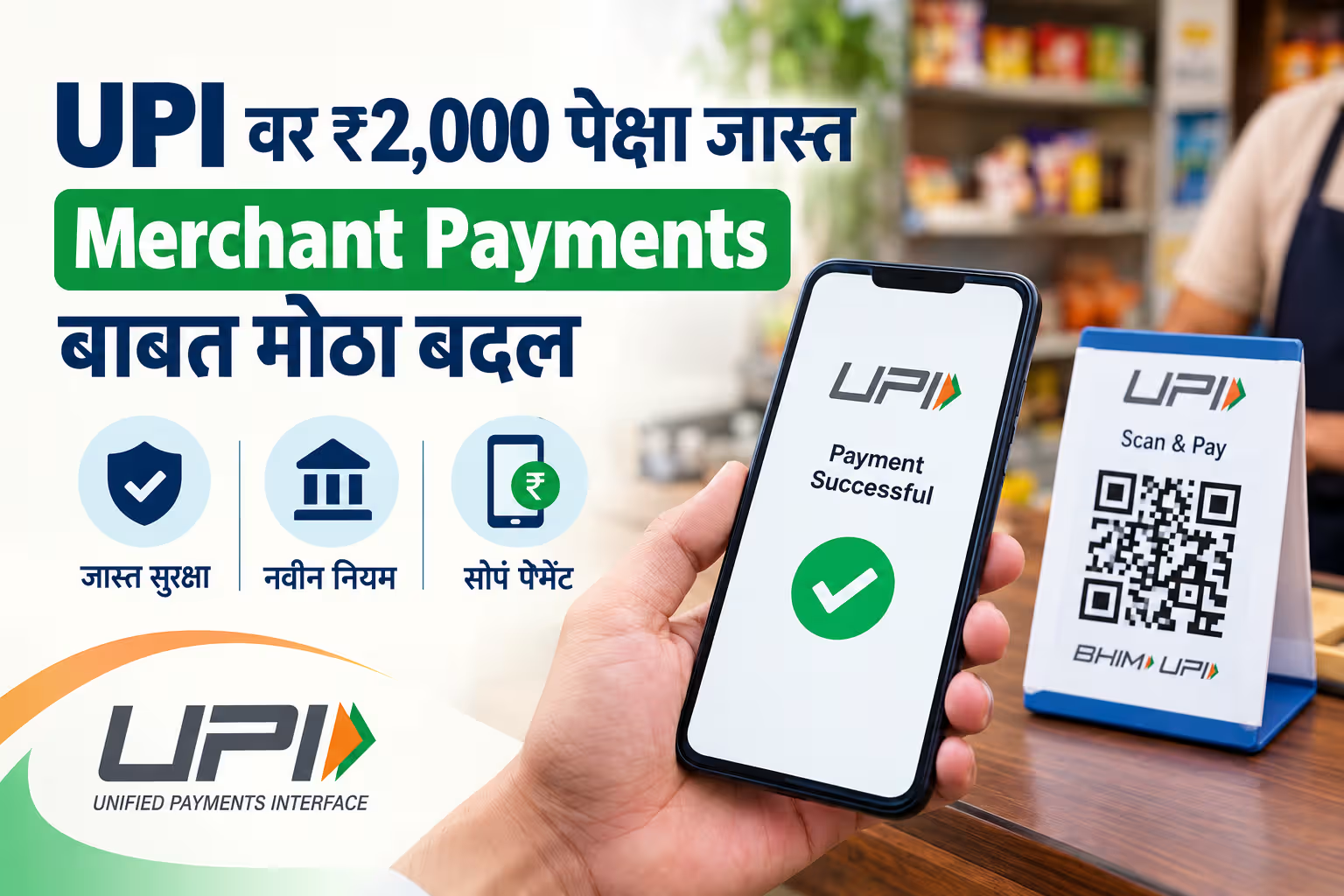
UPI charges above ₹2,000: UPI has become one of the most widely used payment methods in India because it is fast, convenient and, for users, generally free. From buying groceries and paying restaurant bills to purchasing electronics, booking services and transferring money, millions of Indians now use a UPI QR code or UPI-enabled app every day.
That convenience is now entering a new phase.
From October 15, 2026, a new Merchant Discount Rate (MDR) framework is scheduled to apply to specified UPI person-to-merchant (P2M) transactions above ₹2,000. Under the announced framework, the standard MDR is 0.4%, subject to specific exemptions, sector-specific rates and a maximum charge of ₹300 for transactions of ₹75,000 or more.
The most important point for ordinary UPI users is that this is not a blanket UPI charge on customers. Person-to-person UPI transactions remain free, and merchant payments up to ₹2,000 remain protected from charges. Small merchants covered by the zero-MDR provisions are also protected.
At the same time, the new framework is significant because it changes the economics of higher-value merchant UPI payments after years of zero-MDR treatment.
There is also an important legal development. On September 28, 2026, the Supreme Court declined to grant an interim stay on the new MDR framework while seeking responses from the Centre, RBI, NPCI and other parties in a challenge to the policy. Therefore, users and businesses should distinguish between the announced framework and any future changes that may result from the ongoing legal proceedings.
This article explains exactly what is changing, who may pay MDR, whether customers will be charged, how the ₹2,000 threshold works, what merchants should prepare for, and what UPI users should know before October 15.
What Is the New UPI ₹2,000 Rule?
The new framework introduces MDR on certain person-to-merchant UPI transactions above ₹2,000.
MDR stands for Merchant Discount Rate. It is a fee associated with processing a merchant payment and is part of the payment ecosystem rather than a conventional government tax.
Under the announced framework:
- UPI P2P payments remain free.
- UPI merchant payments up to ₹2,000 remain free.
- Specified merchant payments above ₹2,000 can attract MDR.
- The standard MDR rate is 0.4%.
- Transactions of ₹75,000 and above have an MDR ceiling of ₹300.
- Certain essential and thin-margin sectors have a flat ₹5 MDR for eligible transactions above ₹2,000.
- Certain capital-market transactions have a lower MDR of 0.02%, capped at ₹300.
- Eligible small merchants receiving up to ₹1 lakh per month through UPI QR under the specified P2PM category remain under zero MDR.
The framework is scheduled to begin on October 15, 2026.
This does not mean that every UPI payment above ₹2,000 will automatically result in a separate charge appearing on the customer’s screen.
The distinction between UPI user, merchant, bank, payment service provider, and payment application provider is therefore critical.
Why Is MDR Being Introduced for UPI?
For several years, UPI’s zero-MDR structure has supported rapid adoption of digital payments in India.
However, running a large-scale digital payment network involves costs.
These include:
- Payment infrastructure
- Banking technology
- Cybersecurity
- Fraud monitoring
- Transaction processing
- Customer support
- Network maintenance
- QR-code infrastructure
- Payment application operations
- Settlement and reconciliation
- Investments required to scale the ecosystem
The government has said the new framework is intended to support the long-term sustainability of the UPI ecosystem.
Under the new system, MDR is distributed among participants in the payment ecosystem rather than being treated as a government tax collected into the government treasury.
The policy therefore attempts to address a question that has become increasingly relevant as UPI transaction volumes have expanded: how should the infrastructure supporting India’s digital payment ecosystem be funded over the long term?
At the same time, the government has maintained protections for ordinary users and small merchants.
That is why the ₹2,000 threshold matters.
UPI MDR Explained in Simple Language
Suppose you purchase a product worth ₹10,000 from an eligible merchant and pay through UPI.
Under the announced standard MDR:
₹10,000 × 0.4% = ₹40
The ₹40 is the MDR associated with the merchant transaction.
This does not mean the customer should automatically be asked to pay ₹10,040.
The government’s framework states that MDR is a merchant-side payment ecosystem charge and that customers should not be made to pay it as a separate UPI charge.
Another example:
Example 1: ₹1,500 UPI merchant payment
You buy groceries worth ₹1,500.
Because the transaction is within the ₹2,000 threshold:
MDR = ₹0
Example 2: ₹5,000 UPI merchant payment
You purchase a product worth ₹5,000 from an eligible merchant.
At 0.4%:
₹5,000 × 0.4% = ₹20
Example 3: ₹10,000 payment
₹10,000 × 0.4% = ₹40
Example 4: ₹50,000 payment
₹50,000 × 0.4% = ₹200
Example 5: ₹1,00,000 payment
0.4% of ₹1,00,000 would normally be ₹400.
However, the framework provides a maximum MDR of ₹300 for transactions of ₹75,000 and above.
Therefore:
MDR = ₹300 maximum
This cap is particularly relevant for high-value merchant payments.
Will Customers Have to Pay UPI Charges?
This is one of the biggest questions surrounding the new UPI MDR framework.
The short answer is:
The announced MDR is not designed as a direct customer charge.
The government’s framework specifically states that customers are not supposed to bear the MDR.
Therefore, if you make an eligible ₹10,000 merchant payment through UPI, the existence of MDR does not mean you should automatically be asked to transfer ₹10,040.
However, consumers should still pay attention to the final amount shown before completing a transaction.
There is a practical reason for this.
MDR is a cost associated with the merchant’s payment acceptance ecosystem. Merchants may have their own pricing, billing and payment policies. The government has indicated that banks and payment providers should ensure the MDR is not passed on to customers as a UPI charge.
Consumers should therefore distinguish between:
UPI MDR:
A payment ecosystem cost associated with eligible merchant transactions.
Product/service price:
The amount charged by the merchant for what you are purchasing.
Customer-facing convenience or service charges:
Any separate amount that a merchant may display for reasons unrelated to the UPI MDR framework.
If a merchant asks you to pay an additional amount specifically because you selected UPI, check the displayed bill and the applicable payment rules rather than assuming that the new MDR automatically authorises such a charge.
Does the New Rule Apply to All UPI Transactions?
No.
This is perhaps the most important clarification.
The new framework distinguishes between person-to-person transactions and person-to-merchant transactions.
Person-to-Person UPI Payments
If you send money to another individual through UPI, the new MDR framework does not apply to that payment.
For example:
- Sending ₹5,000 to a friend
- Sending ₹25,000 to a family member
- Paying a friend back for dinner
- Transferring money between your own eligible accounts
These are not ordinary merchant purchases.
The government has specifically stated that P2P UPI transactions remain free regardless of the amount.
So a ₹20,000 UPI transfer to another individual does not suddenly become a ₹20,080 payment because of this MDR framework.
What About Person-to-Merchant Payments?
Person-to-merchant transactions are different.
A P2M payment occurs when an individual pays a business or merchant.
Examples include:
- Paying a restaurant
- Buying a television
- Paying an online retailer
- Purchasing furniture
- Paying a hotel
- Paying a service provider
- Making an eligible merchant purchase through a QR code
For specified P2M transactions above ₹2,000, MDR may apply from October 15.
That distinction is central to understanding the new UPI rules.
UPI Payment Charges: What Remains Free?
Several categories remain protected.
1. P2P UPI payments
Person-to-person UPI transactions remain free regardless of transaction amount.
2. Merchant payments up to ₹2,000
P2M UPI payments up to ₹2,000 remain free of MDR under the protected framework.
3. Eligible small merchants
Small merchants receiving up to ₹1 lakh per month through UPI QR under the specified P2PM category continue to receive zero-MDR protection.
This is particularly relevant for:
- Street vendors
- Small neighbourhood shops
- Small local businesses
- Informal retailers
- Micro-businesses using QR payments
The purpose is to avoid imposing a new payment cost on the smallest businesses.
Who Is Most Likely to Feel the Impact?
The change is more relevant to businesses that regularly receive high-value UPI payments.
These may include:
- Electronics retailers
- Furniture stores
- Automobile-related businesses
- Large restaurants
- Hotels
- E-commerce businesses
- Professional service providers
- Large retail chains
- Businesses receiving high-value invoices
- Merchants whose monthly UPI receipts exceed the small-merchant threshold
The actual impact will depend on the merchant category, transaction value, monthly UPI receipts, applicable exemptions and how the merchant’s acquiring/payment arrangement is structured.
For a business that receives hundreds or thousands of high-value UPI payments, even a small percentage-based MDR can become a meaningful operating expense.
For a small vendor receiving modest UPI payments, the impact can be very different because of the exemption framework.
How Much Is 0.4% MDR?
A percentage can sound small until it is applied repeatedly.
Here is a simple illustration:
| Payment Amount | 0.4% MDR |
|---|---|
| ₹2,500 | ₹10 |
| ₹5,000 | ₹20 |
| ₹10,000 | ₹40 |
| ₹20,000 | ₹80 |
| ₹50,000 | ₹200 |
| ₹75,000 | ₹300 |
| ₹1,00,000 | ₹300 cap |
| ₹2,00,000 | ₹300 cap |
The table demonstrates why the ₹75,000 threshold is significant.
Once an eligible transaction reaches ₹75,000, the standard percentage calculation would exceed ₹300, but the framework limits the MDR to ₹300.
Special ₹5 MDR for Certain Essential Sectors
The standard 0.4% MDR does not apply identically across every category.
The framework provides a flat ₹5 MDR for eligible transactions above ₹2,000 in certain essential or thin-margin sectors.
These include categories such as:
- Railways
- Telecommunications
- Insurance
- Fuel
- Agricultural inputs
This approach is designed to provide more predictable payment costs in sectors where margins may be relatively narrow or where digital payments have broader public-service implications.
For example, if an eligible fuel transaction above ₹2,000 falls under the applicable special category, the MDR would be ₹5 rather than 0.4% of the entire transaction.
This is an important reason not to assume that every ₹10,000 UPI merchant transaction will automatically attract a ₹40 MDR.
The merchant category matters.
What About UPI Payments for Mutual Funds and Stocks?
Capital-market transactions have a separate rate under the framework.
Payments relating to categories such as:
- Mutual funds
- Securities
- Stockbrokers
- Dealers
are subject to an MDR rate of 0.02%, with a maximum of ₹300 per transaction under the announced framework.
For example, on a ₹50,000 eligible capital-market payment:
₹50,000 × 0.02% = ₹10
This is substantially different from the standard 0.4% merchant rate.
Again, classification is important.
Consumers should not assume that every payment made through a UPI-enabled platform falls into the ordinary merchant category.
Why the ₹2,000 Threshold Matters
The ₹2,000 threshold serves two different purposes.
First, it preserves free UPI payments for a large part of everyday retail activity.
Think about common transactions such as:
- Tea and snacks
- Local grocery purchases
- Small restaurant bills
- Pharmacy purchases
- Auto-rickshaw fares
- Small household purchases
- Local service payments
Many of these transactions fall below ₹2,000.
Second, the threshold separates everyday low-value transactions from larger merchant payments where the payment ecosystem may have a different cost structure.
The government has stated that approximately 96% of P2M transactions remain unaffected by the framework.
That figure is important, but readers should understand what it means.
It does not mean that 96% of all UPI money is unaffected in exactly the same way. It refers to the government’s stated assessment of P2M transaction coverage.
What Is MDR and Why Is It Different From a Tax?
MDR stands for Merchant Discount Rate.
It is a payment processing fee associated with accepting digital payments.
A simplified payment ecosystem can involve:
Customer → UPI app/payment provider → bank/payment network → merchant bank → merchant
Different participants may perform different roles in authorising, routing, processing and settling a transaction.
MDR is part of the economics of that system.
The government has clarified that the new MDR is not a tax collected by the government.
This distinction matters because consumers often see the word “charge” and assume that the government is imposing a transaction tax.
That is not the stated structure.
The MDR is intended to be distributed among payment ecosystem participants.
Why Is the Government Protecting Small Merchants?
India’s UPI ecosystem includes businesses ranging from large online marketplaces to roadside vendors.
A uniform percentage charge could affect these businesses very differently.
For a large retailer, a small transaction-processing expense may be absorbed into operating costs.
For a street vendor selling low-value goods, payment costs can have a much larger effect relative to the value of individual sales.
The framework therefore provides special protection for eligible small merchants receiving up to ₹1 lakh per month through UPI QR under the relevant category.
This is intended to preserve the low-cost nature of QR-based digital payments for smaller businesses.
What Should Merchants Do Before October 15?
Businesses should not wait until the implementation date to understand their payment arrangements.
A merchant can take several practical steps.
1. Identify Your UPI Transaction Category
Ask your acquiring bank or payment service provider:
- How is my business classified?
- Will my transactions fall under P2M MDR?
- Am I covered by the small-merchant exemption?
- Does my industry have a special ₹5 rate?
- What settlement charges will apply?
- How will MDR appear in my settlement report?
Classification can affect the actual cost.
2. Review Monthly UPI Collections
Look at the previous three to six months.
Calculate:
- Total UPI receipts
- Number of transactions
- Average transaction size
- Number of transactions above ₹2,000
- Number above ₹75,000
- Industry/category classification
This will give you a rough idea of how relevant the new MDR framework could be to your business.
3. Review Your Payment Provider Agreement
Payment aggregators and other service providers may provide revised settlement statements or merchant dashboards.
Read the updated terms carefully.
Look for:
- MDR
- Settlement deductions
- GST, where applicable
- Category-specific rates
- Refund treatment
- Chargeback treatment
- Settlement timing
Do not rely solely on a WhatsApp message or verbal explanation from a salesperson.
4. Keep Accounting Records
From October onward, merchants should separately track payment processing costs in their accounting system.
This will help with:
- Reconciliation
- Profit analysis
- GST/accounting treatment
- Vendor reporting
- Cash-flow management
- Payment-channel comparisons
5. Do Not Automatically Add MDR to Customer Bills
The government’s framework is designed around a merchant-side MDR rather than a separate customer UPI fee.
Businesses should therefore understand the applicable rules before adding a “UPI charge” to invoices.
What Should UPI Users Do?
For consumers, the practical steps are relatively simple.
Check the final amount
Before entering your UPI PIN, confirm the amount shown by the merchant or payment interface.
Know the difference between P2P and P2M
Sending money to a person is different from paying a registered merchant.
Do not panic about the ₹2,000 threshold
The new framework does not mean that UPI suddenly becomes a paid service for every transaction above ₹2,000.
It concerns specified merchant transactions.
Keep your UPI app updated
Use the official version of your bank or payment application and keep security features enabled.
Do not share your UPI PIN
MDR changes do not alter basic UPI security rules.
Your UPI PIN should never be shared with a merchant, caller, delivery agent or supposed customer-service representative.
What Happens If a Merchant Says “UPI Has a Charge Now”?
This situation could become more common as the implementation date approaches.
The correct response is to ask:
“Is this a merchant-side MDR or are you charging me an additional amount?”
If the merchant is referring to MDR, remember that the framework is not structured as a blanket customer fee.
Ask for the final invoice amount.
For example:
Product price: ₹10,000
If the merchant says:
“UPI charge: ₹40”
that should not automatically be treated as a normal consequence of the MDR framework.
The customer should understand what the additional amount represents and whether it is permitted under the applicable rules.
Will UPI Become Less Attractive for Merchants?
The answer may differ from business to business.
A merchant accepting many large-value UPI payments could see higher payment-processing costs.
That could encourage businesses to reassess their payment mix.
Some merchants may continue to prefer UPI because it offers:
- Fast settlement
- Customer convenience
- Easy QR acceptance
- Digital transaction records
- Lower cash-handling requirements
- Wider customer reach
Others may compare UPI costs with:
- Debit cards
- Credit cards
- Bank transfers
- Payment gateways
- Cash
The new MDR therefore creates a new cost consideration rather than necessarily making UPI unsuitable for merchants.
Could This Affect Digital Payment Adoption?
This is one of the major questions surrounding the policy.
There are two competing considerations.
On one side, payment infrastructure requires continuous investment.
A sustainable payment ecosystem needs:
- Reliable uptime
- Cybersecurity
- Fraud prevention
- Technology upgrades
- Customer support
- Banking infrastructure
On the other side, one of UPI’s strongest advantages has been its low cost to users and merchants.
If merchants perceive digital payments as increasingly expensive, some may reconsider which payment methods they encourage.
The actual long-term effect will depend on how merchants respond, how payment providers implement the framework, whether costs are absorbed within business operations, and how customers respond.
It is therefore too early to treat any particular future outcome as certain.
Supreme Court Case: What Is the Current Status?
The new MDR framework has also become the subject of a legal challenge.
A petition was filed in the Supreme Court questioning the introduction of MDR on specified UPI merchant transactions above ₹2,000.
On September 28, 2026, the Supreme Court declined to grant an interim stay on the new framework.
The Court also sought responses from the Centre, RBI, NPCI and other parties concerning the challenge.
This means the legal issue has not simply disappeared.
For readers, the practical takeaway is:
October 15 remains the announced implementation date, but the framework is also subject to ongoing judicial proceedings.
Anyone publishing information about UPI charges should therefore avoid presenting the framework as completely beyond legal challenge.
Businesses should monitor official notifications and updates from their banks or payment providers as the implementation date approaches.
What the Supreme Court Development Means for Users
The September 28 development does not mean that the Supreme Court has issued a final ruling approving every aspect of the MDR framework.
The court declined an interim stay while seeking responses.
That distinction is important.
A court refusing interim relief is not necessarily the same thing as a final judgment resolving every legal question.
Therefore, users should be cautious about social-media posts claiming either:
- “The Supreme Court cancelled UPI charges,” or
- “The Supreme Court permanently approved UPI charges.”
Neither description accurately captures the current procedural position.
The better description is that the court did not grant an interim stay and has sought responses in the ongoing challenge.
Common Misunderstandings About the New UPI Rule
Myth 1: Every UPI payment above ₹2,000 will cost extra
Not necessarily.
The framework applies to specified merchant transactions, with exemptions and special categories.
P2P transactions remain free.
Myth 2: Customers must pay 0.4% MDR
No.
The announced MDR is structured as a merchant-side payment ecosystem charge.
Myth 3: The government is collecting 0.4% as tax
No.
The government has stated that MDR is not a government tax and is distributed among payment ecosystem participants.
Myth 4: Small street vendors will automatically pay MDR
Not necessarily.
Eligible small merchants receiving up to ₹1 lakh per month through UPI QR under the relevant category remain protected by zero-MDR provisions.
Myth 5: A ₹75,000 payment means MDR is ₹300 plus another 0.4%
The framework provides a cap of ₹300 for transactions of ₹75,000 and above under the standard MDR structure.
Myth 6: UPI itself is becoming a paid service
That is an oversimplification.
The change concerns MDR on specified merchant transactions. It does not turn all UPI transactions into paid transactions.
UPI ₹2,000 Rule: Practical Examples
Let’s look at everyday scenarios.
Scenario 1: Paying ₹800 at a restaurant
You pay ₹800 using UPI.
MDR: ₹0 under the ₹2,000 threshold.
Scenario 2: Paying ₹2,000 at a shop
You pay exactly ₹2,000.
MDR: ₹0 under the protected threshold.
Scenario 3: Paying ₹2,500
If the transaction falls under the standard eligible P2M category:
0.4% of ₹2,500 = ₹10
This is an MDR associated with the merchant-side payment ecosystem.
Scenario 4: Paying ₹15,000 for furniture
Standard eligible MDR:
₹15,000 × 0.4% = ₹60
The customer is not supposed to automatically pay ₹15,060 merely because the merchant incurs MDR.
Scenario 5: Paying ₹80,000
0.4% would equal ₹320.
But the ₹300 cap applies to transactions at or above ₹75,000 under the standard structure.
Therefore:
Maximum MDR = ₹300
Scenario 6: Paying ₹3,000 for an eligible essential-sector service
If the transaction belongs to one of the specified essential-sector categories covered by the flat-rate provision:
MDR = ₹5
The standard 0.4% calculation would not be the applicable rate in that category.
How Businesses Can Reduce Payment-Cost Confusion
The objective should not simply be to minimise every payment cost.
Businesses should first understand their total payment economics.
For each payment channel, compare:
- Processing fee
- Settlement time
- Refund cost
- Reconciliation effort
- Customer convenience
- Fraud exposure
- Infrastructure requirements
- Accounting complexity
A payment method with a slightly higher processing cost may still be commercially useful if it generates faster sales or improves customer conversion.
For merchants, the right question is therefore not:
“Is UPI free?”
It is:
“What is the total cost and operational benefit of accepting UPI for my business?”
That is a much more useful business question after the MDR framework takes effect.
What Payment Providers Need to Communicate Clearly
Payment companies and banks have an important role in reducing confusion.
Merchant dashboards should ideally make it clear:
- Which transaction attracted MDR
- Applicable rate
- MDR amount
- Any applicable cap
- Merchant category
- Settlement amount
- Any other applicable deduction
Clear reporting will be particularly important for businesses with large transaction volumes.
If a merchant cannot understand why a particular amount was deducted from settlement, reconciliation becomes difficult.
Transparent reporting can therefore be almost as important as the rate itself.
What Should Consumers Watch for After October 15?
The most important consumer issue is not whether UPI itself remains useful.
It is whether customers encounter unexpected payment-related charges.
Before completing a high-value merchant transaction:
- Check the bill.
- Check the amount displayed in the UPI app.
- Confirm that the recipient is correct.
- Never share your UPI PIN.
- Do not approve an unexpected collect request.
- Keep the transaction confirmation.
- If an additional charge appears, ask what it represents.
A basic rule remains useful:
Never enter your UPI PIN until you have verified the transaction amount and recipient.
What Could Change in the Future?
The UPI payment ecosystem is likely to continue evolving.
Potential areas of change include:
- Merchant pricing models
- Payment infrastructure funding
- Fraud-prevention technology
- QR payment standards
- Cross-border UPI payments
- Credit-linked UPI products
- Bank and fintech partnerships
- Merchant settlement systems
- Payment authentication
- Regulatory oversight
The introduction of MDR for selected high-value merchant transactions represents one part of that larger evolution.
The policy will also provide more information about how India’s payment ecosystem balances consumer affordability, merchant economics and infrastructure sustainability.
A Simple Checklist for UPI Users
Before October 15, remember these points:
If you send money to another person
UPI remains free.
If you pay a merchant up to ₹2,000
The protected framework keeps such payments free of MDR.
If you pay an eligible merchant more than ₹2,000
The merchant-side MDR framework may apply.
If you pay ₹75,000 or more
The standard MDR is subject to the ₹300 cap.
If you pay in a specified essential sector
A flat ₹5 MDR may apply to eligible transactions above ₹2,000.
If you make a capital-market payment
The separate 0.02% MDR structure may apply, subject to the applicable cap and classification.
If you are a small merchant
Check whether you fall within the ₹1 lakh monthly UPI QR receipt exemption.
Frequently Asked Questions About UPI Charges Above ₹2,000
1. Will UPI payments above ₹2,000 become chargeable from October 15, 2026?
Specified person-to-merchant UPI transactions above ₹2,000 are scheduled to attract MDR from October 15, 2026. The standard rate is 0.4%, subject to exemptions, special categories and the applicable cap.
2. Will customers have to pay the 0.4% UPI charge?
The announced framework treats MDR as a merchant-side payment ecosystem charge. Customers are not supposed to be directly charged the MDR merely because they use UPI.
3. Is there any charge on UPI person-to-person transfers?
No. The government has stated that P2P UPI transactions remain free irrespective of the amount transferred.
4. Are UPI payments up to ₹2,000 still free?
Yes. The government has specifically protected UPI transactions up to ₹2,000 from direct or indirect charges by banks and system providers under the notified framework.
5. What is the maximum MDR on a UPI transaction?
For standard eligible merchant transactions, MDR is 0.4%, with a maximum of ₹300 for transactions of ₹75,000 and above.
6. Do small merchants have to pay MDR?
Eligible small merchants receiving up to ₹1 lakh per month through UPI QR under the specified P2PM category remain under zero MDR.
7. Is UPI MDR a government tax?
No. The government has described MDR as a payment ecosystem charge rather than a tax collected by the government.
8. Has the Supreme Court cancelled the new UPI MDR?
No. On September 28, 2026, the Supreme Court declined to grant an interim stay and sought responses from the relevant authorities in a legal challenge. The matter remains subject to the ongoing proceedings.
UPI MDR and the Future of Digital Payments in India
The significance of the new framework goes beyond a 0.4% number.
UPI became successful partly because its pricing structure encouraged both merchants and consumers to adopt digital payments. QR codes made payment acceptance possible even for businesses that previously had limited access to card infrastructure.
The new MDR framework introduces a different economic model for selected higher-value merchant transactions.
That creates a balancing act.
Consumers want:
- Simple payments
- No unexpected fees
- Strong security
- Fast transactions
Merchants want:
- Low processing costs
- Reliable settlement
- Easy reconciliation
- Fraud protection
- Customer convenience
Banks and payment companies need:
- Sustainable infrastructure
- Cybersecurity investment
- Reliable transaction processing
- Operational funding
Regulators need to consider all three sides.
The success of the new framework will therefore depend not only on the headline MDR rate but also on how the rules are implemented, communicated and experienced by businesses and customers.
Final Takeaway: What You Really Need to Know
The new UPI MDR framework does not mean that UPI is becoming a paid service for everyone.
The important changes are more specific.
From October 15, 2026, specified UPI merchant payments above ₹2,000 are scheduled to attract MDR.
The standard rate is 0.4%, while transactions of ₹75,000 and above are subject to a ₹300 cap.
Certain essential sectors have a flat ₹5 rate, while eligible capital-market transactions have a 0.02% rate capped at ₹300.
At the same time, P2P UPI transactions remain free, merchant payments up to ₹2,000 remain protected, and eligible small merchants receiving up to ₹1 lakh per month through UPI QR continue to receive zero-MDR protection.
For consumers, the most important point is that the MDR is designed as a merchant-side payment ecosystem charge, not as a blanket fee that customers must pay whenever they use UPI.
For merchants, however, the change deserves closer attention. Businesses that receive large numbers of high-value UPI payments should review their transaction categories, payment-provider agreements, settlement statements and accounting processes before the October 15 implementation date.
The Supreme Court’s September 28 proceedings also mean that the legal position should be monitored as the case develops.
For now, the safest approach is simple: understand whether a payment is P2P or P2M, check the applicable category, verify the final amount before approving a transaction, and rely on official updates rather than social-media rumours.
If you are a merchant, speak with your bank or payment service provider before October 15 and confirm exactly how the MDR framework applies to your business.
If you are a consumer, there is no need to stop using UPI simply because of the new framework. Instead, understand what the rule actually covers and always verify the amount displayed before entering your UPI PIN.
Mutual Fund Myths 2026: SIP vs FD – Truths They Don’t Tell You
Share this content:

Related Posts

Post Comment